

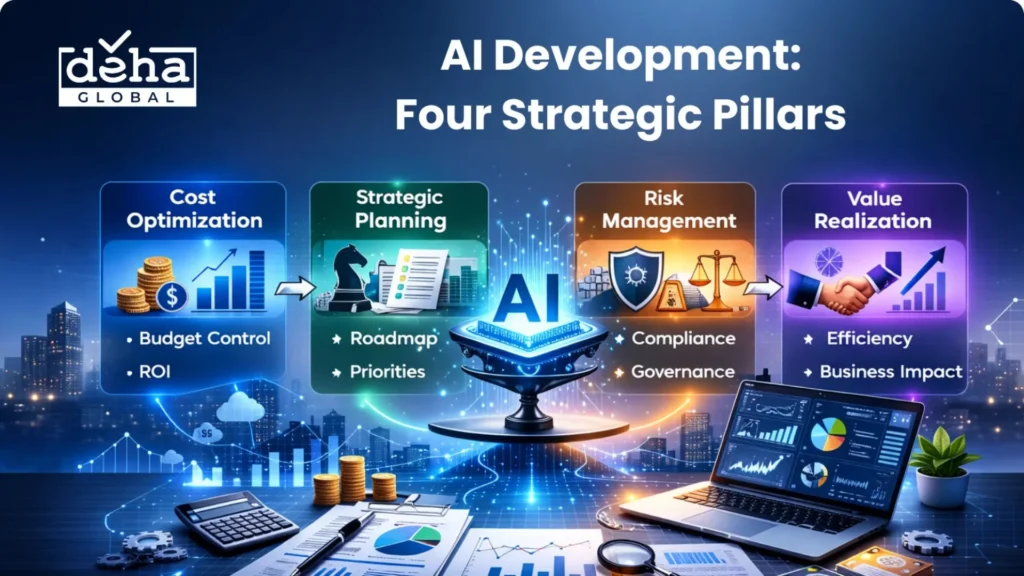
AI continues to accelerate across global enterprises as organizations pursue automation, innovation, and competitive differentiation through AI development. At the same time, rising AI cost has become a primary concern for CFOs as technology budgets expand and financial pressures grow, creating an imbalance between innovation potential and fiscal discipline.
In this article, we outline four strategic pillars that help CFOs manage AI investment costs effectively while ensuring long-term growth and sustainable value.
The Rising AI Cost Challenge in Enterprise AI Development
Enterprises are increasingly required to allocate significant investment toward AI technologies, infrastructure, and operational support, leading to rising expenditures that challenge traditional budget models. As organizations scale AI initiatives from pilot phases to full production usage, these accelerated costs create pressure on finance teams to reconcile growth ambitions with financial sustainability. The high-cost environment of 2024–2026 forces CFOs and business leaders to confront challenges that impact both short-term budgets and long-term enterprise strategy.
Key Challenges Impacting Cost in AI Development:
- Infrastructure and Compute Expenses: High-performance computing for AI models, especially cloud GPU usage and training environments, significantly drives up AI cost as workloads grow. This impacts budget predictability and decision-making for finance teams.
- Data Preparation and Management Overheads: The need for large volumes of high-quality data drives up costs in data cleaning, storage, and pipeline maintenance, which can consume a disproportionate share of AI budgets.
- Talent Acquisition and Retention Costs: Recruiting and retaining skilled AI professionals (e.g., data scientists, ML engineers) remains expensive, particularly in competitive markets, pressuring total development spending.
- Cloud and Platform Spending Growth: Public cloud services absorb a large portion of AI budgets, with costs rising as enterprises scale computing and data resources for AI workloads.
- Lack of Clear Financial Governance: Without structured cost control mechanisms, AI initiatives risk budget overruns and misalignment with business goals, complicating fiscal oversight and ROI measurement.
Four Pillars to Assist CFOs in Balancing AI Investment Costs
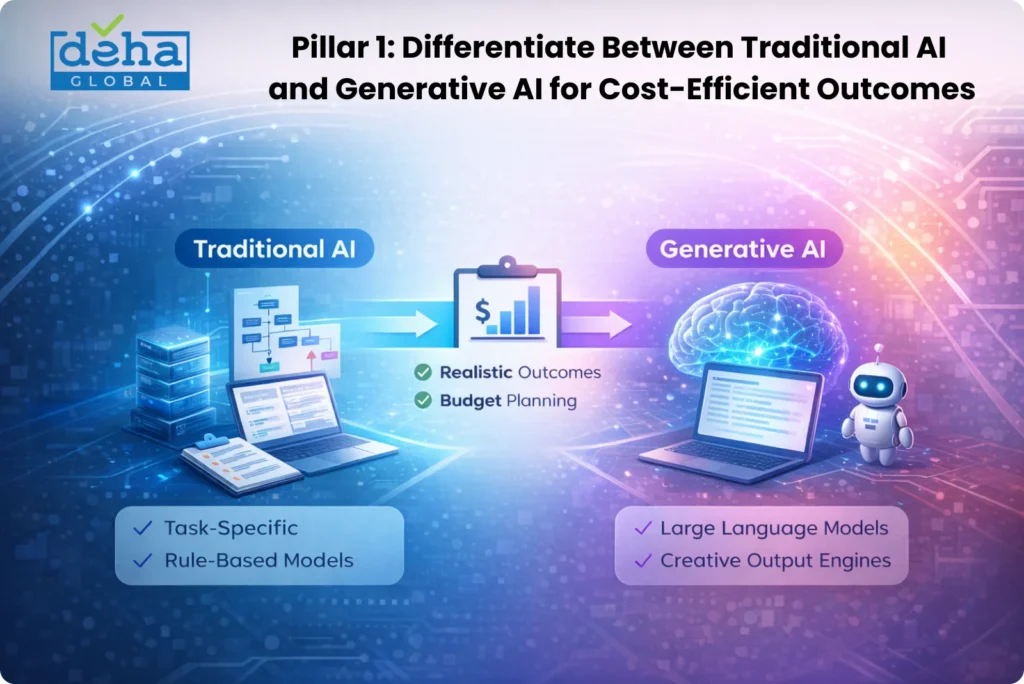
Pillar 1 — Differentiate Between Traditional AI and Generative AI for Cost-Efficient Outcomes
This pillar emphasizes the importance of recognizing the differences between traditional AI systems (task-specific, rule-based models) and modern generative AI (large language models and creative output engines) to help CFOs align cost expectations with realistic outcomes. Understanding this distinction is key to budgeting and planning effectively.
Core Financial Objective
The primary financial goal is to optimize return on AI investments by prioritizing cost-effective technologies where possible and reserving higher investment for strategic use cases where value creation justifies the expense. This helps avoid overspending on expensive AI infrastructures where simpler automation would suffice.
Primary Cost Drivers
Compute costs (for training/inference), licensing fees for proprietary models, and data requirements for generative workflows tend to be the largest drivers in this pillar, particularly for high-volume, high-complexity AI systems.
Risk Mitigation Strategy
CFOs should guard against over-committing to generative capabilities before understanding their cost implications and business value. As a result, performing early cost-benefit evaluations and aligning model selection with expected outcomes reduces exposure to runaway costs.
Key Implementation Actions
- Classify AI use cases by expected value and cost intensity before selecting technology stacks.
- Use pilot projects to validate cost assumptions before scaling expensive generative systems.
- Integrate cloud cost management (FinOps) practices to allocate resources appropriately.
ROI & Success Metrics
- Cost per outcome (e.g., cost per generated asset vs. manual alternative).
- Budget variance against projected compute and licensing costs.
- Time to value (how quickly cost savings or revenue gains are realized).
Pillar 2 — Strengthen Governance to Prevent AI Cost Overruns
Building strong governance structures ensures that AI investments are transparent, accountable, and aligned with corporate financial goals. Governance is a strategic capability that controls spending while enabling innovation.
Core Financial Objective
The primary goal is to prevent budget overruns and financial leakage by ensuring AI spending is tracked, approved, and benchmarked against business objectives rather than ad hoc development.
Primary Cost Drivers
Costs can escalate due to uncontrolled cloud consumption, unmonitored model retraining, shadow AI projects, and a lack of centralized tracking across departments.
Risk Mitigation Strategy
Without governance, organizations risk unpredictable AI expenses and loss of control over AI resource allocation. In order to mitigate these risks, CFOs should establish clear policies, cost ownership, and regular audits to maintain accountability.
Key Implementation Actions
- Establish an AI spending policy with approval workflows and budget limits.
- Use cost allocation tags and dashboards for real-time monitoring.
- Integrate governance checkpoints at key project lifecycle stages.
ROI & Success Metrics
- The frequency of budget overruns reduced over time.
- Percentage of AI projects adhering to governance standards.
- Predictive accuracy of cost forecasts relative to actual spend.
Pillar 3 — Invest in the Right People, Technologies, and Systems
This pillar focuses on aligning talent, system architecture, and technological tools with cost strategy so that AI capabilities scale without disproportionate increases in spend.

Core Financial Objective
The goal is to balance human resources and technology investments to maximize value while minimizing inefficiencies related to skills gaps and suboptimal tooling.
Primary Cost Drivers
Talent acquisition and retention, technology licensing, and integration costs are the most significant drivers here, particularly when AI jobs outpace supply and premium skills command high salaries.
Risk Mitigation Strategy
Overinvestment in expensive talent or tools without a clear productivity impact can erode ROI. As a result, CFOs should prioritize building blended teams (internal and external expertise) and scalable technology stacks that meet business needs without excess cost.
Key Implementation Actions
- Conduct skills gap assessments to inform hiring vs outsourcing decisions.
- Choose modular, interoperable systems that reduce integration overhead.
- Align technology investments with business units that will directly benefit from AI improvements.
ROI & Success Metrics
- Productivity improvements (e.g., work completed per labor dollar).
- Reduction in time-to-deployment for new models.
- Lower total cost of ownership for AI tools over time.
Pillar 4 — Adopt a Phased Deployment Strategy to Control Spending
A phased approach emphasizes gradual rollout—from pilot to scaled implementation—ensuring practical validation before committing large budgets.
Core Financial Objective
The objective is to manage financial risk and drive predictable ROI by confirming value at each stage before expanding investment commitments.
Primary Cost Drivers
Early infrastructure investment, pilot experiment costs, and iterative testing can drive spending if not carefully managed; however, controlled phasing reveals cost patterns early for better forecasting.
Risk Mitigation Strategy
Jumping into full deployment without phased validation can lead to costly mistakes and underperforming systems. In order to reduce these risks, teams should set clear success criteria for each stage and use pilot results to refine budgets.
Key Implementation Actions
- Define pilot success metrics and investment thresholds upfront.
- Secure cross-functional governance for go/no-go decisions.
- Use learnings from early phases to refine scope and cost models.
ROI & Success Metrics
- Percentage of pilots that meet or exceed ROI targets.
- Budget accuracy from pilot forecasting vs actual deployment spend.
- Speed and cost reduction when scaling based on validated pilots.
Tips for Optimizing AI Investment Costs Efficiently
As enterprises face mounting costs associated with AI initiatives, CFOs can implement strategic actions that improve cost efficiency while still unlocking value. The following tips focus on practical approaches to help finance leaders manage AI development spend with clarity and purpose.
- Comprehensive Cost Attribution: Establish detailed cost tracking across AI projects to identify where spending occurs and align budgets with measurable business outcomes. This visibility enables CFOs to pinpoint inefficiencies and ensure spend supports strategic priorities.
- Hybrid Infrastructure Strategy: Adopt a mix of public cloud, private cloud, or on-premises resources to optimize infrastructure spending. By balancing scalable cloud options with cost-controlled environments, organizations can reduce unnecessary compute expenses.
- Leverage Pre-Trained Models: Use pre-trained and open-source models where appropriate to lower development and training costs. These models often reduce compute time and data requirements compared to fully custom model builds, enhancing budget efficiency.
- Incremental Deployment Approach: Pilot AI use cases incrementally before scaling to enterprise production to validate ROI and avoid high upfront costs. This phased approach helps CFOs manage risk and adjust investment based on real outcomes.
- Automate Cost Monitoring: Implement automated tools and dashboards that alert teams when AI spending diverges from budget thresholds. Real-time monitoring helps anticipate cost spikes and enables proactive adjustments.
- Cross-Disciplinary Planning: Encourage collaboration between finance, IT, and business units to align expectations and share accountability for AI cost and performance. This unified planning reduces duplication of effort and enhances financial discipline.
In Conclusion
AI development offers transformative potential, but managing AI cost effectively remains a central challenge for enterprise finance leaders. By applying four strategic pillars—differentiating between AI technologies, strengthening governance, investing in the right talent and systems, and adopting phased deployment—CFOs can align AI investments with financial discipline and measurable outcomes. As a result, CFOs should combine strategic oversight with practical cost controls to ensure AI development delivers sustainable value without eroding budgets.