


Enterprises worldwide are accelerating their adoption of advanced technologies, with AI development now a central element of digital transformation and operational innovation. Yet, the escalating AI cost, driven by token usage, compute infrastructure, and talent investment, is raising questions about sustainable investment and value realization.
This article examines actionable cost optimization strategies that help leaders manage AI expenses while preserving long-term growth potential.
The Importance of Cost Visibility in AI
Understanding where and how money is spent in AI systems is foundational to effective cost management and optimization. The unique dimensions of AI workloads demand real-time cost visibility, as traditional cloud monitoring tools are often insufficient.
The main cost dimensions and their impact:
| Cost Dimension | Why It’s Important | Key Metrics to Track |
| Token Consumption | AI APIs are typically billed per token, so inefficient prompts or high output significantly drive up spend without adding corresponding business value. | Input tokens, output tokens, tokens per feature/endpoint. |
| GPU/TPU Utilization | Compute accelerators are costly, and idle or under-utilized resources that waste budget; high utilization aligns spending with performance needs. | Instance hours, saturation %, memory usage, provisioned vs. active GPU usage. |
| Provisioned Throughput / Reserved Capacity | Unused provisioned capacity becomes a sunk cost; tracking usage rates helps right-size infrastructure. | Utilization ratio, effective hourly rates, reserved vs. actual throughput. |
| Model Invocation Performance | Slow endpoints, errors, or retries can inflate cost via repeated token use and unnecessary compute cycles. | Latency (P50/P95/P99), error, and retry rates. |
| Multi-Tenant Cost Allocation | Without proper tagging and segmentation, shared AI resources obfuscate accountability and make it difficult to allocate costs by project or team. | Requests tagged by tenant/feature, cost allocation by project/team. |
Cost visibility enables teams to spot inefficiencies early and enact targeted interventions before AI cost spikes escalate out of control.
Core Components of AI Development Costs
AI development involves several core cost factors that enterprises must understand to budget and optimize effectively. Each of these components contributes distinctly to total expenses and impacts of financial planning for scalable AI systems.
Key Cost Factors in AI Development:
- Token Pricing & Model Invocation: Most AI APIs charge based on the number of tokens processed — including both input and output — which means costs scale directly with usage volume and model complexity.
- Cloud Provider Pricing Tiers: Different cloud and model families (e.g., standard vs. premium tiers) have varied price structures, so choosing the right pricing plan influences long-term spending.
- Infrastructure Costs: Compute resources (such as GPUs or TPUs), storage, and network throughput constitute the backbone of AI operations, and their provisioning, especially for large-scale systems, forms a substantive part of the budget.
By understanding these core cost drivers, enterprises can more accurately forecast budgets and identify opportunities to control spending as AI adoption grows.
Cost Optimization Strategies for Sustainable AI Development
1. Smart Model Routing
Intelligent model routing allows enterprises to direct requests to different models based on task complexity, business priority, and required accuracy. Instead of defaulting to a high-cost, large-scale model for every request, organizations can dynamically select lightweight models for routine tasks and reserve advanced models for high-value reasoning scenarios.
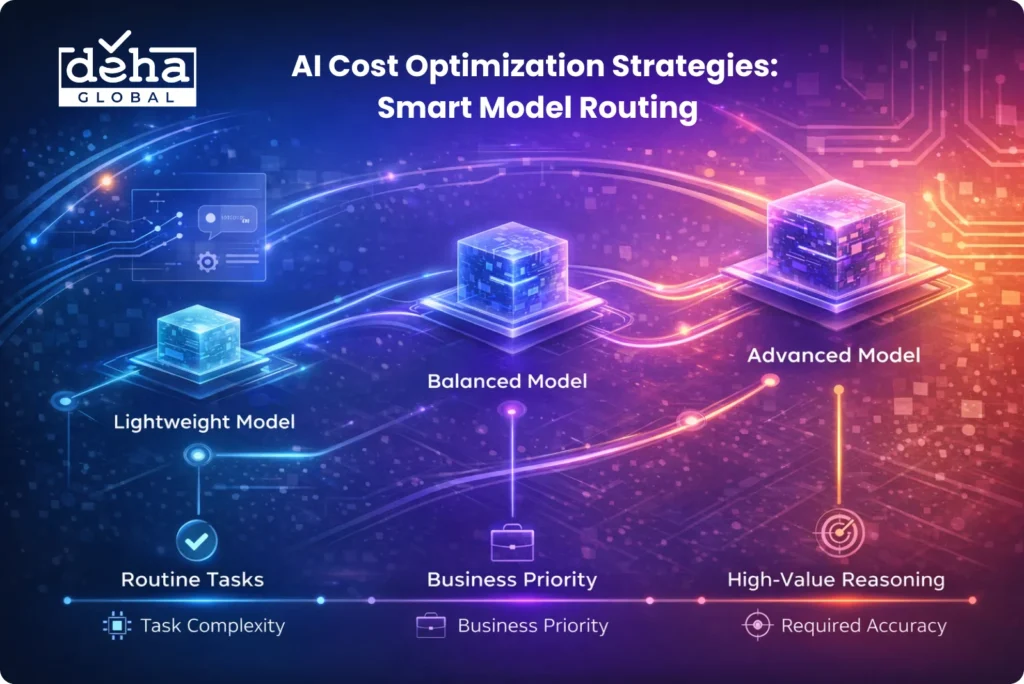
To implement this strategy effectively, teams should:
- Classify use cases into simple, moderate, and complex workloads.
- Build a routing logic layer that automatically assigns the most cost-efficient model.
- Monitor cost per request to continuously refine routing rules.
This approach reduces unnecessary compute consumption and flattens AI development cost growth as usage scales, ensuring infrastructure spend increases proportionally with business value rather than model size.
2. Token-Optimized Prompt Engineering
Token usage directly impacts AI development cost because most APIs charge per input and output token processed. Inefficient prompts, redundant instructions, and overly verbose outputs significantly inflate expenses without delivering proportional value.
Organizations can optimize prompt design by:
- Removing repetitive instructions and compressing context.
- Setting clear output limits to prevent excessive responses.
- Standardizing prompt templates across teams.
Refined prompt engineering shortens interaction cycles and reduces token waste, which directly lowers operational AI cost, especially in high-volume generative workflows.
3. Unified Cost Telemetry Systems
Centralized telemetry pipelines provide real-time visibility into token usage, GPU utilization, latency, and billing metrics across AI systems. Without this centralized oversight, cost anomalies often go undetected until invoices arrive, making reactive control difficult.
To follow this strategy, enterprises should:
- Aggregate usage data from APIs, infrastructure, and applications into a unified dashboard.
- Set automated alerts for abnormal cost spikes.
- Integrate cost metrics into DevOps and FinOps workflows.
Granular telemetry enables proactive cost management, helping finance and engineering teams prevent runaway spend and maintain disciplined AI development practices.
4. Efficient RAG Architecture Design
Retrieval Augmented Generation architectures often increase token usage because large contextual documents are passed into models. If retrieval depth is not optimized, unnecessary context inflates processing time and token charges.
Optimization methods include:
- Limiting document chunk size and retrieval count.
- Ranking and filtering context before passing it to the model.
- Testing performance versus cost tradeoffs at different retrieval depths.
Improving RAG efficiency reduces contextual overhead, speeds response times, and lowers total AI development cost while maintaining output relevance.
5. Optimized Batch Processing
Many AI workloads, such as report generation or background analytics, do not require real-time execution. Running these tasks individually wastes GPU cycles and increases per-task processing cost.
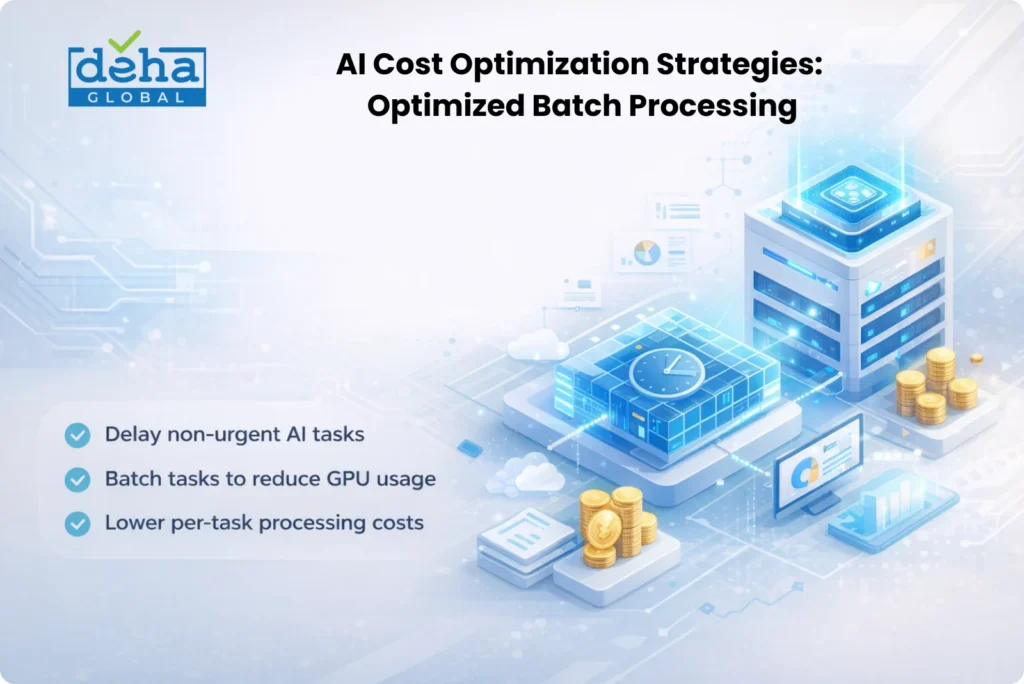
Enterprises can:
- Group non-urgent tasks into scheduled batch runs.
- Optimize GPU utilization by increasing workload density.
- Monitor batch efficiency metrics to refine scheduling logic.
Batch execution maximizes hardware utilization and reduces idle compute, leading to measurable cost savings in large-scale AI environments.
6. Compute-Level Resource Governance
Over-provisioned infrastructure is one of the most significant contributors to AI cost inflation. Without workload-aligned provisioning, enterprises pay for idle GPU hours and unused capacity.
Best practices include:
- Implementing autoscaling policies tied to demand patterns.
- Enforcing compute quotas and resource limits per team.
- Regularly reviewing reserved capacity commitments.
Infrastructure enforcement aligns compute supply with actual usage, preventing unnecessary overspending and improving long-term sustainability of AI development.
7. Granular Cost Allocation Tagging
AI environments often serve multiple products, teams, or business units, which can obscure accountability for cost consumption. Without tagging and allocation mechanisms, CFOs struggle to identify which initiatives generate value versus waste.
Organizations should:
- Apply standardized tagging policies across applications and features.
- Break down AI cost by department, product line, or customer segment.
- Implement internal chargeback or showback models.
Application-level tagging increases transparency and financial accountability, enabling leaders to prioritize high-ROI AI initiatives and discontinue inefficient spending areas.
In Conclusion
Understanding the structure of AI cost and applying focused optimization strategies allows enterprises to transform AI development from an experimental expense into a strategic growth engine. Real-time monitoring, cost-aware system design, and close collaboration between finance and technical teams are critical to maintaining efficiency as usage expands. A proactive and iterative optimization approach will help organizations sustain innovation while keeping AI costs under control.