


A software project can be delivered on time and with all required features—yet still fail in real-world operation. The root cause often lies not in the development team, but in quality risks that were not tightly controlled before release.
More than anyone, we understand that a critical issue after go-live doesn’t just impact the system—it directly affects user experience, revenue, and the brand reputation of both the client and the implementation partner.
That’s why at DEHA, Software Quality Assurance (SQA) is not just a final testing phase. It is a comprehensive quality control process from the very beginning, designed to ensure every release is fully ready for real-world environments.
Let’s take a closer look at how DEHA’s software quality assurance process works, including evaluation criteria and key performance indicators.
4 Key Criteria for Software Quality Evaluation Before Release
At DEHA, evaluation goes far beyond simply “no bugs means ready.” Instead, we rely on a comprehensive Quality Gate framework built on four core pillars:
1. Completeness & Accuracy
This is the most fundamental criterion. QA specialists compare the final product against the original Business Requirements.
Ideal standard:
- 100% of features function correctly, fully, and smoothly
- All test cases—from basic to the most complex—must be executed and pass successfully
2. “Zero Critical Defect” Mindset
With over 10 years of experience working with Japanese clients, we understand that even minor UI issues can be considered serious.
Therefore, before release:
- No Critical or High severity defects are allowed
- Any remaining Minor defects must be:
- Carefully analyzed
- Accompanied by a clear resolution plan
- Proven not to impact core user experience
3. User Experience (UX)
Japanese users place strong emphasis on stability and consistency.
Ideal standards include:
- Consistent UI design
- Standardized fonts
- Pixel-perfect alignment
The product must deliver a sense of reliability:
- Fast system response
- Clear and user-friendly error messages
- Logical and intuitive workflows
Users should never feel “lost” when using the system.
4. Security & Performance
The product must pass:
- Security testing aligned with OWASP standards
- No vulnerabilities or data leakage risks
At the same time:
- The system must handle peak loads effectively
- Ensure stable 24/7 operation
Only when all four criteria are met will QA confirm the status: “Ready for Release.”
This ensures quality is controlled by clear standards—not by deadline pressure.
6 Key Metrics That Indicate a “Safe” Project
Quality cannot be managed without measurement. At DEHA, SQA continuously tracks critical metrics to assess project stability.
1. QA Bug Rate & Customer Bug Rate
These are core indicators of defect control effectiveness:
- QA Bug Rate: Defects identified during internal testing
- Customer Bug Rate: Defects identified after delivery
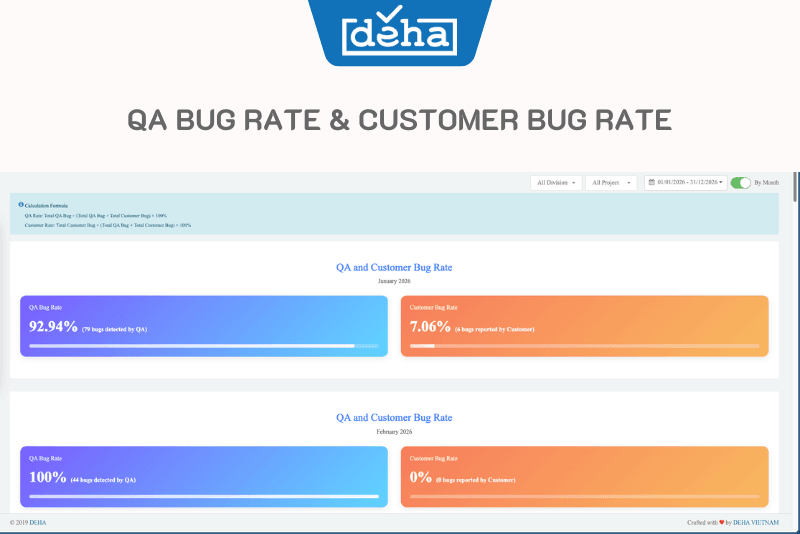
At DEHA, both metrics ≤ 1 are considered acceptable.
This indicates:
- Issues are detected and resolved early
- Post-release defects are minimal
- Testing processes are highly effective
This is a direct measure of product “safety” when delivered to customers.
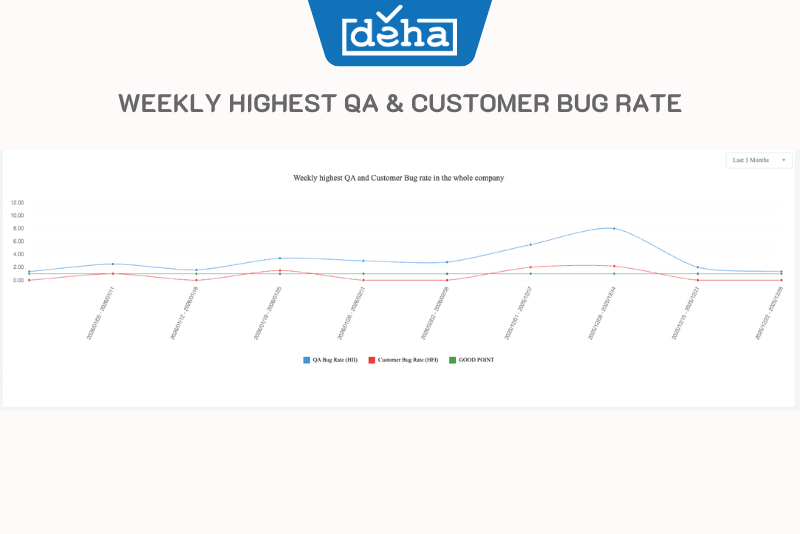
2. Defect Leakage & Bug Rate
This metric reflects how many defects “leak” through quality control stages.
- Defect Leakage: Defects missed in earlier phases but found later
- Combined with Bug Rate, it evaluates effectiveness at each quality gate
A strong SQA system:
- Finds the right defects at the right stage
Low Defect Leakage indicates:
- Well-designed testing processes
- Effective quality gates
- Risks are not deferred to later stages
3. Customer Defect Leakage
One of the most important customer-centric metrics.
DEHA target: < 5%
Compared to the industry benchmark (5–10%), maintaining <5% shows:
- Over 95% of issues are intercepted before reaching users
- Strong internal quality control
- Minimal unexpected issues for customers
This directly impacts user experience and brand reputation.
4. Bug Density
Bug Density measures defects per unit of functionality or code.
Low Bug Density indicates:
- High-quality code from the start
- Effective internal review processes
- Stable system design and implementation
It reflects not only QA performance but also overall team capability.
5. Test Coverage
DEHA’s principle: “No blind spots.”
Test Coverage measures how thoroughly requirements are validated.
Ideal target: 100% Requirements Coverage
This ensures:
- Every requirement is tested
- No functionality is overlooked
- Risks from “blind spots” are minimized
High coverage improves:
- Quality
- Transparency for clients
Every requirement—no matter how small—is converted into test cases and executed.
6. Bug Trend
No project is bug-free at the beginning. A “safe” project is one that controls and reduces defects over time.
Bug Trend tracks:
- Opened Bugs
- Closed Bugs
- Trends across sprints/phases
Ideal state:
- Opened Bugs decrease over time
- Closed Bugs increase and converge with Opened Bugs
- Both lines meet near project completion
This shows:
- Fewer new issues
- Resolution pace keeps up with or exceeds defect creation
- Quality risks are under control
If Opened Bugs spike late in the project → release risk warning
Why These Metrics Matter
These metrics form an integrated early warning system that helps projects:
- Identify risks early
- Make data-driven release decisions
- Maintain transparent quality control
Each release is not just a milestone—it is a validated decision backed by data.
DEHA’s Real-World SQA Process
At DEHA, SQA is not a standalone activity—it spans the entire project lifecycle.
1. Requirement Analysis & Review
Quality starts with requirements—not testing.
QA:
- Reviews and challenges requirements
- Identifies logical inconsistencies
- Clarifies unclear or untestable points
Goal:
- Detect risks early when fixing costs are lowest
2. Test Planning & Strategy
QA defines:
- Scope
- Resources and timeline
- Quality gates
- Key safety metrics
All criteria are:
- Defined early
- Transparently shared with clients
3. Test Design
QA creates detailed test cases covering:
- Main flows
- Edge cases
- Exception scenarios
- User error situations
- High-risk scenarios
Automation is prepared where applicable for efficient regression testing.
4. Environment & Data Preparation
Testing must reflect real-world conditions.
QA ensures:
- Environment closely matches production
- Test data is realistic and clean
This guarantees reliable testing outcomes.
5. Test Execution & Bug Management
QA:
- Executes tests
- Logs and tracks all defects
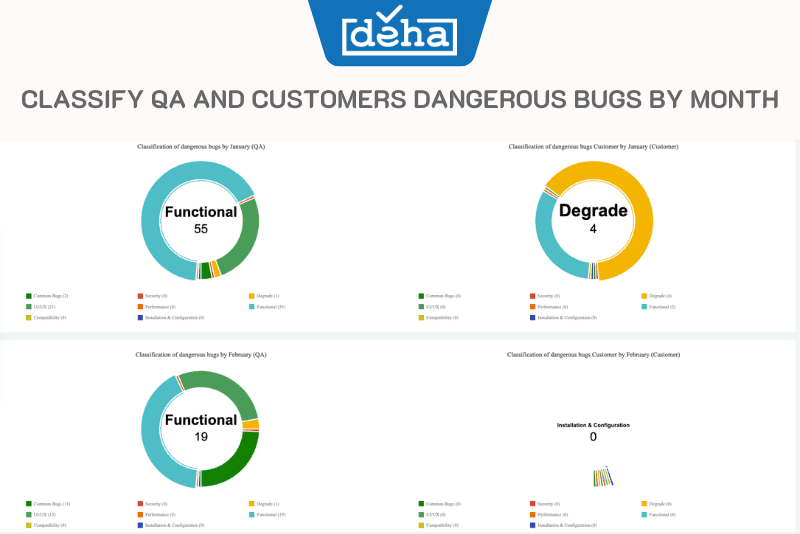
Each defect:
- Is categorized by severity
- Tracked through resolution
- Re-tested after fixing
For critical/repeated issues:
- Root Cause Analysis (RCA) is conducted
This ensures defects do not recur.
6. Closure & Continuous Improvement
Before release or after phases:
QA:
- Analyzes metrics
- Produces transparent reports
- Conducts retrospective (Kaizen) sessions
Goal:
- Continuous improvement, not just completion
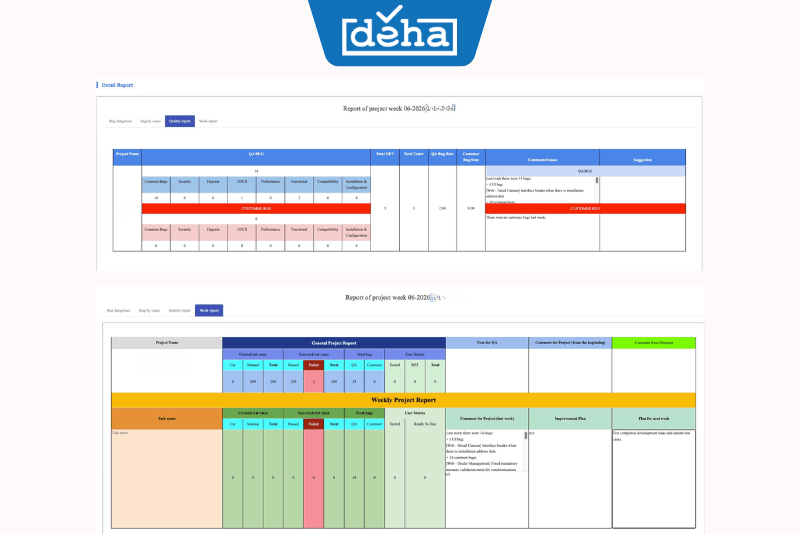
DEHA’s SQA ensures:
- Early defect detection
- Standardized quality control
- Data-driven release decisions
- No repeated mistakes
Clients receive not just a tested product but one validated through a comprehensive quality system.
DEHA SQA: The Differentiator Behind the Brand
The core difference of DEHA’s SQA lies in its transformation:
From a “quality verifier” → to a “co-creator of product value.”
Instead of appearing at the final stage, we:
- Engage throughout the entire development lifecycle
- Participate from requirement analysis
- Eliminate risks at the design stage
This advantage is further strengthened by:
- Experience across industries:
- Smart Factory
- E-commerce
- Fintech
This enables our team to:
- Think flexibly
- Provide solution consulting not just bug detection
By combining:
- Shift-Left Testing strategy
- Extensive cross-industry experience
DEHA’s SQA becomes a true quality assurance expert system ensuring:
- Japanese-standard precision
- Absolute reliability
- Confidence in every digital transformation journey