AI Development: Costs For Developing AI By Industries In 2026
March 19, 2026





Enterprise demand for AI development is expanding rapidly in 2026 as organizations across sectors invest in tailored intelligence systems to boost productivity and innovation. Consequently, understanding how AI costs vary by industry complexity, data requirements, compliance needs, and use case is essential for accurate budgeting and strategic planning.
As discussed in “07 Key Factors Influencing AI Development Costs in 2026” AI development costs vary depending on factors such as data complexity, model sophistication, regulatory requirements, and infrastructure needs, which differ across industries.
In this article, you will gain benchmark cost ranges for major industries and proven methods to evaluate AI development projects for realistic forecasting and better investment decisions.
This year, according to a Yahoo Finance report, global AI investment continues to accelerate with major technology companies projected to spend nearly $650 billion on AI infrastructure and tools, reflecting dramatic increases in compute demand and development scope. Estimating AI development costs is increasingly complex, as organizations must weigh a range of competing factors. These include advanced machine learning models, data preparation needs, and cloud or infrastructure pricing — all of which can substantially influence the total investment required.
AI costs do not look the same across use cases. Depending on data volume, compliance requirements, and the complexity of AI functions, industries experience different AI development cost structures. Here we break down how costs unfold in real-world applications.
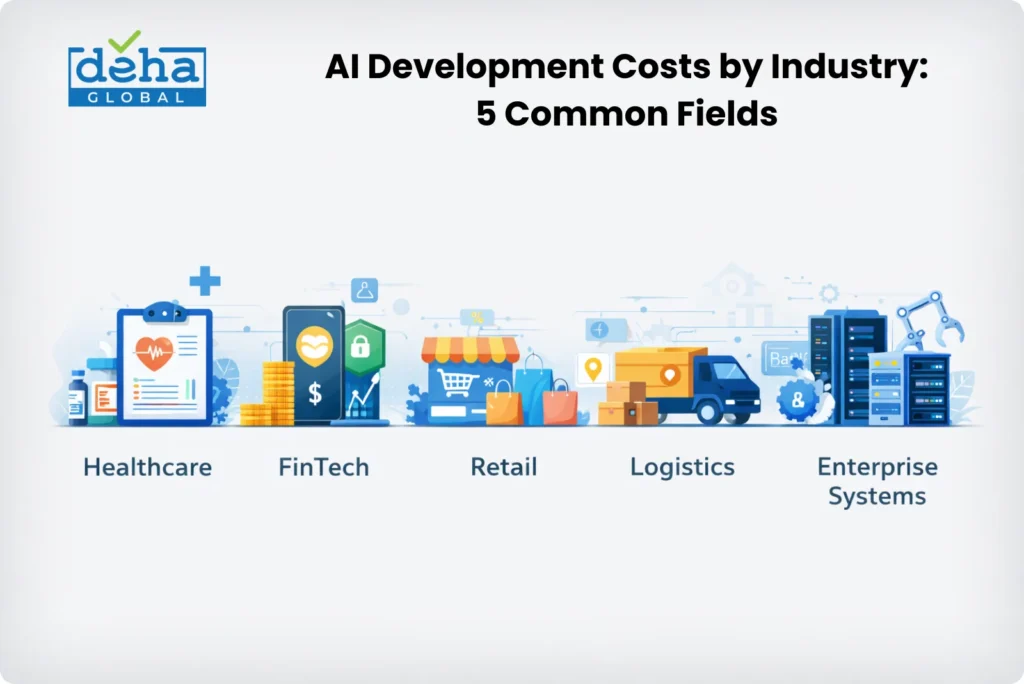
Healthcare organizations are increasingly deploying AI to power predictive diagnostics, patient monitoring systems, and personalized treatment recommendations, thereby improving patient outcomes and operational efficiency. The complexity of clinical data, strict privacy regulations, and the need for high model accuracy mean healthcare AI projects often require more extensive data engineering and validation efforts than general business apps.
As a result, developing AI solutions in this sector demands deep data preparation, specialized compliance safeguards, and robust model training, which together elevate AI cost compared to simpler applications.
Estimated Cost & Key Fees:
Financial technology firms use AI for fraud detection, risk analytics, credit scoring, and high-frequency trading models that must operate in real time and meet strict regulatory requirements. These systems are designed to analyze massive data volumes with ultra-low latency, which raises both infrastructure and development costs.
Regulatory compliance, such as for anti-money-laundering and data security, adds further layers of safeguards and testing, pushing AI costs higher than in lower-risk sectors.
Estimated Cost & Key Fees:
Retailers are investing in AI to power recommendation systems, dynamic pricing tools, and demand forecasting models, thereby increasing sales and improving customer experiences. Because retail applications often require real-time data processing and integration with e-commerce, ERP, and inventory systems, costs are influenced by the number of data sources and scalability requirements.
In addition, continuous retraining of models to adapt to changing customer behaviors contributes to ongoing AI costs beyond initial development.
Estimated Cost & Key Fees:
In logistics, AI fuels route optimization, demand forecasting, and predictive maintenance, helping companies reduce fuel use, shorten delivery times, and anticipate equipment failures. The need to ingest and analyze real-time tracking data from vehicles, warehouses, and IoT devices increases both engineering complexity and compute requirements.
As companies implement more autonomous decision-making systems, the AI development cost rises accordingly, driven by sophisticated algorithms and infrastructure that support high throughput.
Estimated Cost & Key Fees:
Large enterprises often build AI platforms that span multiple business units, including automated analytics, intelligent workflow automation, and cross-functional decision support. These systems require not only deep integration with legacy enterprise software and databases, but also scalable architectures capable of serving tens of thousands of users or internal teams.
The broad scope, high customization, and long-term maintenance plans typical of enterprise AI projects result in some of the highest development costs across sectors.
Estimated Cost & Key Fees:
To forecast AI cost accurately and choose the right projects, these enterprise-ready evaluation frameworks help align investment with expected value.
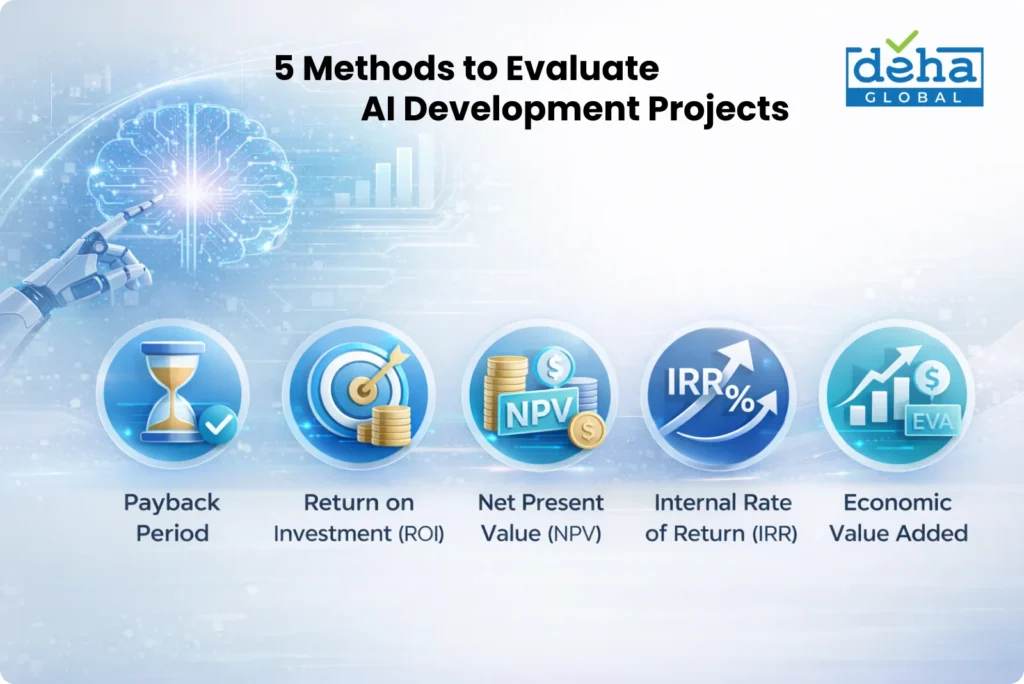
The payback period measures how long it takes for an AI initiative to return its initial investment through cost savings or revenue gains. Organizations should select projects with shorter payback periods to ensure quick validation and minimize capital risks.
ROI assesses the proportional value generated relative to the total AI cost. For larger enterprise systems, measuring ROI helps justify long-term development expenses by quantifying efficiency gains and business impact.
NPV calculates the present value of future cash flows from an AI project against its initial cost. This method is especially valuable when evaluating long-running AI platforms with recurring benefits over several years.
IRR identifies the discount rate at which an AI project’s NPV becomes zero. A higher IRR suggests a strong project relative to its cost, making it a useful benchmark for prioritizing investments in competitive AI portfolios.
Economic value added (EVA) measures the real economic profit after deducting the cost of capital. In AI development, applying EVA ensures that projects generate value beyond traditional cost and revenue metrics.
AI cost drivers vary by industry and project goals. Understanding and managing these elements helps optimize budgets and improve outcomes.
In Conclusion
AI cost varies widely by industry and project complexity, making informed planning essential for realistic budgeting and competitive advantage. Implementing structured evaluation methods and benchmarks helps enterprises control AI cost and maximize long-term ROI. If your organization is preparing to invest in AI development in 2026, consider consulting and a personalized AI cost estimate to frame your investment strategy with confidence.