AI Development: How to Calculate ROI by Industry
March 24, 2026






As AI development becomes central to enterprise innovation, organizations face the dual challenge of managing complex deployments and capturing their financial impact with precision. However, rising implementation costs — including data engineering, infrastructure, and governance — make it difficult to clearly evaluate the value of AI projects.
A structured ROI framework helps organizations understand the real impact of AI investments by connecting costs with measurable business outcomes. This article explains how to calculate AI ROI across major industries and highlights the key cost factors that influence long-term returns.
Measuring ROI is essential in any AI development project, as it clarifies whether the investment is generating real value and keeps decision-making grounded in tangible business outcomes.
Key Benefit of Measuring AI ROI:
Beyond direct expenses like development and tooling, AI development projects often incur hidden costs that can inflate budgets and reduce expected returns. Understanding these potential hidden costs helps enterprises plan more realistic budgets and avoid surprises that can undermine ROI projections.
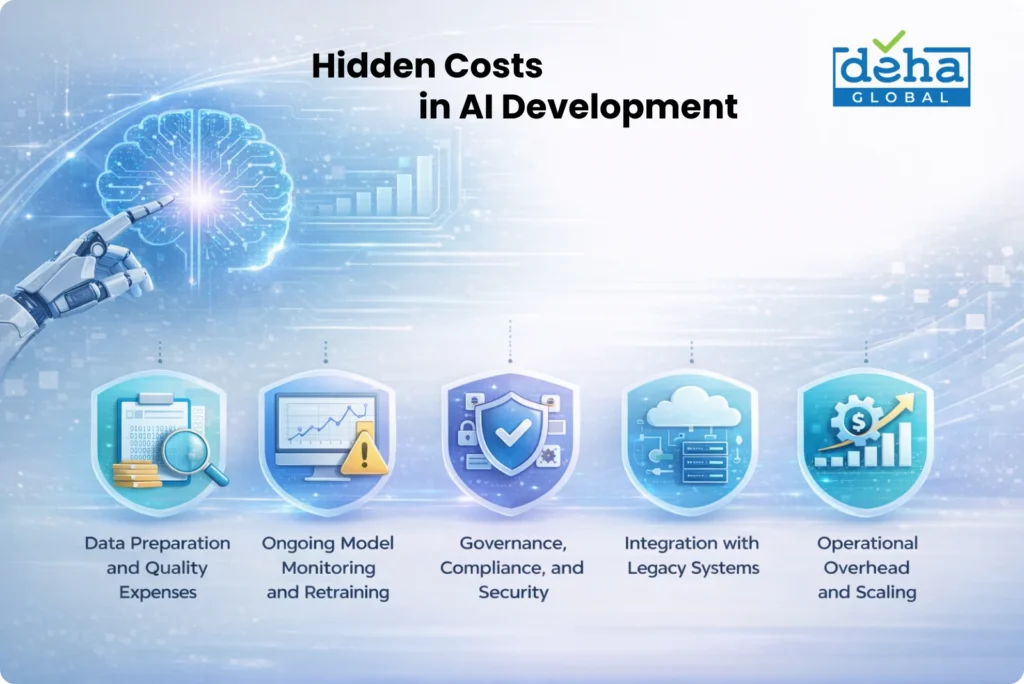
Data preparation represents a major cost component because high-quality training data drives model accuracy but often requires significant labor and tooling. Gathering, cleaning, and annotating data can consume a large portion of the project budget, particularly when datasets are unstructured or inconsistent. Businesses should invest in robust data pipelines and quality checks early in the project to reduce iterative rework and long-term scaling difficulties, which helps safeguard overall AI cost.
AI models inevitably degrade in performance over time due to shifting data patterns, requiring continuous monitoring and retraining to maintain reliability. These activities contribute to ongoing operational costs that are frequently underestimated in initial budgets, making them a hidden cost risk. Establishing automated monitoring systems and a retraining schedule based on usage patterns helps enterprises limit unexpected expenses while preserving performance.
Investments in governance, compliance, and security are critical for regulated industries such as healthcare and finance, where data privacy and audit requirements are stringent. This includes costs associated with access controls, audit trails, bias testing, and regulatory certifications, which are essential to mitigate legal and reputational risks. Enterprises should integrate these activities into overall AI management processes to ensure compliance without compromising ROI potential.
Embedding AI solutions into legacy enterprise workflows requires custom development and infrastructure adjustments, which often leads to overlooked integration costs. This process can involve adapting old systems, creating APIs, and ensuring compatibility, all of which can add complexity and expense. Prioritizing modular design and phased deployment strategies helps contain these hidden costs and improves total AI development efficiency.
As AI initiatives expand from pilot stages to enterprise-wide adoption, operational overhead can rise sharply due to increased support, platform management, and cross-team coordination. These scaling costs may include additional tooling, extra full-time staff, and cloud billing spikes, making long-term ROI projections highly sensitive to scaling decisions. Building robust governance and monitoring practices early helps minimize this hidden cost impact and enhances growth sustainability.
AI ROI calculation varies by industry, as each sector carries distinct cost structures, compliance requirements, and benefit timelines. A tailored ROI framework helps enterprises assess financial impact relative to AI cost and aligns expectations with industry realities.
Common ROI Formula: ROI = (Net Benefits – Total AI Cost) / Total AI Cost
Net benefits encompass direct time savings, additional revenue generated, and cost avoidance resulting from the implementation of AI.
Key Elements in ROI Calculation:

The following examples illustrate how the ROI formula can be applied across different industries using simplified financial scenarios.
Healthcare organizations that implement AI can see significant ROI through outcomes like faster diagnostics and operational efficiency, but must account for compliance and data governance costs. According to ROI analyses, enterprises across industries report average returns of about 3.7× per dollar invested, with top performers achieving more than $10 back for every $1 spent, which is indicative of potential healthcare impact when applications drive clinical value.
Key factors that influence healthcare ROI include: data quality and integration expenses, regulatory compliance overhead, and measurable benefits such as reduced administrative costs and improved patient throughput.
The financial services industry tends to deliver some of the highest ROI figures among major sectors due to AI use cases like fraud detection, risk modeling, and automated customer service. Real-world data shows that financial organizations can achieve ROI higher than most other industries, often benefiting from a combination of cost avoidance from fraud and revenue gains from personalized services.
However, robust security frameworks and substantial infrastructure investments — including high-throughput data platforms and real-time analytics — are significant cost components that should be included in ROI calculations.
Retail and e-commerce sectors often track ROI by measuring revenue increases from personalization, inventory optimization, and dynamic pricing, with data showing that retailers report an ROI of around 3.6× on average when AI is applied to customer experience and pricing strategies.
Retailers must balance these benefits against costs such as data pipeline investments and integration with point-of-sale and supply systems, which are critical to driving accurate forecasts and seamless customer interactions.
In manufacturing, predictive maintenance and automation have become core AI use cases, delivering measurable ROI through reductions in unplanned downtime by 30-50% and maintenance cost cuts of 15-20%, according to industry analyses of AI adoption outcomes in 2026.
The cost side of the ROI equation includes sensor integration, legacy system upgrades, and continuous monitoring platforms, which must be forecasted accurately to determine net benefit and performance impact over typical ROI windows of 1–2 years.
Some businesses encounter challenges in measuring ROI because the variables involved in calculating AI ROI can fluctuate widely depending on usage patterns, cost structures, and business outcomes. The right tools and frameworks make it possible to track and refine AI ROI with confidence, turning investments into measurable, lasting outcomes.
Many organizations fall into the trap of estimating ROI based on theoretical assumptions that may not reflect actual performance metrics in production. Instead, leveraging real-world usage data — such as transaction counts, support volumes, time saved, and performance baselines — ensures that ROI models are grounded in observable outcomes rather than optimism. Tying ROI inputs directly to live operational metrics helps finance and engineering teams better forecast returns and adjust strategies when reality diverges from initial expectations.
A comprehensive ROI calculation must go beyond initial development and deployment costs to include recurring expenses such as maintenance, retraining, compliance, and monitoring. These ongoing costs can accumulate significantly over time and materially affect net benefits if they are ignored or underestimated. By accounting for lifecycle expenses in your ROI framework, your organization gains a more accurate picture of long-term value and avoids surprise cost overruns that can erode projected returns.
Scenario planning allows your organization to examine how ROI changes under different assumptions, such as variations in adoption rates, usage volumes, cost inflation, or revenue impact. By modeling best-case, worst-case, and most likely outcomes, leaders can understand the risk and range of potential returns before committing significant resources. This sensitivity analysis supports more resilient decision-making, helps identify key drivers of value, and highlights areas where early adjustments can improve outcomes.
In Conclusion
Understanding both visible and hidden AI cost components is essential to accurately calculating ROI and ensuring that AI development delivers sustainable value across industries. Real-world ROI frameworks help organizations balance investment with measurable outcomes, aligning AI development expenditures with strategic business goals. By adopting disciplined cost tracking, industry-specific ROI methods, and continuous optimization practices, enterprises can achieve lasting impact while managing AI cost effectively.