AI App Development Roadmap: From Strategic to Successful Implementation
March 26, 2026





Many AI initiatives fail to reach production – not due to model limitations, but because organizations lack a structured implementation strategy from the outset. Without alignment between business goals, data readiness, and engineering execution, even promising AI concepts fail to deliver measurable outcomes.
This guide outlines a practical AI app development roadmap to help teams move beyond experimentation and build solutions that scale.
AI development is not just a technical exercise. It requires coordination across multiple functions—product, data, engineering, and compliance.
A structured roadmap helps organizations:
Here is a detailed breakdown of essential steps in a strategic AI app development process based on industry best practices and standard methodologies.
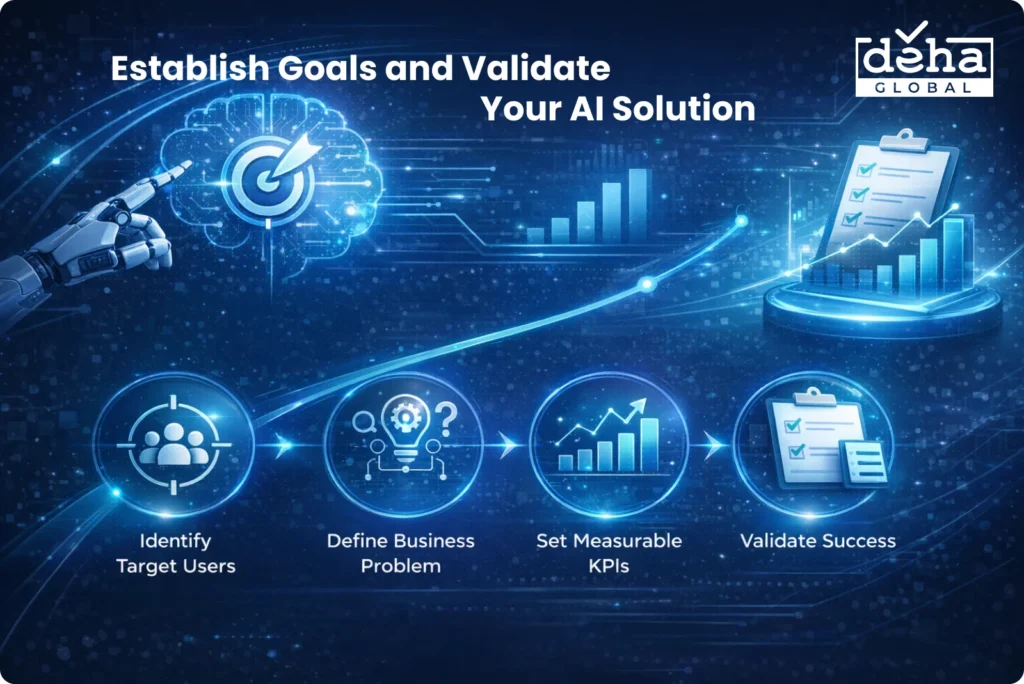
At the initial stage, the business should clearly define:
Just as importantly, teams should validate whether AI is the most effective approach – or if a simpler solution can achieve the same outcome.
After setting goals, outline the core features the AI app must have to achieve them. This step focuses on capabilities that directly support the core use case, such as:
Clear prioritization keeps development focused and cost-efficient.
Even the most accurate model delivers little value if users don’t trust or understand it.
Interfaces should:
In enterprise environments, usability directly impacts adoption rates.
Data readiness is a critical success factor. Beyond collection and preprocessing, teams need to:
Clean, well-structured data reduces rework and improves model reliability.
AI apps often process sensitive user information, which means security and compliance must be part of the development lifecycle from day one. This involves encrypting data at rest and in transit, applying access control mechanisms, and adhering to privacy regulations like GDPR. Building these guardrails early reduces risk and ensures user trust.
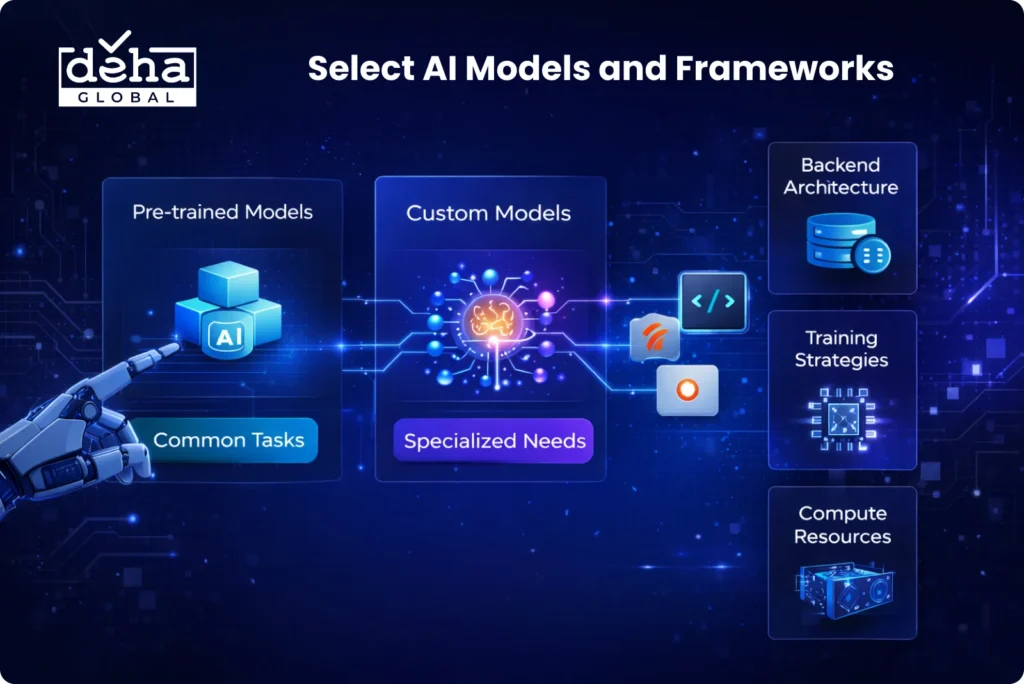
Tool selection should be driven by scalability requirements, existing infrastructure, and team expertise – not just popularity. The right stack enables faster iteration while minimizing long-term operational complexity.
Training involves fine-tuning algorithms on prepared data and evaluating model performance against validation sets. Some projects may require continuous learning where models are retrained on new input over time. Monitoring performance metrics like accuracy, precision, and recall ensures the model meets quality thresholds.
Selecting the appropriate development environment, cloud platforms, and toolchains is critical for efficient execution. This includes IDEs, SDKs, CI/CD pipelines, and collaboration tools that support testing and deployment. The right platform choices can speed up iteration and make scaling easier.
This phase connects trained models with front-end interfaces and backend services via APIs or microservices. Developers ensure the AI component works seamlessly with the app architecture so that insights are delivered reliably to users. Integration should also consider error handling and fallback options for service disruptions.
AI apps must be tested not only for functionality but also for performance, bias, and security. Testing in real-world scenarios helps reveal issues that might not surface in development environments. Developers refine models and application logic to improve accuracy, stability, and responsiveness.
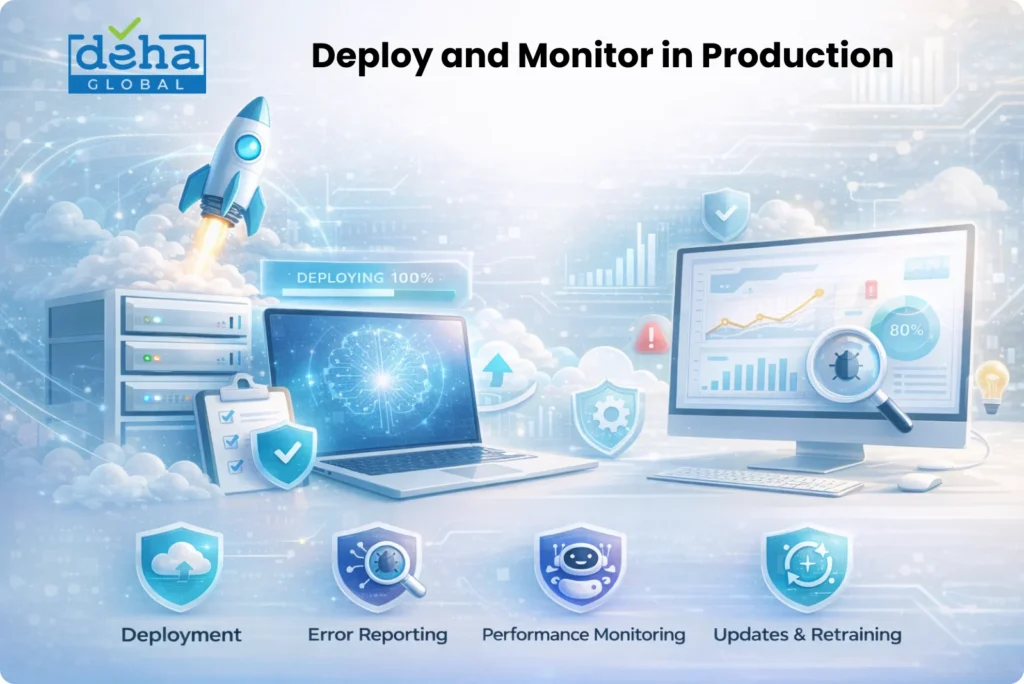
Deployment involves rolling out the AI app to user environments while ensuring capabilities like continuous monitoring and error reporting are in place. Performance monitoring helps detect model drift or latency issues early. Teams should also plan for updates and retraining to maintain long-term performance.
Developers need the right combinations of tools and frameworks to support each phase of AI app development. Below are key technologies commonly used in the industry:
Enterprise teams often face challenges when building AI apps. Below are common obstacles and practical solutions:
In Conclusion
Successful AI implementation depends less on model sophistication and more on clarity of problem definition, data maturity, and execution discipline.
Organizations that focus on clear problem definition, data readiness, and scalable architecture are significantly more likely to deliver AI solutions that create real business value.