

The cost to build an AI application can range from approximately $30,000 for basic implementations to more than $500,000 for enterprise-level platforms. It depends on factors such as system complexity, infrastructure requirements, and integration needs.
Most AI app Development budgets seem reasonable initially. In reality, costs spike after development begins – especially in data pipelines, infrastructure scaling, and model maintenance.
As the third part of the AI App Development Cost series, this article breaks down: which hidden costs impact ROI the most, and how to reduce unnecessary spending without slowing innovation
If you’re planning AI adoption in 2026, this is the cost structure you need to understand before committing budget.
Hidden Costs in AI App Development
Beyond the visible expenses of coding and UI design, many enterprises are finding themselves blindsided by “shadow costs” such as surging GPU electricity consumption and the ongoing refinement required to combat LLM model drift.
This section highlights the costs teams often miss — from data cleaning to compliance. These are the items that typically cause budget overruns mid-project.
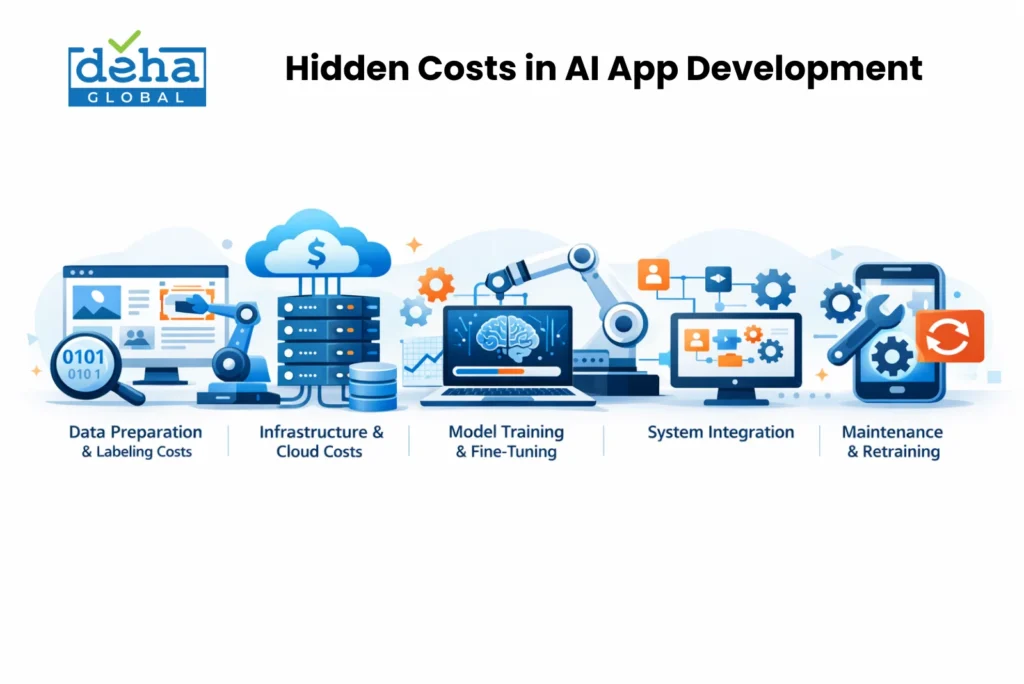
1. Data Preparation and Labeling Costs
Data preparation is often underestimated – even though every model depends on clean, structured, and labeled data to work. This hidden cost comes from multiple steps: collecting data from different sources, cleaning inconsistent records, labeling datasets, and transforming raw data into usable formats.
In many real-world AI projects, organizations discover that preparing data consumes a significant portion of the development timeline and budget. Industry research indicates that data preparation alone can account for 40–60% of total AI project budgets, while some studies suggest that up to 60–80% of the overall project time may be spent on data engineering tasks.
Typical data preparation expenses include:
- Dataset acquisition or licensing: $10,000 – $50,000 depending on dataset quality
- Data labeling and annotation: $5,000 – $20,000 or more for large datasets
- Data cleaning and normalization pipelines
- Handling unstructured datasets such as images, audio, and large text corpora
- Continuous dataset updates to maintain model accuracy
Without high-quality data pipelines and governance processes, machine learning models may generate inaccurate predictions, forcing teams to repeat training cycles and significantly increasing the total AI App Development cost.
2. Infrastructure and Cloud Computing Costs
AI applications require specialized computing infrastructure capable of processing large datasets and running computationally intensive machine learning algorithms. Unlike traditional software applications, AI systems often rely on GPU-accelerated cloud environments for training models and executing real-time inference workloads.
Infrastructure costs look manageable during prototyping — but they scale quickly into production. Organizations must support scalable storage systems, distributed data pipelines, and cloud-based inference environments that operate continuously.
Key infrastructure cost components include:
- GPU computing resources for model training and inference
- High-capacity storage infrastructure for datasets
- Cloud computing services such as AWS, Azure, or Google Cloud
- Networking infrastructure for real-time AI applications
In large-scale deployments, cloud inference workloads can cost thousands to tens of thousands of dollars per month, particularly when AI applications process high volumes of user requests or real-time data streams. As AI systems scale, infrastructure usage grows. Over time, this becomes one of the highest operational costs.
3. AI Model Training and Fine-Tuning Costs
Another hidden component of AI app development costs emerges during the process of training and fine-tuning machine learning models. Building domain-specific AI models often requires multiple training cycles, experimentation with different algorithms, and extensive hyperparameter tuning to achieve acceptable performance levels.
This process becomes particularly expensive when organizations choose to develop custom models rather than using pre-trained AI frameworks. Training advanced machine learning models may require specialized datasets and extended GPU processing time, which significantly increases infrastructure costs.
Typical expenses involved in model training include:
- Custom dataset preparation for domain-specific models
- Algorithm selection and model architecture design
- Hyperparameter tuning and performance optimization
- Repeated training cycles and validation testing
In many projects, training and experimentation costs alone can exceed $20,000–$40,000 depending on model complexity and compute requirements, especially when organizations experiment with multiple model architectures before achieving optimal results.
4. Integration with Existing Systems
Many organizations underestimate the cost of integrating AI solutions with existing enterprise systems such as CRM platforms, ERP software, or internal databases. Unlike standalone applications, enterprise AI systems must interact with multiple legacy systems, data sources, and APIs.
Integration tasks often involve designing middleware layers, building secure APIs, and synchronizing data between multiple platforms. These processes require additional engineering resources and extended testing cycles to ensure compatibility and system stability.
Typical integration tasks include:
- Connecting AI models with CRM or ERP platforms
- Developing APIs and middleware for data exchange
- Synchronizing data pipelines across business systems
- Ensuring compatibility with legacy infrastructure
Depending on the complexity of enterprise architecture, integration costs may range from $20,000 to $50,000 or more, particularly when multiple systems must exchange data in real time.
5. Ongoing Maintenance and Model Retraining
Unlike traditional software systems, AI applications require continuous monitoring and improvement after deployment because machine learning models gradually lose accuracy as real-world data patterns change. This process, commonly known as model drift, requires regular retraining of models using updated datasets.
Maintenance activities also include infrastructure updates, security monitoring, and performance optimization to ensure the AI system continues delivering reliable predictions.
Typical maintenance activities include:
- Monitoring AI model accuracy and performance
- Retraining models using new datasets
- Updating infrastructure and cloud resources
- Security patching and compliance updates
Maintenance expenses are often underestimated during early project planning. Industry estimates suggest that ongoing AI maintenance and retraining costs typically represent 15–25% of the original development budget annually, making long-term planning essential for sustainable AI adoption.
Strategies to Optimize AI App Development Cost
While the complexity of generative AI continues to scale, many forward-thinking organizations are successfully reducing their overhead by 25% to 40% through the strategic use of open-source model fine-tuning and automated synthetic data generation.
We will examine the most effective optimization techniques available this year, providing you with a roadmap to minimize resource waste while maintaining the high-performance standards your users expect.
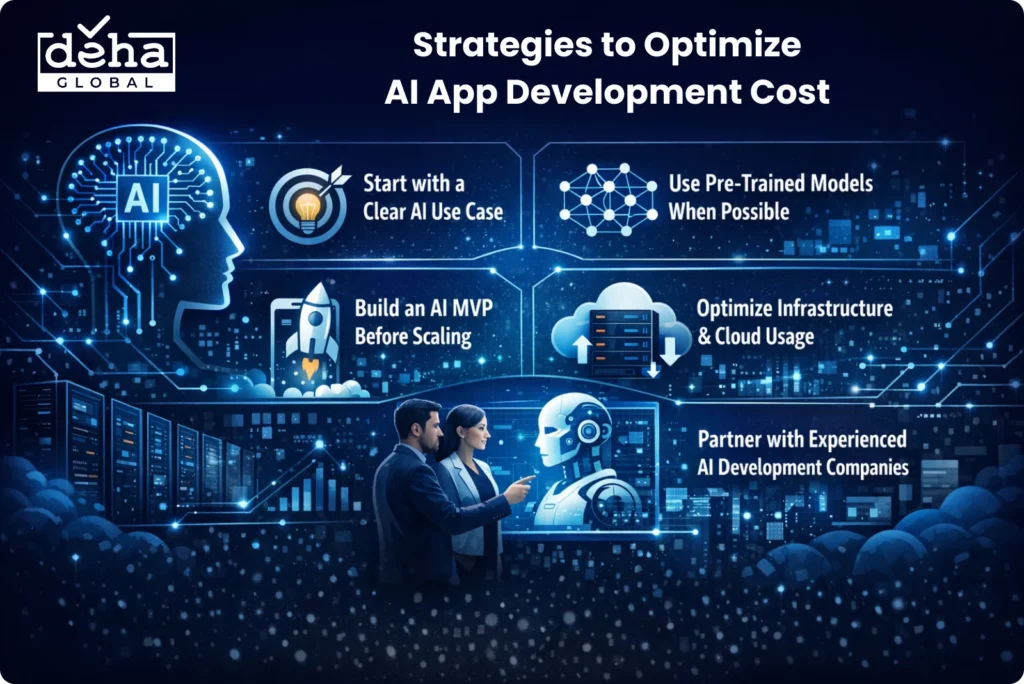
1. Start with a Clear AI Use Case
One of the most effective ways to control AI App Development cost is to begin with a clearly defined business problem that artificial intelligence is expected to solve. Organizations that start AI initiatives with vague objectives often experience scope expansion, repeated experimentation, and prolonged development cycles that significantly increase project costs.
A well-defined AI use case allows development teams to prioritize the most valuable features and avoid unnecessary complexity.
Practical steps include:
- Defining measurable business objectives for the AI solution
- Identifying specific tasks that AI can automate or improve
- Prioritizing high-impact functionality during early development stages
This focused approach helps organizations allocate resources efficiently while ensuring that AI investments deliver measurable business value.
2. Use Pre-Trained Models When Possible
Leveraging pre-trained machine learning models is one of the most effective strategies for reducing AI development costs. Instead of building complex models from scratch, organizations can integrate existing AI frameworks and customize them using domain-specific datasets.
Examples of pre-trained AI resources include:
- Open-source machine learning frameworks such as TensorFlow or PyTorch
- Large language models that support fine-tuning rather than full model training
- Pre-trained computer vision or speech recognition models
By using pre-trained models, companies can avoid expensive model training cycles and significantly reduce development timelines while still achieving strong performance.
3. Build an AI MVP Before Scaling
Developing a Minimum Viable Product (MVP) is a proven strategy for controlling the initial AI App Development cost. Instead of investing heavily in a full-scale AI system from the beginning, organizations can first launch a simplified version of the application that focuses on core functionality.
AI MVP development typically includes:
- A limited set of AI features focused on the main use case
- Simplified system architecture
- Early user testing and feedback collection
Most AI MVPs cost approximately $20,000–$80,000 depending on functionality, making them a relatively low-risk starting point for validating AI concepts before scaling the solution.
4. Optimize Infrastructure and Cloud Usage
Cloud infrastructure represents one of the largest operational expenses in AI systems, especially when models process large volumes of data in real time. Organizations can significantly reduce costs by selecting the appropriate cloud architecture and implementing efficient resource management strategies.
Key cost-optimization techniques include:
- Using auto-scaling infrastructure to allocate resources dynamically
- Implementing serverless architectures for event-based workloads
- Monitoring cloud usage to avoid over-provisioning resources
These strategies allow companies to maintain system performance while ensuring that infrastructure expenses remain aligned with actual usage patterns.
5. Partner with Experienced AI Development Companies
Working with experienced AI development companies helps organizations avoid common technical mistakes and reduces the risk of expensive rework during development. Specialized AI partners bring industry experience, proven development frameworks, and optimized workflows that accelerate delivery timelines.
Outsourcing AI development can also provide access to highly specialized talent, such as machine learning engineers and data scientists, without requiring companies to build large internal teams.
Benefits of partnering with experienced AI development providers include:
- Faster development timelines
- Access to specialized AI expertise
- Reduced recruitment and training costs
- More accurate cost estimation and project planning
Long-Term AI Cost Planning for Sustainable ROI
The true value of an AI application is not measured by its launch day success but by its ability to remain profitable as API pricing fluctuates and user demands evolve over a three-to-five-year lifecycle. By exploring longitudinal financial models and recurring maintenance benchmarks, this analysis empowers you to calculate a realistic Return on Investment (ROI) and secure long-term stakeholder buy-in for your digital transformation initiatives.
- AI development budgets should include not only initial development expenses but also infrastructure, maintenance, and scaling costs throughout the system lifecycle.
- Organizations must evaluate long-term return on investment (ROI) rather than focusing solely on short-term development expenses.
- Continuous optimization strategies such as MLOps pipelines help automate monitoring, retraining, and deployment processes while reducing operational overhead.
- Some companies underestimate operational expenses, which can grow two to three times larger than the original development budget over several years due to infrastructure scaling and model maintenance.
- Proactive lifecycle planning enables organizations to control operational spending and maintain predictable AI budgets.
In Conclusion
The AI App Development cost extends far beyond the initial development phase and includes hidden operational expenses such as infrastructure scaling, data pipelines, and ongoing model maintenance. This article highlights the importance of identifying hidden cost drivers early and implementing cost optimization strategies throughout the AI lifecycle. Understanding the full cost structure helps organizations control risk and achieve better long-term ROI from AI investments.