

AI development is often seen as a fast track to innovation. For startups, it’s usually the opposite. Instead of a single technical problem, building a generative AI product requires solving multiple layers at once – data, infrastructure, talent, and go-to-market.
Most teams don’t fail because of one issue. They fail because these challenges compound early.
This guide breaks down the most critical challenges in GenAI development, and links to deeper resources for each area so you can move from strategy to execution.
Common GenAI Development Challenges Startups Faced
The AI startup ecosystem is built on innovation, but it is also defined by structural obstacles that test every emerging company’s resilience long before a product reaches its first real customer. These challenges span both technical and business dimensions, and they do not arrive sequentially. Instead, founders typically face talent gaps, infrastructure constraints, and market positioning pressures all at once, which is precisely what makes early strategic clarity so valuable.
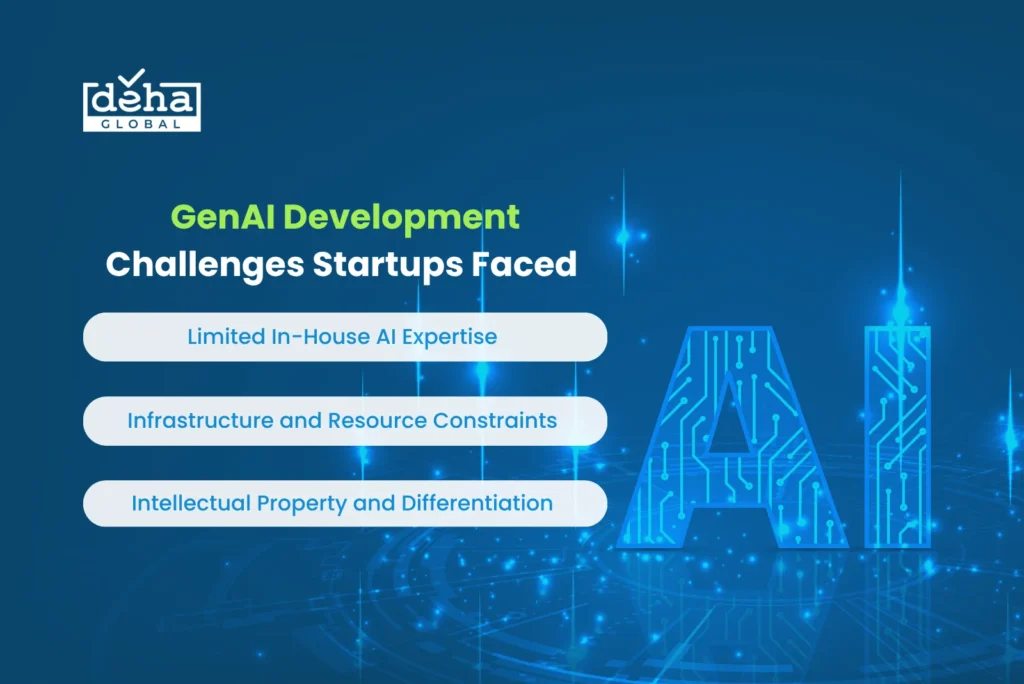
Limited In-House AI Expertise
Talent scarcity is the biggest barrier in the AI startup space. The demand for skilled AI researchers and engineers has substantially outstripped supply for years, making hiring both competitive and expensive.
A startup building healthcare AI, for instance, requires not only machine learning engineers but also clinical domain experts. This combination is difficult to source and even harder to retain when larger technology companies offer significantly higher compensation packages.
Common issues:
- Hiring takes longer than planned: Most early-stage startups cannot match the salaries and benefits offered by established tech firms, making talent acquisition a persistent disadvantage.
- Key roles remain unfilled: Specialized roles – such as data engineers – are particularly scarce and require significant lead time to fill.
- Product timeline slip: High staff turnover in key technical positions can derail development timelines and create knowledge gaps that are costly to address mid-project.
A more practical approach:
- Partner with universities or AI labs to access emerging talent.
- Invest in training programs for existing engineers.
- Leverage AI development partners to accelerate delivery, allowing the core team to focus on product differentiation rather than foundational engineering.
Infrastructure and Resource Constraints
GenAI is computationally intensive by design. Training models, running inference, and storing large datasets require significant compute resources. For startups, this quickly becomes a financial bottleneck.
This constraint is particularly acute at the prototype stage, when infrastructure spending competes directly with investment in product development and customer acquisition.
Common issues:
- Cloud costs grow faster than expected: Upfront hardware costs or equivalent cloud spending can absorb a disproportionate share of early funding rounds.
- Doesn’t scale to production: The current prototype infrastructure is not designed to support real production traffic. To make it production-ready, we would need major re-engineering, which leads to an expensive and time‑consuming rebuild cycle.
- Struggling with operational complexity: Managing storage, computing, and network requirements across different environments adds operational overhead that small teams struggle to absorb.
A more practical approach:
- Start with a cloud-based infrastructure (pay-as-you-go payment) to avoid upfront investment
- Design systems with scalability in mind from day one
- Avoid over-optimizing early – focus on flexibility instead
Infrastructure decisions made at the MVP stage often determine long-term cost structure.
Intellectual Property and Differentiation
AI startups face a dual intellectual property challenge: protect what they build while carefully managing their use of third-party datasets, models, and APIs. At the same time, they also need to clearly differentiate themselves in a crowded market.
Common issues:
- AI models are hard to protect without patents: Proprietary algorithms and training methodologies are difficult to protect if the patent process is slow and expensive for a startup.
- Third-party datasets come with licensing risks.
- Struggling to compete: Generic AI products that attempt to compete on breadth rather than depth struggle to differentiate against larger, better-resourced players.
A more practical approach:
- Define a clear niche instead of building broad solutions
- Secure IP early where it matters (models, workflows, data pipelines).
- Set clear ownership terms in all data and technology partnerships
In Generative AI development, differentiation comes from application — not just capability.
Key Challenges in Generative AI Development
When a startup commits to building a generative AI product, the general pressures of the startup environment do not disappear — they intensify. GenAI development adds a distinct and compounding layer of technical, financial, and operational complexity that most founding teams encounter more acutely than they anticipated.
The six challenges below represent the most consequential obstacles across the AI development lifecycle.
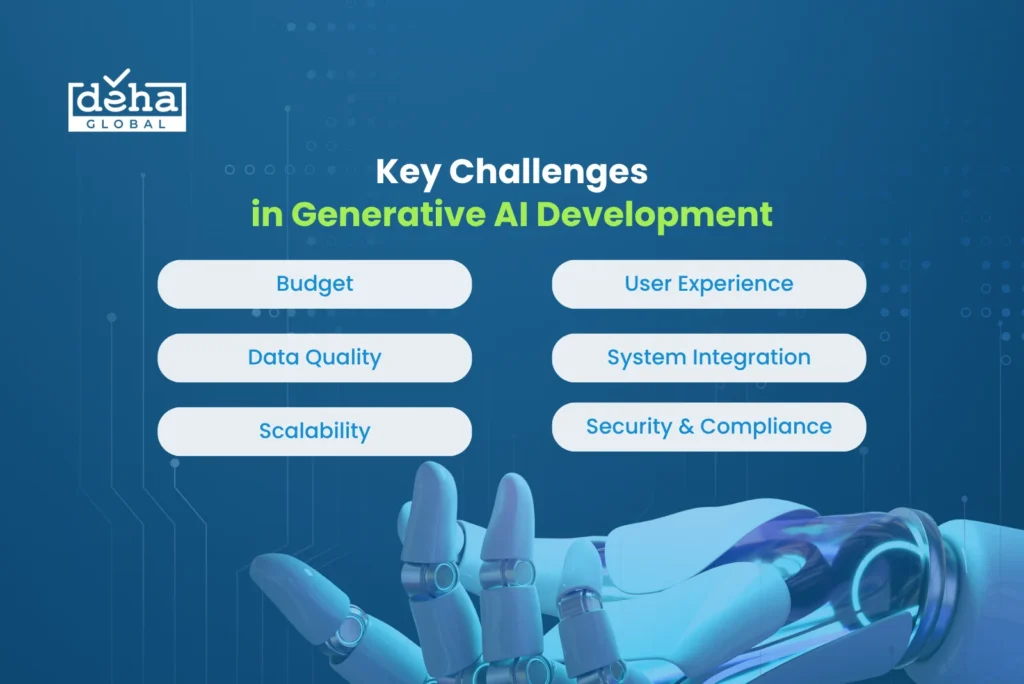
1. Budget for Generative AI Development
The financial demands of generative AI startup development are substantial and frequently underestimated – especially by early-stage teams.
The real cost is not just building the model. It includes:
- Data preparation
- Infrastructure scaling
- Engineering talent
- Ongoing maintenance
This creates a common startup trap: running out of budget before reaching a usable product.
Core challenges:
- Working on a product to attract funding, but need funding to build that product.
Solutions:
- Prioritize a fast MVP (weeks, not months) to provide investors with a tangible, testable product rather than a pitch deck.
- Focus on core functionality instead of full features.
- Use predictable pricing models when possible.
2. Data Quality
The output quality of any generative AI model directly defines product quality. Poor datasets don’t always break the system immediately, but they lead to unreliable outputs, biased results, and loss of user trust
Core challenges:
- Fragmented data sources: Training datasets that over-represent certain demographics, geographies, or use cases produce models that perform inconsistently for underrepresented user groups.
- Lack of validation processes: Integrating data from multiple legacy systems and formats creates significant normalization and validation overhead.
- Limited domain expertise.
Solutions:
- Treat data as a core product asset: Source training data from genuinely diverse datasets from the outset, after bias is detected in production outputs.
- Validate and clean data before model training: Build automated data cleaning and normalization pipelines early. Data quality post-training is significantly more expensive and time-consuming than preventing issues upstream.
- Involve domain experts early in the process: Integrate domain expert review into the data labeling and validation workflow, not just at the end of the pipeline but throughout the process.
3. Scalability
Many generative AI systems are built quickly to validate ideas but are not designed to handle real usage.
Core challenges:
- Performance issues under load: Technical debt accumulated during fast prototyping creates brittle systems that break under increased load rather than scaling gracefully.
- Rising update & upgrade cost: The GenAI technology stack evolves rapidly, meaning that systems built on current best practices can fall behind within months without ongoing investment in updates.
- Need for expensive re-architecture: Designing scalability from the start requires upfront architectural decisions that conflict with the pressure to ship quickly and cheaply.
Solutions:
- Design systems with scaling from the start: Treat infrastructure architecture as a long-term commitment from the prototype phase, not a problem to solve after launch.
- Use modular architecture to avoid full rebuilds: Build modular, component-based code architecture so that individual system elements can scale independently rather than requiring a full rebuild as demand grows.
- Regularly review and update the tech stack: Commit to a structured technology review cadence – monthly evaluations and quarterly updates – to ensure the system remains current with the evolving GenAI capability landscape.
4. User Experience
Technical capability alone does not drive adoption – user experience does. A generative AI product that is difficult, confusing, or counterintuitive will be abandoned regardless of how powerful its underlying model is.
Core challenges:
- AI outputs can be inconsistent or unpredictable
- Interfaces are often built for engineers, not users
- Cross-platform inconsistency reduces trust
Solutions:
- Test with real users early, not after launch
- Simplify core workflows as much as possible
- Ensure consistent experience across platforms
5. System Integration
For startups targeting enterprise clients, integration is often the hardest part of AI development. The scope of this challenge is growing: a significant surge in AI integration requirements is expected across industries as GenAI becomes more embedded in core business operations.
Core challenges:
- Lack of modern APIs: Enterprise clients often rely on legacy systems that predate modern API standards, making integration technically complex and time-consuming.
- Underestimated scope: Integration requirements are frequently under-scoped during product design, leading to expensive discovery and remediation work after the product is already in a client’s hands.
- Data formats vary across systems: Incompatible data formats across client environments create repeated, one-off engineering challenges that consume disproportionate development resources.
Solutions:
- Build API-first architecture from the beginning
- Design flexible integration layers
- Anticipate common enterprise constraints early
6. Security & Compliance
Security is a core requirement that must be addressed from the earliest architecture decisions. AI systems introduce new risks: realistic content generation enables deep-fake fraud, autonomous model behavior creates manipulation risks, and large training datasets introduce data leakage vulnerabilities. At the same time, enterprises expect strict compliance with regulations.
Core challenges and mitigation strategies:
| Security Risk | Description | Mitigation Strategy |
| AI model poisoning | Malicious actors corrupt training data to degrade or manipulate model outputs in production. | Rigorous dataset validation pipelines and continuous model integrity monitoring throughout the deployment lifecycle. |
| Training data leakage | Models inadvertently memorize and expose sensitive data from training sets in their generated outputs. | Apply differential privacy techniques during training; restrict sensitive data inclusion in training pipelines. |
| Deepfakes and synthetic fraud | GenAI enables the creation of convincing fake identities, documents, and audio-visual content used for fraud. | Deploy digital watermarking, AI-powered content verification tools, and user education programs. |
| AI-driven phishing | GenAI automates the creation of highly personalized and convincing phishing messages at scale. | Implement AI-powered threat detection; provide ongoing staff security awareness training tailored to AI-generated threats. |
| Regulatory non-compliance | Failure to meet GDPR, HIPAA, CCPA, or sector-specific data requirements creates legal and financial exposure. | Adopt privacy-by-design architecture from the outset; consider on-premises or local model deployment for sensitive workloads. |
| Big tech platform dependency | Over-reliance on a single LLM provider creates vendor lock-in risk and exposes startups to changing platform terms. | Build multi-provider LLM architecture; maintain support for local model deployment as an operational fallback. |
In Conclusion
Generative AI development amplifies the typical challenges startups already face. Each of the challenges examined in this article represents a known failure mode in AI development, which means that awareness of them translates directly into a strategic advantage over teams that discover these obstacles reactively in production.
Startups that build habits of measurement, structured iteration, and proactive governance from their earliest development decisions are the ones best positioned to scale confidently when product-market fit is confirmed, and investor interest grows.
The startups that succeed are not necessarily the most advanced technically. They are the ones who manage trade-offs early: speed vs scalability, cost vs performance, innovation vs reliability.