

Many large enterprises have already started experimenting with generative AI. However, most organizations still struggle to move from isolated demos to measurable business impact. As a result, enterprise Generative AI Development now focuses less on model performance and more on solving real industry problems.
This shift changes how organizations approach AI initiatives. Instead of testing capabilities, companies now aim to embed AI into core workflows. Therefore, this article highlights practical use cases across finance, healthcare, retail, and logistics. At the same time, it explains how enterprises can turn these use cases into structured GenAI Development projects.
Why Enterprises Are Turning to Generative AI
Enterprises increasingly integrate generative AI into daily operations. Traditional tools cannot handle the growing volume of data and rising customer expectations. Therefore, organizations adopt AI to improve speed, efficiency, and scalability.
- Need for faster, more scalable content creation and communication: Generative models can produce emails, support replies, marketing content, and reports quickly. This capability reduces manual workload and improves response consistency. As a result, customer-facing teams can maintain both speed and quality.
- Rising interest in automation and agent-style assistants: Many organizations deploy AI agents to handle scheduling, data aggregation, and ticket triage. These agents reduce repetitive tasks for employees. Consequently, teams can focus more on decision-making and complex problem-solving.
- Pressure to extract value from large, unstructured data sets: Industries such as finance, legal, healthcare, and logistics store large volumes of unstructured data. Generative AI can efficiently summarize, classify, and extract insights from this data. Therefore, teams can identify patterns and act faster.
- Competitive differentiation and innovation pressure: Industry leaders leverage GenAI Development to create personalized, intelligent experiences. Early adopters integrate AI directly into products and services. As a result, they build capabilities that competitors cannot easily replicate.
Use Cases of GenAI Development Across Industry
The true value of generative AI in large organizations becomes visible when it is applied to specific industry problems. Instead of vague “AI projects,” enterprises get the most benefit by targeting concrete functions such as customer support, documentation, and planning.
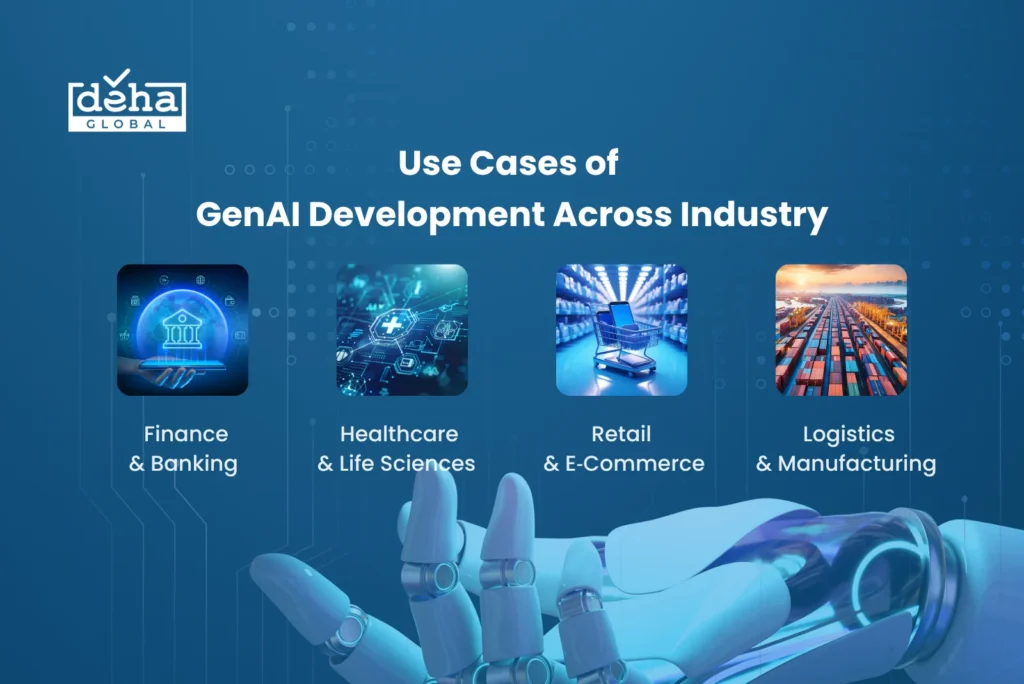
The following sections outline practical use cases for four major industries.
| Industry | Typical Gen AI use cases in an enterprise environment |
| Finance & Banking | Automated reports, customer comms, fraud explanations, internal knowledge assistants. |
| Healthcare & Life Sciences | Clinical notes, research summaries, patient education, and experimental design support. |
| Retail & E‑Commerce | Product copy, chatbots, personalization, vendor, and internal comms. |
| Logistics/Supply Chain | Planning summaries, incident reports, contract drafting, and maintenance logs. |
GenAI Applications in Finance and Banking
- Automated report and summary generation: Banks and asset managers use generative AI to create market summaries, risk reports, and portfolio updates. This approach reduces manual drafting time while maintaining consistency. At the same time, outputs align with regulatory requirements.
- Personalized customer communication and advisory: Generative AI can generate tailored messages for clients based on their profiles and transaction history. These messages include recommendations, next steps, and risk disclosures. As a result, communication becomes more relevant and compliant.
- Fraud and anomaly detection explanations: When systems detect suspicious transactions, generative models provide clear explanations. These explanations help investigators and compliance teams understand risks. Therefore, decision-making is faster and more consistent.
- Internal knowledge and onboarding assistance: Finance teams can access internal policies and documentation via natural-language queries. This capability reduces onboarding time for new employees. In addition, it helps existing staff stay aligned with updated regulations.
GenAI Applications in Healthcare and Life Sciences
- Clinical documentation and note-taking support: Generative AI can assist doctors by drafting clinical notes from conversations. This process reduces administrative burden and saves time. However, human review remains essential to ensure accuracy.
- Research summarization and insight extraction: Researchers use AI to summarize academic papers and clinical reports. This capability helps teams process large volumes of scientific information. As a result, research cycles have become faster and more efficient.
- Patient communication and education content: Healthcare providers generate educational materials and multilingual content using AI. These materials help patients understand their conditions and treatments. Therefore, patient engagement and clarity improve.
- Drug discovery and experimental design support: Generative models can suggest hypotheses and summarize lab results. These tools do not replace scientists but support their work. Consequently, researchers can focus more on critical analysis and innovation.
GenAI Applications in Retail and E‑Commerce
- Personalized product descriptions and marketing copy: Generative AI enables retailers to create multiple content variations. These variations target different customer segments and channels. As a result, content production scales without increasing manual effort.
- Dynamic customer support and chatbots: AI-powered chatbots handle routine inquiries such as shipping and returns. When issues become complex, the system passes context to human agents. Therefore, customer support becomes more efficient and seamless.
- Personalized recommendations and nudges: Modern recommender systems combine data analysis with AI-generated explanations. These explanations clarify why products are suggested. As a result, customer trust and conversion rates increase.
- Internal task automation and vendor communication: Retail teams use AI to draft emails, reports, and planning documents. These drafts reduce repetitive work and improve internal coordination. Consequently, teams can focus on strategic tasks.
GenAI Applications in Logistics and Manufacturing
- Intelligent planning and documentation: Generative AI helps teams convert operational data into clear summaries. These summaries support planning and decision-making. As a result, communication between stakeholders improves.
- Automated incident and damage-report writing: AI systems can generate standardized reports for delays or damages. Human teams review and refine these drafts. Therefore, organizations maintain both accuracy and consistency.
- Procurement and contract drafting assistance: AI tools support the creation of purchase orders and contracts. This process reduces drafting time and minimizes errors. As a result, procurement cycles become faster and more reliable.
- Operator and maintenance communication: Factories use AI to generate maintenance logs and shift notes. These updates help teams stay aligned across operations. Consequently, communication errors decrease.
Turning Use Cases into Gen AI Development Projects
From “interesting use cases” to real projects, the key step is to design Gen AI Development initiatives that are specific, measurable, and governed by business needs. Enterprises benefit most when they treat generative AI as a tool embedded in existing workflows, not as a standalone technology project.
- Map business problems to technical patterns: Teams should classify each use case as generation, summarization, Q&A, or automation. This mapping helps select the right technical approach. As a result, development becomes more focused and efficient.
- Prioritize by impact, feasibility, and risk: Organizations should evaluate each use case carefully. High-impact and low-risk use cases provide better starting points. Therefore, internal tools often serve as effective pilot projects.
- Design for governance, bias, and compliance from the start: Regulated industries require strict controls on data and outputs. Teams should integrate human review, logging, and governance mechanisms early. As a result, compliance risks decrease significantly.
- Build incrementally and iterate with feedback: Small pilot projects allow teams to test performance and user trust. These pilots generate insights for future scaling. Therefore, organizations can expand with greater confidence.
A short checklist can help teams stay focused:
- Identify which industry‑specific use cases are most relevant to your enterprise.
- Map each use case to a clear technical pattern (generation, summarization, Q&A, etc.).
- Assess impact, feasibility, and compliance risk before starting development.
- Start with small, controlled pilots and scale up once the value and safety are proven.
In Conclusion
Generative AI has moved beyond experimentation and into real enterprise operations. Organizations now use it to solve practical problems across multiple industries. As a result, Gen AI Development has become a key driver of efficiency and innovation.
Enterprises achieve the best results when they focus on specific, high-impact use cases. A structured approach helps teams align AI initiatives with business goals. Therefore, organizations should start small and scale gradually based on real performance data.