

Healthcare organizations are no longer asking whether generative AI matters. Most hospitals, clinics, and healthcare technology providers have already tested AI in some form, from clinical documentation tools to patient-facing assistants.
The bigger challenge now is turning those experiments into systems that are safe, scalable, and operationally useful. In practice, healthcare AI adoption is rarely limited by model capability alone. Integration with existing workflows, regulatory requirements, physician trust, and data governance often become the real barriers to deployment.
This article explores practical healthcare use cases, measurable business benefits, and implementation considerations for organizations planning to scale generative AI initiatives responsibly.
High-Impact Generative AI Use Cases in Healthcare Operations
Before investing in generative AI, healthcare leaders benefit from understanding which functions deliver the most immediate value.
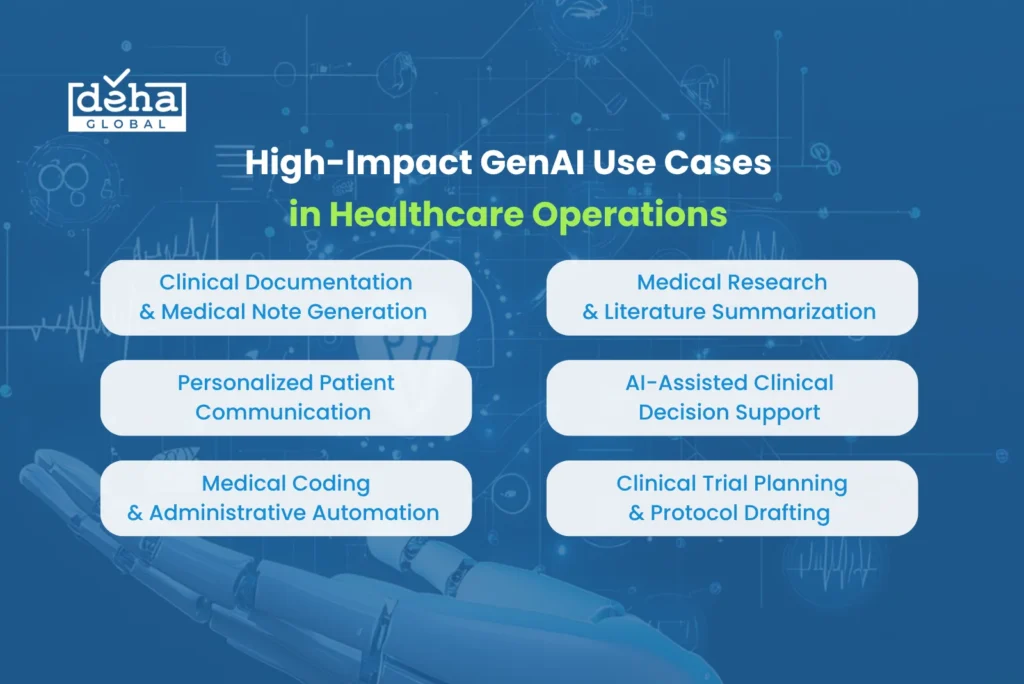
The following sections describe concrete, realistic use cases that can be turned into structured Gen AI Development projects.
| Use Case Category | Typical impact in healthcare |
| Clinical Documentation | Reduced administrative burden for clinicians. |
| Research and Literature Summarization | Faster literature review and discovery. |
| Patient Communication | Clearer, tailored explanations for patients. |
| AI-Assisted Clinical Decision Support | Structured, second‑opinion‑style support for clinicians. |
| Medical Coding and Billing | Faster, more consistent documentation for reimbursement. |
| Clinical Trial Design | Accelerated planning and protocol drafting. |
| Internal Knowledge and Training | Rapid access to guidelines and policy information. |
Clinical Documentation and Medical Note Generation
Documentation remains one of the largest sources of administrative burden in healthcare environments. Physicians often spend hours updating electronic health records (EHRs), preparing discharge summaries, and documenting patient encounters.
Generative AI systems can help reduce that workload by drafting:
- Clinical notes
- SOAP summaries
- Discharge instructions
- Encounter documentation,
- Follow-up reports.
Many healthcare organizations are also exploring ambient clinical intelligence solutions that convert physician-patient conversations into structured medical documentation.
The goal is not to replace clinicians. Human review remains essential. Instead, these systems help reduce repetitive typing and allow healthcare professionals to spend more time focused on patient care rather than administrative tasks.
For healthcare providers facing clinician burnout and staffing shortages, documentation support is often one of the most immediately valuable AI investments.
Medical Research and Literature Summarization
Healthcare researchers and medical teams process enormous volumes of clinical studies, journal articles, treatment guidelines, and regulatory updates.
Generative AI can significantly accelerate literature review workflows by:
- Summarizing clinical studies
- Extracting key findings
- Comparing treatment approaches
- Organizing research into structured formats.
This becomes particularly valuable in:
- Pharmaceutical research
- Clinical trial preparation
- Evidence-based care initiatives
- Medical innovation programs.
Instead of manually reviewing hundreds of documents, research teams can focus attention on the most relevant insights and high-priority findings.
In fast-moving healthcare domains, reducing research turnaround time can directly improve decision-making speed and innovation cycles.
Personalized Patient Communication
One of the most practical applications of Generative AI Development in healthcare is improving patient communication.
Medical information is often difficult for non-clinical audiences to understand. Patients may struggle with:
- Treatment instructions
- Medication guidance
- Post-discharge care
- Appointment preparation.
Generative AI systems can help healthcare organizations create:
- Plain-language medical explanations
- Personalized follow-up messages
- Appointment reminders
- Multilingual patient communication
- Condition-specific educational materials.
This improves patient engagement while reducing confusion around treatment plans and care instructions.
For hospitals and healthcare networks, clearer communication can also help reduce missed appointments, improve adherence, and support better patient satisfaction outcomes.
AI-Assisted Clinical Decision Support
Generative AI is increasingly being explored as a decision-support layer for clinicians rather than an autonomous diagnostic system.
AI models can analyze:
- Patient histories
- Laboratory results
- Imaging summaries
- Structured clinical data
to help surface relevant findings or suggest potential diagnostic considerations.
In practice, these tools function more like intelligent assistants that support physician workflows by organizing information and identifying patterns that may require attention.
However, healthcare organizations remain cautious in high-risk clinical scenarios.
Human oversight, explainability, validation processes, and governance controls remain essential, particularly in environments involving diagnosis, treatment recommendations, or patient safety decisions.
The most successful healthcare AI implementations usually position generative AI as a support system for clinicians, not a replacement for medical expertise.
Medical Coding and Administrative Automation
Revenue cycle management remains a major operational challenge across healthcare systems.
Administrative teams spend significant time preparing:
- Coding documentation
- Billing narratives
- Prior authorization requests
- Insurance-related documentation
- Compliance records.
Generative AI systems can help standardize portions of these workflows by generating structured drafts based on clinical records and operational data.
Potential benefits include:
- Reduced administrative workload
- Improved coding consistency
- Fewer documentation errors
- Faster reimbursement workflows.
For enterprise healthcare providers managing large patient volumes, even small efficiency improvements in administrative operations can produce a meaningful financial impact.
Clinical Trial Planning and Protocol Drafting
In pharmaceutical and life sciences environments, generative AI can support early-stage clinical trial preparation.
Teams can use AI systems to assist with:
- Protocol drafting
- Inclusion and exclusion criteria
- Consent-form generation
- Research summaries
- Trial documentation preparation.
These tools help research and regulatory teams move faster during planning phases while improving internal alignment across stakeholders.
Although human review remains mandatory, AI-assisted drafting can shorten preparation cycles and reduce manual coordination work in complex research environments.
Internal Knowledge Management and Staff Training
Healthcare organizations manage large volumes of internal policies, treatment guidelines, operational procedures, and compliance documentation.
Finding accurate information quickly can be difficult, especially across large hospital networks or multi-location healthcare systems.
AI-powered internal knowledge systems allow healthcare staff to:
- Search institutional policies
- Retrieve treatment guidance
- Access operational procedures
- Receive contextual answers from internal documentation.
This supports:
- Faster onboarding
- More consistent policy adherence
- Improved access to institutional knowledge.
For healthcare enterprises operating across multiple departments or facilities, internal AI knowledge systems can help standardize access to information at scale.
Business Benefits of Generative AI in Healthcare Operations
Beyond technical capabilities, healthcare stakeholders focus on measurable outcomes. Generative AI must deliver value for clinicians, patients, and operational leadership. Therefore, the following benefits highlight both clinical and business impact.
- Reducing Administrative Burden for Clinicians: By automating routine documentation and administrative tasks, generative AI frees up clinicians to spend more time with patients. This shift can reduce stress and burnout, which are common challenges in healthcare work environments.
- Improving Documentation Consistency: AI-assisted documentation improves consistency across clinical records. These systems help capture key details and standardize terminology. As a result, communication between providers becomes clearer. In addition, continuity of care improves across departments.
- Accelerating Research and Innovation: Researchers can process and synthesize large volumes of literature and trial data much faster with generative AI support. This acceleration shortens the time needed to move from discovery to clinical application.
- Accelerating Research and Innovation: Patients receive clearer explanations and personalized follow-up messages. These communications improve understanding of treatment plans and risks. As a result, adherence increases, and complications decrease. In addition, overall patient satisfaction improves.
- Supporting Revenue Integrity and Compliance: Generative models can help ensure that documentation and billing narratives match clinical reality, reducing errors and rejections. This support helps protect revenue streams while maintaining compliance with payer and regulatory requirements.
- Scalable internal knowledge sharing: AI-powered knowledge systems allow medical staff to access guidelines and institutional policies quickly. These tools support both new hires and experienced professionals. As a result, healthcare systems maintain consistency across multiple locations.
Key Considerations Before Deploying Generative AI in Clinical Environments
Medical environments face strict requirements for privacy, safety, and accountability, so Gen AI Development must be carefully structured from the beginning.
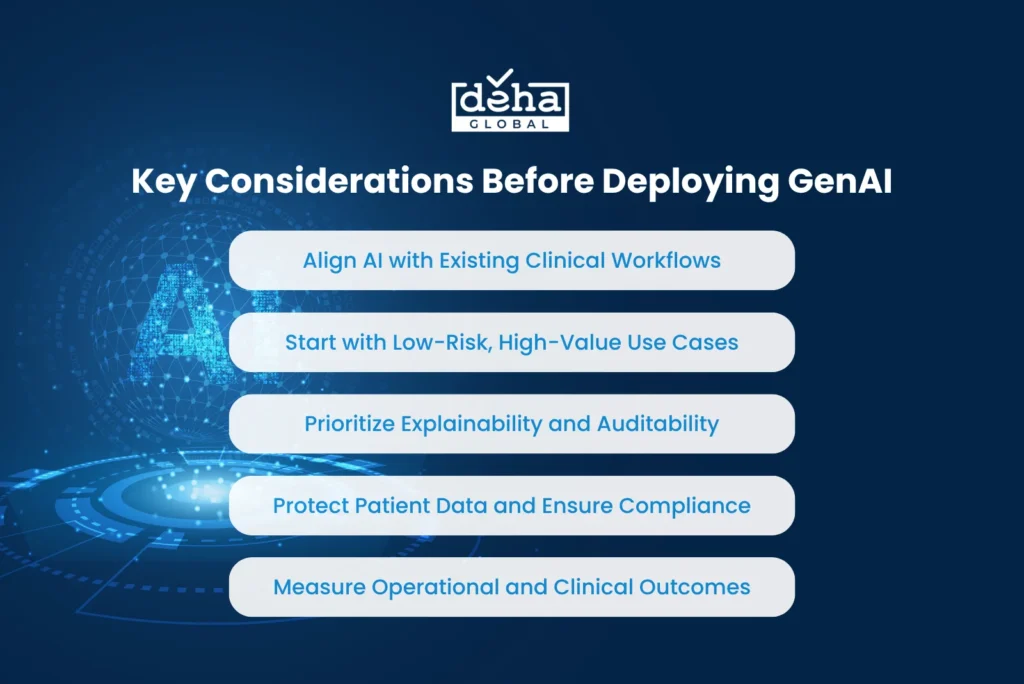
This section outlines key principles for designing, deploying, and governing generative AI projects in healthcare.
- Align AI with Existing Clinical Workflows: Healthcare leaders should embed generative tools into existing workflows. These workflows include both clinical and administrative processes. As a result, AI solutions support daily operations instead of disrupting them.
- Start with Low-Risk, High-Value Use Cases: Not all use cases are equally suitable for early pilots; low‑risk, high‑value tasks such as internal knowledge search or documentation drafting may be good starting points. Higher‑risk areas like autonomous diagnosis should remain under tight human oversight and rigorous validation.
- Prioritize Explainability and Auditability: Healthcare systems must track how AI outputs are generated. This includes prompts, sources, and human approvals. As a result, audit processes become easier and more reliable. In addition, regulatory compliance improves.
- Protect Patient Data and Ensure Compliance: Sensitive patient data must follow strict regulations such as HIPAA or GDPR. Systems should include encryption, access control, and monitoring mechanisms. At the same time, developers must identify and reduce bias in training data.
- Measure Operational and Clinical Outcomes: Healthcare providers should begin with small pilot programs. These pilots can focus on one department or a single workflow. As a result, stakeholders can evaluate safety, usability, and performance before scaling.
A Practical Readiness Checklist for Healthcare Organizations
- Identify which clinical or administrative workflows would benefit most from generative AI.
- Define clear boundaries for AI versus human responsibility in each use case.
- Establish data‑privacy, governance, and monitoring procedures before deployment.
- Start with low‑risk pilots and expand based on safety and performance data.
In Conclusion
Generative AI development is gradually transforming healthcare services. It supports clinicians, patients, and administrative staff in more efficient and structured ways. As a result, medical systems can improve both operational performance and care quality.
By focusing on targeted use cases such as documentation, research, and patient communication, healthcare institutions can achieve measurable results. Therefore, the most effective approach is to start with controlled pilots. From there, stakeholders can scale solutions based on clinical evidence, user feedback, and regulatory requirements.