

AI app development is more accessible than ever. With APIs, pre-trained models, and cloud infrastructure, startups can launch AI-powered products much faster than before.
However, building an AI app is very different from building traditional software. The real challenge is not adding AI features, but creating a product that can scale, manage data effectively, and deliver reliable user experiences under real business conditions. Many founders focus too heavily on the technology itself while overlooking workflow design, operational complexity, and long-term scalability.
This article provides a complete overview of AI app development, helping startups understand the process, costs, and best practices before building their first AI product.
What AI App Development Actually Means
AI app development refers to building software that uses artificial intelligence to perform tasks that require human judgment. These tasks include language understanding, pattern recognition, and content generation. For startups, AI app development is less about building from scratch and more about integrating intelligence into a specific workflow.
In practical terms, most AI products today rely on existing models and cloud services rather than proprietary research. Founders do not need to train large language models themselves to build useful AI applications. In fact, trying to do so too early usually introduces unnecessary complexity and infrastructure cost.
The real challenge is identifying where AI meaningfully improves the user experience or automates a high-friction process.
In B2B SaaS products, this often means:
- Reducing manual workflows
- Improving search and retrieval
- Automating support operations
- Generating structured content
- Extracting insights from internal data
In consumer applications, AI is more commonly used for personalization, recommendation systems, conversational interfaces, or content generation.
For startup founders, this distinction influences every major decision. It affects system architecture, hiring strategy, vendor selection, and go-to-market timing. Therefore, understanding this difference is critical from the beginning.
Core AI capabilities commonly built into startup apps:
- Natural Language Processing (NLP): Powers chatbots, virtual assistants, smart search, and sentiment analysis tools. Libraries like Hugging Face and APIs like OpenAI GPT enable rapid integration without building models from scratch.
- Machine Learning (ML): Enables predictive analytics, fraud detection, recommendation engines, and behavioral personalization. Frameworks like TensorFlow and Google Vertex AI are the standard entry points.
- Computer Vision: Used in healthcare diagnostics, manufacturing quality control, retail shelf analytics, and security systems. Cloud providers like AWS, Google, and Azure all offer accessible vision APIs.
- Generative AI: Powers content generation, code assistance, product description automation, and creative tooling. GPT-4 and similar models are available via API with flexible token-based pricing.
AI app types by business model:
| Type | Best for | Example use case |
| B2C consumer app | User-facing personalization | AI fitness coach, language learning app |
| B2B SaaS tool | Workflow automation for businesses | AI-powered CRM, smart invoice processing |
| Internal ops tool | Reducing internal overhead | AI code reviewer, smart HR screening |
| AI-enhanced marketplace | Matching & recommendation | Property suggestions, freelancer matching |
The most common AI capabilities integrated into apps today include personalization, automation of repetitive workflows, advanced analytics from user data, and conversational AI powering chatbots and voice assistants. Startups that clearly define which capability they are building — rather than pursuing “AI” as a vague goal — ship faster and spend less.
Step-by-Step Guide for AI App Development Process
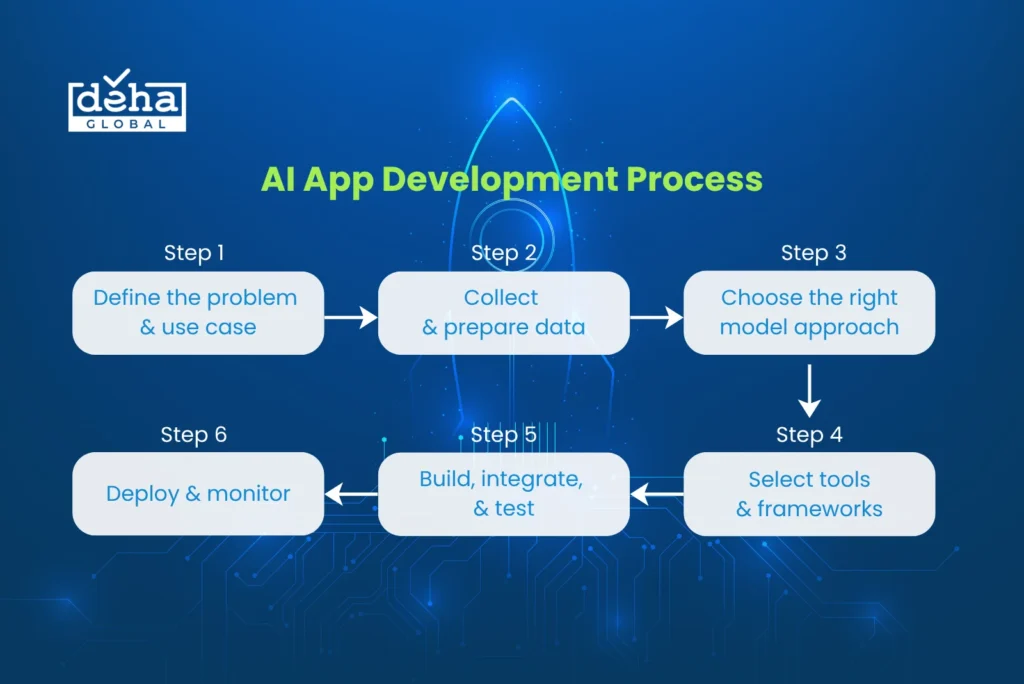
Building an AI application requires a structured process. This process differs significantly from traditional software development. It combines strategic planning, data science, engineering, and UX design. Skipping early steps often creates long-term problems. In particular, weak data preparation or incorrect model selection leads to costly issues at launch.
AI development follows a structured journey. The process usually starts with a strategic planning phase that lasts 2–4 weeks. During this phase, product owners define objectives and analyze market needs.
Step 1: Define the problem and use case
Before any technical work begins, the startup must define precisely what the AI component will solve. Having a specific goal helps select the right data, algorithms, and infrastructure. Broad goals like “make the app smarter” produce unfocused builds; a specific goal like “reduce support ticket volume by 40% through an intent-detection chatbot” produces a testable product.
Step 2: Collect and prepare data
AI models are only as good as the data they are trained on. Focus first on ensuring its accuracy, completeness, and relevance rather than simply collecting large volumes. For most early-stage startups, this means sourcing existing labeled datasets, using public datasets, or implementing structured data collection from day one.
Step 3: Choose the right model approach
Startups rarely need to train models from scratch. Using pre-trained models such as OpenAI, Salesforce Einstein, or Google Vertex AI can reduce development and training costs for startups to create AI apps quickly. Custom training becomes relevant only when domain-specific accuracy requirements exceed what off-the-shelf models can deliver.
Step 4: Select tools and frameworks
Popular AI tools used in app development include TensorFlow for machine learning, Core ML for iOS features like face recognition, Dialogflow for conversational assistants, and Microsoft Azure AI for cloud-based intelligent apps. The right stack depends on the app’s primary AI function and the team’s existing expertise.
Step 5: Build, integrate, and test
AI models behave differently in real-world scenarios compared to lab conditions. Continuous testing is necessary throughout the development cycle, including A/B tests to compare AI-driven versus non-AI workflows. Functional testing should happen in parallel with model performance evaluation.
Step 6: Deploy and monitor
Deployment is not the end of the process. Build a feedback loop into the workflow to ensure models stay up-to-date and relevant. Model drift — where accuracy degrades as real-world data patterns shift — is one of the most common and underestimated post-launch challenges for AI startups.
Estimated development timeline by scope:
| App scope | Typical timeline | Key variable |
| AI MVP (single feature) | 4 – 8 weeks | Pre-trained model vs. custom training |
| Mid-complexity AI app | 3 – 6 months | Data availability and UI complexity |
| Full-scale AI product | 6 – 12+ months | Custom model training and enterprise integrations |
In 2026, the speed of experimentation matters more than technical perfection. The companies that win are not the ones with the most advanced models — they are the ones that learn the fastest.
Cost of AI App Development for Startups
Cost remains one of the most underestimated factors in AI development. AI engineers and data scientists typically charge higher rates due to specialized expertise. In addition, infrastructure and API costs increase as usage grows.
Total investment includes multiple cost layers. These layers scale at different rates as the product grows. Therefore, startups must plan beyond initial development expenses.
Key cost components:
- Development team: Salaries or agency fees for AI engineers and data scientists represent the largest line item for most startups. Outsourcing to regions with lower rates (e.g., Eastern Europe, Southeast Asia, India) is a common cost-optimization strategy.
- Pre-trained model APIs: OpenAI API usage for GPT-4 is billed based on token volume. Google Cloud AI and ML costs are based on training and inference time, while AWS SageMaker charges for instance usage and data processing. These costs scale directly with app usage and can become significant at volume.
- Cloud infrastructure: Flexera’s 2025 State of the Cloud report highlights that 84% of organizations consider cost management their top cloud challenge. For startups, right-sizing infrastructure from early stages prevents the “cloud sprawl” that inflates burn rates.
- UI/UX development: Costs rise with cross-platform support across iOS, Android, and web, as well as custom UI animations, real-time interactions, or voice interfaces.
Estimated budget ranges by app type:
| App type | Estimated cost range | Notes |
| AI MVP (single feature, pre-trained model) | $15,000 – $40,000 | Fastest to market; validates core AI hypothesis |
| Mid-tier AI app (custom integrations) | $40,000 – $120,000 | Adds data pipeline and custom model tuning |
| Enterprise-grade AI product | $120,000 – $500,000+ | Custom model training, compliance, and enterprise integrations |
Cost optimization strategies:
- Start with an MVP and validate before committing to custom model training
- Use pre-trained APIs for NLP and vision tasks in early stages
- On AWS, combining EC2 Predictive Scaling with Graviton3 processors has helped platforms boost throughput while cutting compute expenses by 20% — infrastructure choices matter from day one
- Partner with an AI development firm that offers fixed-price discovery before full engagement, rather than open-ended T&M contracts
Responsible AI Is Becoming a Competitive Requirement
Most AI app failures are not technical — they are strategic. The most promising AI applications for startups focus on solving specific industry problems rather than implementing AI for its own sake. The following practices distinguish products that sustain traction from those that launch and stall.

- Narrow the use case before building: If the idea feels too broad, founders should reduce the scope. A focused workflow creates a clearer path to execution. Successful startups build a thin but intelligent layer first. They launch quickly, measure outcomes, and iterate. In contrast, building a full AI platform too early often leads to over-engineering.
- Prioritize data quality over quantity: While it is tempting to collect large volumes of data, focus first on ensuring accuracy, completeness, and relevance. Good data practices lead to better model outcomes and more accurate predictions. Poor training data is the single most common cause of AI product underperformance in production.
- Design for user trust, not just functionality: AI products must feel intuitive to users. Interfaces should clearly explain capabilities and limitations. In addition, systems should provide fallback options when outputs are uncertain. As a result, users gain confidence in the product. Without this trust, user churn increases quickly.
- Build continuous evaluation into the roadmap: Automated review AI agents catch roughly 80% of security and style flaws before merge, reducing bug-fix costs. Generative AI-written end-to-end tests cut over 90% of false positives and shrink regression runs from days to hours. The same discipline that applies to the product’s AI should apply to the development process itself.
- Plan for model drift: AI models do not stay accurate indefinitely as user behavior and data patterns evolve. Build monitoring and retraining cycles into the product roadmap from the start, not as an afterthought after the first production accuracy dip.
- Responsible AI is a product feature: Responsible AI development ensures models remain explainable, fair, and secure. For startups in regulated industries, this requirement is mandatory. At the same time, strong AI governance has become a competitive advantage. Enterprise buyers increasingly evaluate vendors based on these standards.
In Conclusion
The startups that succeed with AI are not the ones with the largest budgets. They are the ones who learn and adapt the fastest. These companies launch small, intelligent products early. They measure performance carefully and iterate continuously. As a result, they improve faster than competitors.
AI app development has become more accessible than ever. Therefore, execution speed now matters more than technical complexity. The next step is simple: choose the right problem and start building.