

Artificial intelligence investment continues to accelerate in 2026 as enterprises expand automation initiatives, adopt generative AI technologies, and compete in increasingly data-driven markets. At the same time, the rapid evolution of foundation models and enterprise AI platforms has created both opportunity and financial complexity, which makes AI cost estimation more challenging than in previous years.
In this article, we will break down the insights of AI development costs by analyzing the key factors that influence pricing and the most common AI development pricing models in 2026 to help your business plan strategically and allocate budgets effectively.
Key Factors Influencing AI Development Costs
A clear understanding of cost drivers allows enterprises to estimate AI development costs more accurately and avoid unexpected budget overruns. The following factors represent the most critical elements that directly influence AI cost in modern AI development projects.
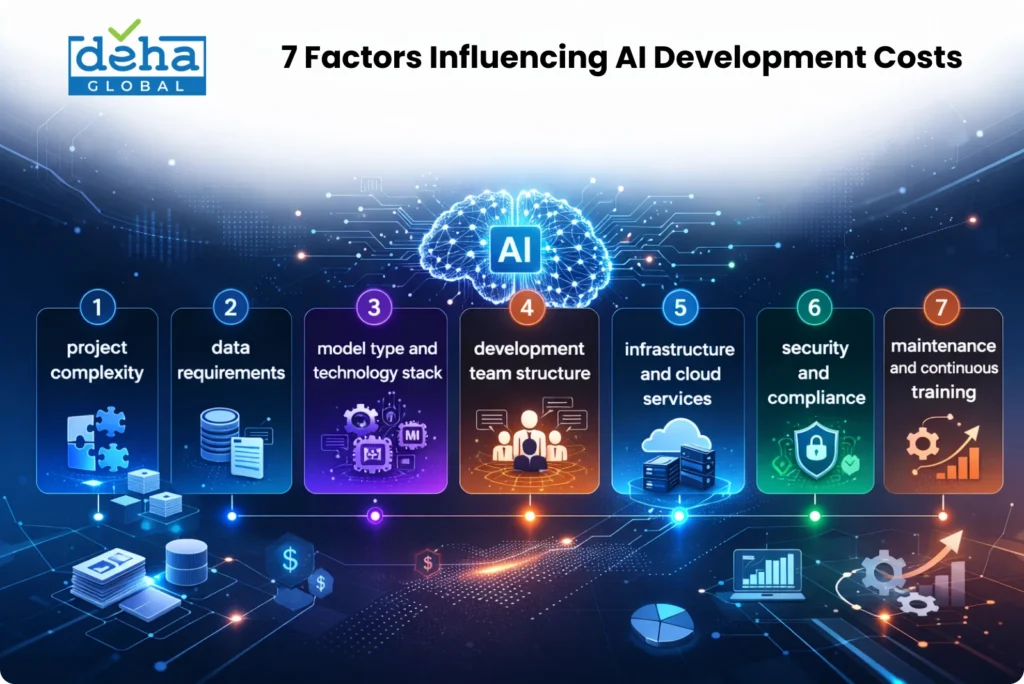
1. Project Complexity
Project complexity remains one of the most decisive factors in AI development costs. A simple AI-powered chatbot that integrates an existing API requires significantly fewer resources than a custom-built predictive analytics engine trained on proprietary datasets. As the scope expands to include advanced features such as real-time decision-making or multi-model architecture, development time and infrastructure needs to increase substantially.
For example, OpenAI reportedly spends tens of millions of dollars on training large-scale models due to computational complexity, while Tesla invests heavily in autonomous driving AI systems that require continuous algorithm refinement and real-world testing. These examples demonstrate how technical ambition directly translates into higher AI costs.
2. Data Requirements
Data availability and quality strongly impact AI development expenses. High-quality AI systems require large, well-labeled datasets, and data collection, cleaning, annotation, and storage can represent a significant portion of the total budget.
In enterprise contexts, companies such as Amazon rely on massive proprietary datasets to power recommendation engines, which increases both storage and data engineering costs. Similarly, healthcare AI solutions often require structured and compliant datasets, which further raises development expenditure due to strict validation processes.
3. Model Type and Technology Stack
The choice between traditional machine learning models and advanced deep learning architectures significantly affects AI development costs. Fine-tuning an existing pre-trained model may reduce initial expenses, whereas building a large custom deep learning model from scratch demands higher computational power and engineering expertise.
Additionally, generative AI models and large language models require substantial GPU resources and optimization, increasing infrastructure spending. Businesses that rely heavily on third-party APIs may reduce upfront development costs but incur recurring usage fees that accumulate over time.
4. Development Team Structure
The composition and expertise of the development team directly influence total AI cost. A typical AI development project may require data scientists, machine learning engineers, MLOps specialists, backend developers, and domain experts.
Enterprises that build in-house AI teams often face high recruitment and retention expenses, especially given the global shortage of experienced AI engineers. According to industry reports, senior AI specialists in North America command six-figure annual salaries, which significantly raises operational costs compared to outsourcing models.
5. Infrastructure and Cloud Services
Infrastructure expenses represent a major portion of AI development costs, particularly for projects that require GPU-intensive training. Cloud providers such as AWS, Microsoft Azure, and Google Cloud charge premium rates for high-performance computing instances, especially when models require large-scale training cycles.
For instance, training advanced AI models can cost millions of dollars in computing resources alone, depending on model size and training duration. As a result, infrastructure planning plays a decisive role in overall budget allocation.
6. Security and Compliance
Security and regulatory compliance increase AI development costs, particularly in industries such as finance and healthcare. Organizations must implement encryption, secure data storage, audit mechanisms, and regulatory documentation to meet standards such as GDPR or HIPAA.
Financial institutions deploying AI-driven fraud detection systems must integrate strict governance frameworks, which adds both technical and legal expenses. Therefore, compliance requirements often extend project timelines and inflate total development budgets.
7. Maintenance and Continuous Training
AI development cost does not end after deployment. Continuous model monitoring, retraining, performance optimization, and infrastructure scaling generate ongoing expenses.
For example, recommendation systems at companies such as Netflix require constant retraining to adapt to user behavior changes, which demands sustained computational resources and engineering oversight. Consequently, long-term maintenance must be included in strategic AI budgeting from the beginning.
AI Development Pricing Models in 2026
A clear understanding of AI development pricing models helps enterprises select the most suitable structure for their business objectives and risk tolerance. The following pricing models represent the most common approaches used in AI development projects today.
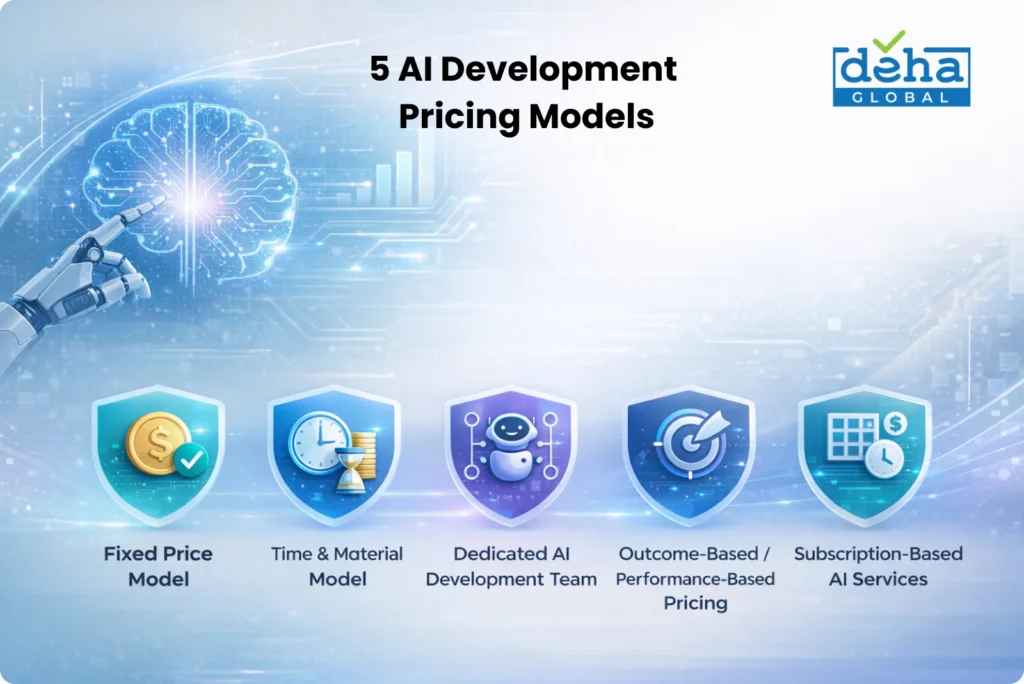
1. Fixed Price Model
The fixed price model defines a predetermined budget and scope before development begins. This model operates on clearly defined deliverables and milestones, which limit scope changes during execution.
Best for:
- Startups with limited budgets and well-defined AI features
- SMEs implementing a proof of concept
- Enterprises with stable, non-evolving AI requirements
2. Time & Material Model
The time and material model charges based on actual hours worked and resources used. This approach offers flexibility for AI projects that evolve during development and require iterative experimentation.
Best for:
- Companies building AI products with evolving requirements
- Enterprises conducting R&D-heavy AI initiatives
- Businesses requiring agile development cycles
3. Dedicated AI Development Team
The dedicated team model provides a full-time AI development team that works exclusively on your project. This structure ensures continuity, scalability, and long-term collaboration.
Best for:
- Enterprises undergoing digital transformation
- Organizations developing proprietary AI platforms
- Businesses seeking long-term cost efficiency
4. Outcome-Based / Performance-Based Pricing
Outcome-based pricing links payment to predefined performance indicators or measurable KPIs. This model aligns vendor incentives with business outcomes and represents a growing trend in 2026.
Best for:
- Enterprises implementing AI for revenue optimization
- Financial institutions targeting fraud reduction rates
- E-commerce companies are improving conversion through AI personalization
5. Subscription-Based AI Services
Subscription-based models operate under AI-as-a-Service structures, where businesses pay recurring fees for managed AI platforms or API access. This model reduces upfront investment but creates ongoing operational expenses.
Best for:
- SMEs adopting AI without internal technical teams
- Companies integrating chatbot or analytics APIs
- Organizations seeking predictable monthly costs
Examples of AI Development Costs in Common Industries
- Healthcare & Medical Diagnostics – AI applications support medical imaging analysis and predictive patient monitoring, with estimated development costs ranging from $150,000 to over $500,000 depending on regulatory requirements and dataset complexity.
- Financial Services & Fintech – AI systems enable fraud detection, risk modeling, and algorithmic trading, with typical AI development costs between $200,000 and $600,000 due to compliance and security standards.
- Retail & E-commerce – AI solutions power recommendation engines and demand forecasting tools, with development budgets commonly ranging from $80,000 to $300,000 depending on integration scope.
- Manufacturing & Industrial Automation – AI supports predictive maintenance and quality inspection systems, with costs estimated between $100,000 and $400,000 based on IoT integration and real-time processing needs.
- Logistics & Transportation – AI applications optimize route planning and fleet management, and development expenses often range from $120,000 to $350,000 depending on system complexity and scalability requirements.
How to Manage AI Development Costs in 2026
The following proven strategies help enterprises optimize AI development costs while maintaining performance and scalability.
- Start with an AI MVP that validates ROI before scaling full deployment.
- Leverage pre-trained AI models and APIs to reduce development time and infrastructure investment.
- Use open-source AI frameworks such as TensorFlow, PyTorch, and Hugging Face to minimize licensing expenses.
- Optimize data acquisition and labeling by focusing on relevant datasets and semi-automated processes.
- Choose cloud services strategically by selecting cost-efficient compute plans and auto-scaling options.
- Monitor system usage and performance continuously to detect inefficiencies early.
- Outsource to an experienced AI development partner to reduce in-house recruitment and operational overhead.
Why Partnering with an Experienced AI Development Company Matters
Underestimating AI development costs often results in budget overruns, delayed delivery, and systems that fail to achieve expected ROI. Many enterprises begin AI initiatives without proper technical consulting, which leads to unclear scope, data gaps, and infrastructure miscalculations. Therefore, strategic planning with experienced experts helps reduce long-term expenses and ensures that your AI investment remains scalable and sustainable.
Partnering with an experienced provider such as DEHA Global enables your business to control costs, access specialized AI talent, and accelerate time-to-market without heavy in-house overhead. Our team delivers AI consulting, custom AI development, scalable architecture design, and enterprise-grade security through skilled developers, designers, and QA engineers. You can explore our AI development services page to see how we support enterprise-level AI transformation with reliable and high-quality solutions.
In Conclusion
AI development in 2026 demands a strategic perspective, as AI cost is influenced by project complexity, data strategy, infrastructure investment, and the chosen pricing model. A well-structured approach that includes early technical consulting and long-term planning enables enterprises to maximize ROI while controlling both initial and ongoing expenses. If your organization is evaluating AI development opportunities, DEHA Global encourages you to schedule a consultation and request a tailored AI cost estimation aligned with your business goals.