AI App Development 2026: Cost Breakdown, Enterprise Budget Guide (Part 1)
March 30, 2026





Enterprises across industries are adopting AI-powered applications to automate processes, enhance customer experiences, and improve decision-making. Despite this growing adoption, many companies still find it difficult to predict the true AI app development cost due to the technical complexity of AI infrastructure and model training.
This article introduces the first part of the AI Cost series, focusing on the right timing for AI app development and the methods used to measure AI cost in 2026.
Many companies want to adopt artificial intelligence but are unsure when the investment will deliver the highest value. Identifying the right timing for AI app development helps businesses maximize return on investment while minimizing unnecessary development costs.
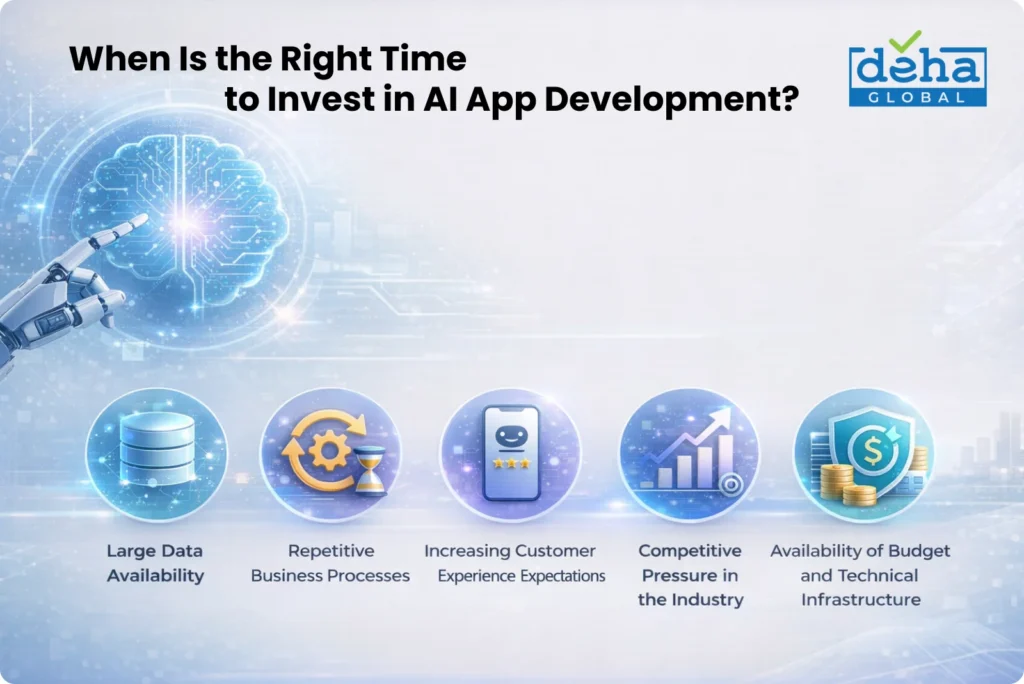
Organizations that already collect large volumes of structured or unstructured data are well-positioned to invest in AI applications. These datasets provide the foundation required to train machine learning models and generate meaningful insights that support business decisions.
Businesses that operate repetitive workflows often gain immediate value from AI-powered automation. AI applications can automate routine tasks, reduce human errors, and significantly increase operational efficiency.
Companies facing rising expectations for personalized digital experiences should consider AI app development sooner rather than later. AI-driven recommendation systems and intelligent chatbots can enhance customer engagement and improve satisfaction levels.
Organizations operating in highly competitive markets may need AI solutions to maintain their market position. Competitors that successfully deploy AI-driven platforms often gain advantages in efficiency, innovation, and customer insight.
Many enterprises begin AI app development as part of a broader digital transformation strategy. Integrating artificial intelligence into existing systems can accelerate innovation and enable data-driven decision-making across the organization.
Companies that already have cloud infrastructure, data platforms, and digital development teams can adopt AI more efficiently. These resources reduce initial setup costs and enable businesses to scale AI applications more quickly.
Accurately estimating AI app development expenses requires a structured and systematic approach. A step-by-step cost measurement framework helps organizations define project scope, allocate resources, and avoid unexpected financial risks.
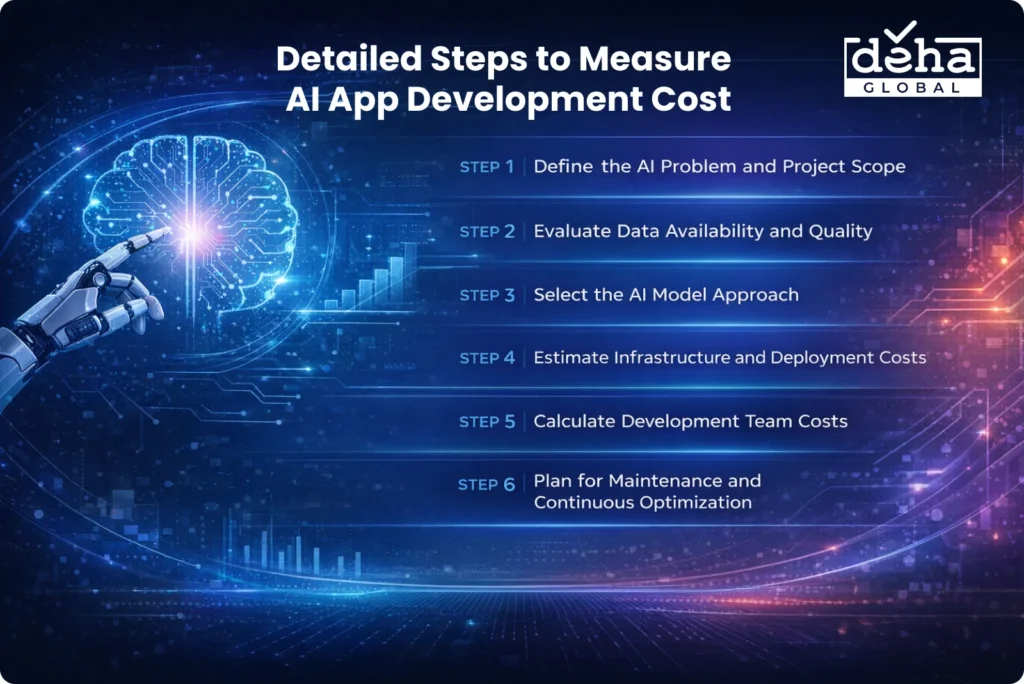
Organizations should begin by clearly defining the business problem the AI application will solve. A well-defined scope helps development teams estimate the level of complexity and required resources.
Businesses should focus on identifying specific use cases such as predictive analytics, intelligent chatbots, fraud detection systems, or recommendation engines.
Key considerations include:
Data is the core component of every AI system, and its quality directly impacts development cost. Companies must evaluate whether existing datasets are sufficient for training machine learning models.
Important tasks in this step include:
Organizations should note that data preparation can represent a significant portion of the overall AI app development cost.
Choosing the right AI model strategy strongly influences the total development budget. Businesses must determine whether they will use pre-trained models, fine-tuned models, or fully customized machine learning systems.
Common AI model approaches include:
Each option offers different trade-offs in cost, accuracy, and development time.
AI systems require computing resources for training, testing, and deployment. Organizations must estimate infrastructure costs related to cloud services, GPU usage, data storage, and AI model hosting.
Key infrastructure components include:
Infrastructure planning ensures the AI system can scale efficiently as data volume increases.
AI application development requires a multidisciplinary team with specialized skills. Businesses should estimate labor costs based on the expertise required for the project.
Typical roles in AI development include:
Accurately estimating team resources helps organizations create a realistic development budget.
AI applications require ongoing monitoring, retraining, and optimization after deployment. Companies should include long-term operational costs when calculating the overall AI app development cost.
Important maintenance activities include:
Continuous improvement ensures that AI models remain accurate and relevant as business conditions evolve.
Calculating development costs early in the planning phase offers several strategic advantages for businesses. Early cost measurement enables organizations to align AI investments with long-term business objectives.
Successful AI projects require more than technical expertise and development resources. Enterprises must also evaluate strategic, operational, and organizational factors before launching AI app development initiatives.
In Conclusion
Estimating the AI app development cost early allows businesses to approach AI investment with greater confidence. Organizations that evaluate the right development timing and measure costs systematically can avoid unnecessary risks. All in all, strategic budgeting ultimately enables enterprises to capture the full value of AI-driven innovation.