AI App Development 2026: Cost Breakdown, Enterprise Budget Guide (Part 2)
April 02, 2026





AI adoption is accelerating across industries as enterprises use AI to automate operations and improve decision-making. However, estimating AI App Development cost is difficult because it depends heavily on complexity, data readiness, and infrastructure.
This article, the second part of the AI App Development Cost series, breaks down AI cost by factors, stages, project scale, and industry.
In 2026, the price of AI is no longer just about lines of code, but rather the high-stakes interplay between specialized hardware, data quality, and model complexity. This section identifies the core variables driving your expenses, allowing you to prioritize investments that deliver the highest return on innovation.
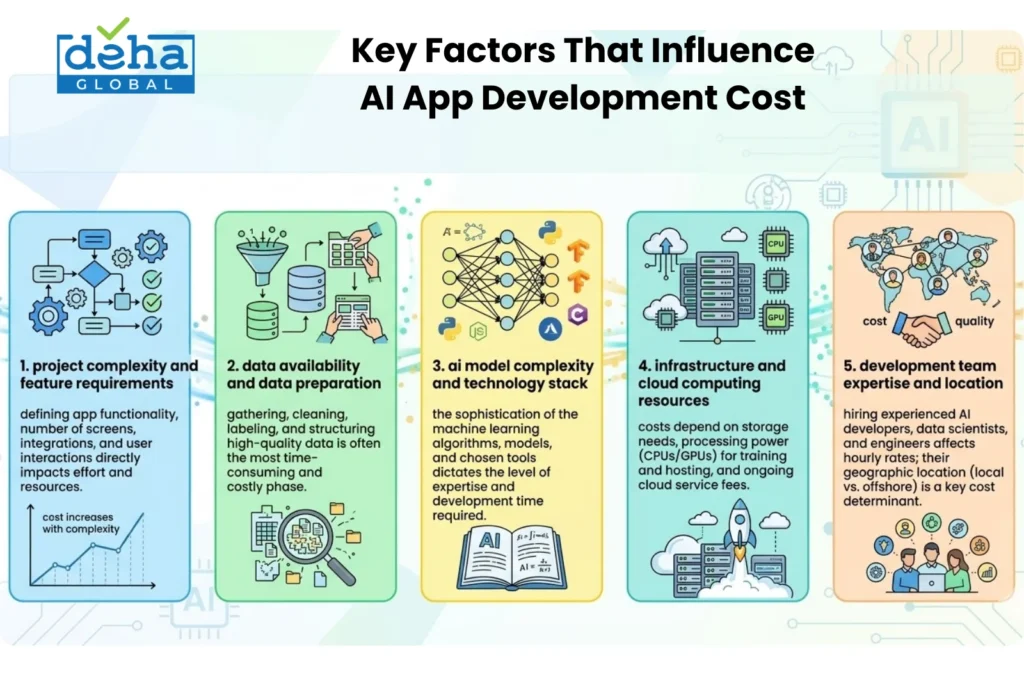
Project complexity remains the most influential factor affecting the total AI App Development cost, because the number of features, level of automation, and sophistication of machine learning models determine the overall development effort.
A basic AI-enabled application – such as a rule-based chatbot or simple automation workflow – can often be delivered within a relatively controlled budget.
In many projects, feature expansion, such as real-time analytics, predictive modeling, or personalized recommendation systems, increases the complexity of the system architecture.
From what we’ve seen, this is the point where cost begins to scale non-linearly, often pushing total budgets into the $150,000 to $500,000+ range.
Data preparation is one of the most time-consuming and costly phases, as models require high-quality training data. Organizations with structured, production-ready data move faster and spend less.
In many real-world projects:
Data preparation alone can account for 10–30% of the total development budget, particularly when working with unstructured data such as images, audio recordings, or large text datasets.
Model and technology choices directly impact cost, as different approaches require different levels of computing and expertise. Pre-trained models and AI APIs often reduce development time, whereas custom machine learning models require longer training cycles and specialized infrastructure.
Advanced AI systems such as natural language processing platforms, computer vision systems, or deep learning neural networks often require significant computing resources and GPU infrastructure. In large-scale AI environments, the cost of training complex models can reach hundreds of thousands or even millions of dollars, depending on dataset size and model architecture.
AI applications require high-performance infrastructure capable of processing large datasets and running computationally intensive machine learning models. Cloud platforms such as AWS, Google Cloud, or Azure make it easier to get started, but usage-based pricing – especially GPU workloads – can quickly become a major cost driver.
These infrastructure requirements often represent 15–25% of the total AI development budget, especially enterprise AI platforms with high data processing demands.
Team size, expertise, and location directly affect AI App Development cost. AI projects require multidisciplinary teams consisting of data scientists, machine learning engineers, software developers, AI architects, and MLOps specialists.
Hiring an in-house AI team in regions such as North America or Western Europe can significantly increase labor costs, while outsourcing development to experienced technology partners in regions such as Southeast Asia or Eastern Europe can reduce expenses without sacrificing quality. In many projects, labor costs alone may represent 20–40% of the total development budget.
Many businesses struggle with budget overruns because they focus heavily on the “build” phase while neglecting the costly realities of data refinement and post-launch optimization. We break down the financial requirements of each phase—from discovery to deployment—to help you maintain a sustainable and predictable cash flow throughout the project.
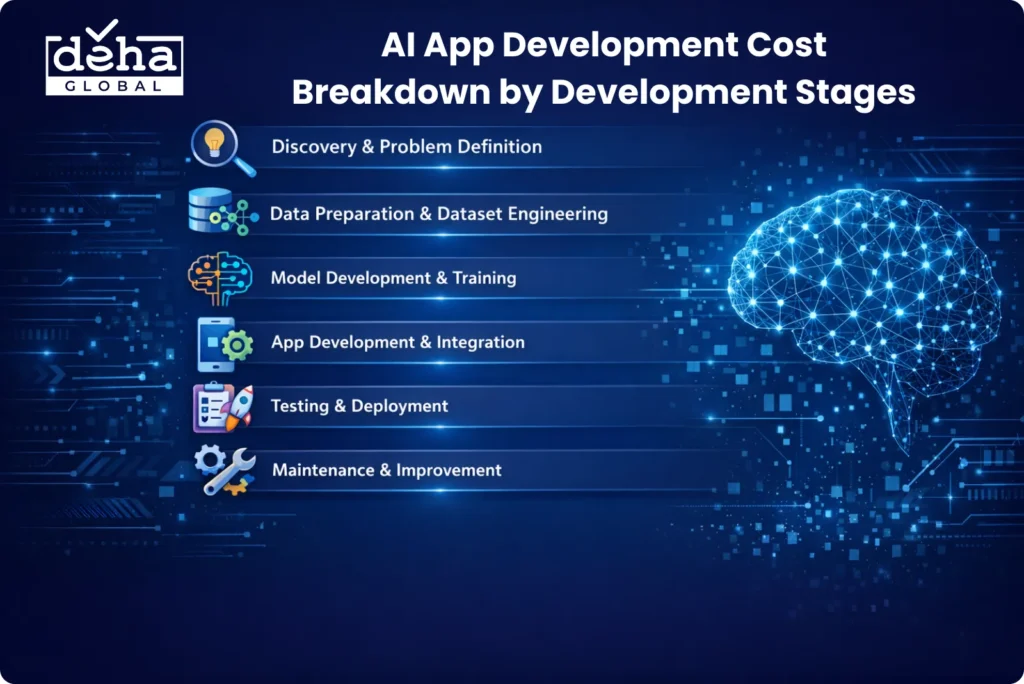
The discovery stage defines business goals, identifies use cases, and validates whether AI is the right solution. During this phase, teams conduct feasibility studies, assess available datasets, and design an initial system architecture to determine the technical requirements and expected return on investment.
Typical activities in this stage include defining business goals, identifying AI opportunities, conducting data availability assessments, and planning prototype architecture. Although discovery generally represents only 5–10% of the total AI development budget, it plays a critical role in reducing project risk because poorly defined AI use cases are one of the primary reasons why many AI initiatives fail to reach production.
Data preparation is widely recognized as one of the most resource-intensive stages in AI App Development because machine learning models depend on high-quality datasets for training and validation. Organizations must collect, label, clean, and transform raw datasets before the data can be used effectively for machine learning workflows.
Key tasks during this stage include:
Industry estimates indicate that data preparation can consume 40–60% of the total AI project timeline, making it one of the most expensive phases of AI development.
The model development stage focuses on transforming prepared datasets into functional AI models capable of solving real business problems. Engineers select appropriate machine learning algorithms, train models using large datasets, and optimize model performance through multiple iterations.
Typical activities include selecting machine learning frameworks, training models with datasets, performing hyperparameter tuning, and validating model accuracy. For many AI projects, the cost of model training can be substantial because high-performance computing resources such as GPUs are required to process large datasets and run complex neural network architectures.
In large-scale AI systems, training advanced models can cost tens of thousands to hundreds of thousands of dollars, depending on dataset size, algorithm complexity, and infrastructure requirements.
Once AI models have been trained and validated, the next stage focuses on integrating the AI capabilities into a functional application that can be used by end users. This phase involves building the application interface, developing backend services, and connecting the AI models with existing enterprise systems.
Key tasks typically include:
This stage often accounts for 20–30% of the total AI development budget, particularly in enterprise environments where AI systems must integrate with multiple internal systems and business platforms.
Before an AI application can be deployed into a production environment, the system must undergo extensive testing to ensure reliability, accuracy, and scalability. AI systems need more validation than traditional software, as predictions must match real-world data.
Important activities during this stage include:
Testing and validation are critical for preventing costly failures because a significant number of AI projects struggle to transition from prototype to production due to insufficient validation processes.
Unlike traditional software systems, AI applications require continuous monitoring and improvement after deployment because model accuracy can degrade over time as new data patterns emerge. Organizations must implement ongoing maintenance processes to ensure that AI models remain accurate and reliable.
Typical maintenance activities include:
Maintenance and ongoing optimization typically represent 10–20% of the original development cost annually, making long-term cost planning essential for successful AI adoption.
There is no “one-size-fits-all” budget in the AI era, as the capital needed for a lean MVP differs vastly from that of a multi-modal enterprise ecosystem. By categorizing costs based on project size, this guide provides a realistic financial benchmark to help you align your development roadmap with your current business scale.
| AI MVP | Mid-Scale AI Application | Enterprise AI Platforms | |
| Estimated Cost | $30,000 – $70,000 | $70,000 – $150,000 | $150,000 – $500,000+ |
| Development Timeline | 2–4 months | 4–8 months | 8–12+ months |
| Purpose | Validate AI concept and test product-market fit | Deploy production-ready AI applications with moderate complexity | Build large-scale AI ecosystems supporting complex business operations |
| Typical Features | – AI chatbot for customer support – Basic recommendation engine – Automated tagging or classification tools | – AI analytics dashboards – Predictive demand forecasting – Intelligent scheduling systems | – Advanced predictive analytics platforms – Large recommendation engines – Fraud detection or risk Management systems – Generative AI assistants |
| Key Cost Drivers | – Dataset availability – Integration with existing software systems – Limited feature scope | – Multiple AI features – Integration with enterprise databases – Scalable cloud infrastructure |
While a retail chatbot might be cost-effective, a healthcare AI demands a much larger investment due to 2026’s stringent regulatory compliance and high-precision requirements. We explore industry-specific pricing trends so you can understand the unique technical and legal overheads associated with your particular niche.
Healthcare AI applications often focus on tasks such as medical image analysis, clinical decision support, predictive diagnostics, and patient monitoring systems. These AI systems must comply with strict healthcare regulations and data privacy requirements such as HIPAA or GDPR.
Typical cost considerations include:
Healthcare AI solutions often range from $100,000 to $600,000+, depending on system complexity and compliance requirements.
AI technology is widely used in financial services to support fraud detection, credit scoring, risk assessment, and algorithmic trading. FinTech AI systems require high levels of accuracy and strong cybersecurity infrastructure because they handle sensitive financial data.
Key factors influencing development cost include:
FinTech AI applications often range between $120,000 and $400,000, depending on system scale and data security requirements.
Retail companies use AI to power product recommendation engines, demand forecasting systems, dynamic pricing algorithms, and personalized marketing automation. These AI solutions focus primarily on improving customer experience and increasing sales conversion rates.
Typical AI implementation tasks include:
Retail AI solutions often cost $60,000 – $200,000, depending on integration complexity and personalization capabilities.
Logistics companies use AI to optimize supply chain operations through route optimization, predictive maintenance, demand forecasting, and warehouse automation systems.
Important cost drivers include:
AI solutions in logistics typically cost $80,000 – $250,000, depending on the number of operational systems involved.
Manufacturing organizations deploy AI to support predictive maintenance, production optimization, quality inspection using computer vision, and intelligent robotics automation.
Key cost considerations include:
Manufacturing AI systems often require budgets between $100,000 and $300,000, especially when integrated with factory automation systems.
In Conclusion
Understanding the real AI App Development cost requires analyzing multiple variables such as system complexity, infrastructure needs, and data preparation requirements. Companies that evaluate cost drivers, including development stages, project scope, and industry regulations, can make more informed AI investment decisions. By adopting a structured cost estimation approach, enterprises can reduce risks and achieve stronger returns from their AI initiatives.