Artificial intelligence is fundamentally transforming how companies build digital products, ranging from sophisticated predictive analytics platforms to intuitive AI-powered mobile apps.
However, a critical strategic question arises early in every AI project: Should your company build the AI application in-house or outsource development to an external partner?
In this article, we break down AI app development cost structures, trade-offs, and when each model makes sense from a business perspective.
In-House vs Outsourced AI App Development: Budget Comparison
One of the most significant differences between development models is the AI app development cost structure. Each approach requires different financial commitments, operational resources, and long-term investments. Therefore, organizations must evaluate how both models influence project budgets, resource allocation, and scalability before deciding how to execute an AI App Development strategy.
Typical AI App Development Cost
The overall cost of building an AI application varies widely depending on complexity, data requirements, infrastructure, and AI model sophistication. In many cases, enterprises allocate significant budgets to build scalable and production-ready AI systems. Industry estimates indicate that AI App Development projects typically range from tens of thousands to several hundred thousand dollars, depending on scope.
Below are common categories of AI applications and their typical development costs:
- Basic AI applications: $30,000 – $75,000
These solutions usually include simple AI functions such as chatbots, recommendation engines, or rule-based automation.
- Mid-level AI applications: $75,000 – $150,000
These applications often involve machine learning models, predictive analytics systems, or AI-powered mobile applications.
- Enterprise AI systems: $150,000 – $500,000+
Enterprise platforms typically include complex architectures, large-scale data pipelines, and custom AI models trained for specific business operations.
- Advanced AI/ Generative AI: $500,000+
These solutions often require large training datasets, distributed cloud infrastructure, and specialized AI engineers.
Because AI systems rely heavily on data processing, model training, and infrastructure resources, AI Cost tends to increase significantly as application complexity grows.
Cost Structure of In-House AI Development
An in-house development team requires significant upfront investment because the organization must build an entire engineering ecosystem internally. Companies typically allocate budgets across several operational areas.
An in-house development team requires significant upfront investment, including:
- Talent: AI engineers and data scientists command high salaries due to their specialized expertise. In many global markets, the annual compensation for experienced AI developers can exceed $150,000 – $200,000 per engineer, excluding bonuses and benefits.
- Infrastructure (GPU, Cloud, Data pipeline): AI systems require powerful computing environments for training models and processing large datasets. Companies often spend $2,000 – $20,000 per month on cloud infrastructure, depending on the workload and GPU usage.
- AI tooling and software licenses: Organizations frequently invest in enterprise AI tools, data platforms, and model monitoring systems. These licenses may cost $5,000 – $25,000 annually depending on the platform and integration requirements.
- Hiring and training costs: Recruiting AI engineers costs can reach $4,000 – $5,000 per hire, while onboarding and training may require several months of additional investment.
- Ongoing operational overhead: Maintaining an internal team requires office space, equipment, HR management, and administrative overhead. These operational costs often add 30% to 50% on top of employee salaries, significantly increasing the total cost of ownership.
Because of these combined factors, in-house AI development often represents a long-term capital investment rather than a short-term project expense.
Cost Structure of Outsourced AI Development
Outsourcing shifts many development responsibilities to external vendors, allowing organizations to convert fixed engineering costs into flexible project-based spending.
Common cost components of outsourced AI development include:
- Project-based development fees: Many outsourcing partners provide fixed price contracts or milestone-based billing models. Typical AI development projects range between $30,000 and $300,000 depending on complexity, which allows businesses to control budgets more predictably.
- Hourly rates: External AI engineers usually charge hourly rates based on region and expertise. For example, development teams in Eastern Europe may charge around $30 – $75 per hour, while North American specialists may charge more than $100 per hour.
- Infrastructure and AI model usage costs: Many outsourcing partners integrate cloud infrastructure into their service offerings. However, companies may still need to pay for computing resources, data storage, and API usage depending on the AI architecture.
- Communication and project management costs: External collaboration requires structured communication processes, documentation, and coordination. Although these costs exist, they are generally lower than maintaining a full internal engineering department.
- Optional Maintenance: AI applications require ongoing monitoring, model retraining, and performance optimization. Outsourcing partners often provide maintenance contracts ranging from $2,000 – $10,000 per month, depending on system complexity.
Because outsourcing eliminates recruitment overhead and long-term staffing commitments, many companies experience 20–40% cost savings compared to in-house teams while maintaining development flexibility.
In-house vs Outsourcing: How to Decide for AI App Development
Read on to discover when you should consider outsourcing, or when to rely on your in-house team to develop a secure AI App.
Key Factors for Choosing the Right Development Model
- Core IP Protection – If the AI algorithm is your primary intellectual property and unique competitive advantage, maintaining an in-house team is the safer choice to ensure maximum control and confidentiality. Conversely, for non-core features, outsourcing allows you to benefit from external innovation without risking your most sensitive trade secrets.
- Talent Availability & Infrastructure – Building internally requires a long-term commitment to high-cost recruitment and specialized hardware setup, which may delay your project launch significantly. Outsourcing provides immediate access to a pre-vetted pool of AI experts, making it the ideal solution for companies needing to scale quickly without the overhead of permanent hires.
- Specialized Skill Sets Management – AI projects often demand a diverse range of niche skills, from data engineering to deep learning, which can be difficult to manage within a small in-house team. An outsourcing model offers a more versatile approach by allowing you to tap into broad expertise on demand, ensuring every technical aspect of your product vision is executed correctly.
- Long-term Product Vision – For enterprises planning to make AI the heart of their future product roadmap, investing in an internal department fosters deep institutional knowledge and continuous evolution. However, if your goal is to validate a concept or launch a specific AI-powered tool rapidly, the flexible cost structure of outsourcing provides a more efficient path to a permanent competitive advantage.
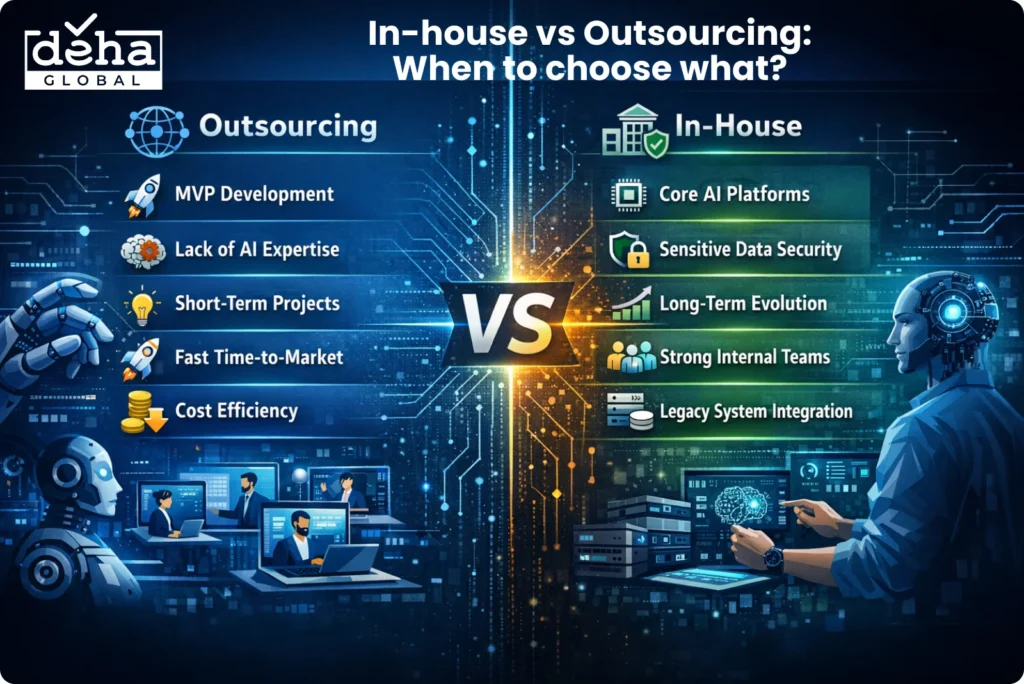
When to choose Outsourcing
The outsourcing model works best in situations where businesses require flexibility, speed, and access to specialized AI expertise.
- MVP AI product development: Startups that are validating an AI-driven business idea often choose outsourcing because external teams can deliver prototypes faster without requiring long-term hiring commitments.
- Limited internal AI expertise: Organizations that lack experienced machine learning engineers benefit from outsourcing because specialized vendors already possess the required technical capabilities.
- Short-term innovation projects: Companies running AI experimentation programs or proof of concept initiatives often prefer outsourcing since the engagement period is limited.
- Rapid product launch timelines: Businesses that must release AI features quickly often rely on outsourced teams because vendors can deploy ready-made engineering teams immediately.
- Budget-constrained digital transformation initiatives: Enterprises with limited technology budgets may choose outsourcing to reduce recruitment costs and infrastructure investment.
When to choose In-house
In-house development becomes advantageous when AI technology plays a central role in a long-term business strategy.
- Core AI-powered product platforms: Companies building AI products as their primary offering usually prefer internal teams to maintain full control over product architecture and intellectual property.
- Highly sensitive or regulated data environments: Industries such as healthcare, finance, or defense often choose in-house development to ensure strict compliance with internal security policies.
- Continuous long-term product evolution: Businesses that plan to expand AI capabilities for several years may benefit from building a stable internal engineering team.
- Strong internal engineering culture: Companies with mature technical teams often integrate AI engineers directly into their product development processes.
- Deep integration with proprietary systems: Organizations with complex internal infrastructure sometimes prefer in-house development because internal teams already understand legacy systems and data pipelines.
How to Choose the Right AI App Development Outsourcing Partner
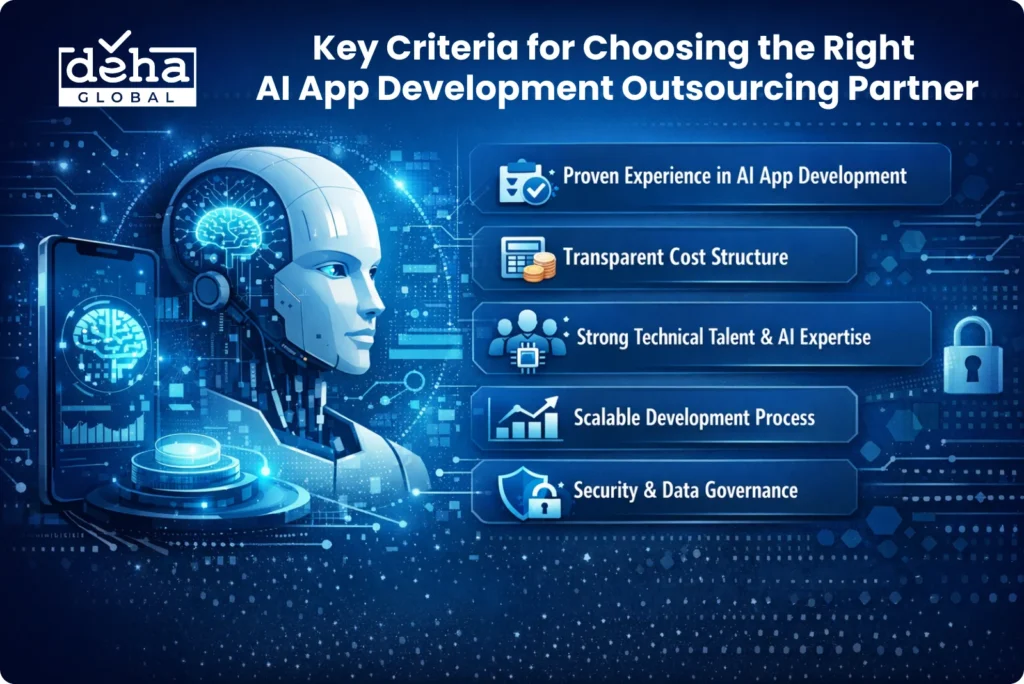
Selecting the right outsourcing partner is essential to ensure that AI app development delivers long-term value. Companies should evaluate vendors carefully across several technical and operational dimensions before committing to a development partnership.
1. Real AI Experience
A reliable outsourcing partner should demonstrate extensive experience delivering AI solutions across multiple industries. Proven expertise indicates that the vendor understands the full lifecycle of AI App Development, from data preparation to model deployment.
Key areas of technical experience include:
- Machine learning applications
- Natural language processing solutions
A vendor with experience across these domains is more likely to deliver robust and scalable AI solutions.
2. Cost Transparency
AI development projects involve several hidden cost drivers that many organizations underestimate during early planning stages. Therefore, outsourcing partners should provide clear cost breakdowns and realistic budget forecasts.
Important cost components typically include:
- Data preparation and labeling
- Model retraining and maintenance
Transparent pricing helps companies avoid unexpected expenses during long-term AI system operation.
3. Engineering Quality
The success of an AI product heavily depends on the technical expertise of the development team. Companies should evaluate the vendor’s engineering capabilities and technical stack before signing any partnership agreement.
Evaluation criteria may include:
- Developer expertise in machine learning and data engineering
- AI frameworks used, such as TensorFlow or PyTorch
- Previous AI project success stories
These factors indicate whether the outsourcing partner has the ability to deliver high-quality AI systems.
4. Scalable Process
AI products evolve rapidly as new data becomes available, and models require continuous improvement. Therefore, outsourcing vendors should follow scalable development frameworks such as Agile or iterative MVP development to support continuous improvement.
A structured development process allows businesses to adapt to AI features quickly and improve system performance over time.
5. Security and Data Governance
AI systems often process sensitive data such as customer information, financial transactions, or healthcare records. As a result, companies must ensure that outsourcing partners follow strict security and compliance standards.
Key security practices include:
- Compliance with data privacy regulations
- Secure infrastructure practices
- NDA and intellectual property agreements
These safeguards help organizations protect proprietary algorithms and maintain full ownership of their AI solutions.
In Conclusion
The success of any AI-driven project depends heavily on the chosen delivery model, as this decision dictates the trajectory of both development speed and resource allocation. Consequently, enterprises must weigh the benefits of direct oversight against the agility offered by third-party experts to optimize their long-term investment.
Although maintaining an in-house team ensures that core intellectual property remains strictly within the organization, it necessitates a long-term commitment to infrastructure and talent development. On the other hand, the outsourcing model offers a more versatile approach to managing specialized skill sets, helping businesses execute their product vision correctly and turn AI technology into a permanent competitive advantage.