AI App Development for Startup: What Founders Need to Know Before Building
May 21, 2026






AI app development is more accessible than ever. With APIs, pre-trained models, and cloud infrastructure, startups can launch AI-powered products much faster than before.
However, building an AI app is very different from building traditional software. The real challenge is not adding AI features, but creating a product that can scale, manage data effectively, and deliver reliable user experiences under real business conditions. Many founders focus too heavily on the technology itself while overlooking workflow design, operational complexity, and long-term scalability.
This article provides a complete overview of AI app development, helping startups understand the process, costs, and best practices before building their first AI product.
AI app development refers to building software that uses artificial intelligence to perform tasks that require human judgment. These tasks include language understanding, pattern recognition, and content generation. For startups, AI app development is less about building from scratch and more about integrating intelligence into a specific workflow.
In practical terms, most AI products today rely on existing models and cloud services rather than proprietary research. Founders do not need to train large language models themselves to build useful AI applications. In fact, trying to do so too early usually introduces unnecessary complexity and infrastructure cost.
The real challenge is identifying where AI meaningfully improves the user experience or automates a high-friction process.
In B2B SaaS products, this often means:
In consumer applications, AI is more commonly used for personalization, recommendation systems, conversational interfaces, or content generation.
For startup founders, this distinction influences every major decision. It affects system architecture, hiring strategy, vendor selection, and go-to-market timing. Therefore, understanding this difference is critical from the beginning.
Core AI capabilities commonly built into startup apps:
AI app types by business model:
| Type | Best for | Example use case |
| B2C consumer app | User-facing personalization | AI fitness coach, language learning app |
| B2B SaaS tool | Workflow automation for businesses | AI-powered CRM, smart invoice processing |
| Internal ops tool | Reducing internal overhead | AI code reviewer, smart HR screening |
| AI-enhanced marketplace | Matching & recommendation | Property suggestions, freelancer matching |
The most common AI capabilities integrated into apps today include personalization, automation of repetitive workflows, advanced analytics from user data, and conversational AI powering chatbots and voice assistants. Startups that clearly define which capability they are building — rather than pursuing “AI” as a vague goal — ship faster and spend less.
Building an AI application requires a structured process. This process differs significantly from traditional software development. It combines strategic planning, data science, engineering, and UX design. Skipping early steps often creates long-term problems. In particular, weak data preparation or incorrect model selection leads to costly issues at launch.
AI development follows a structured journey. The process usually starts with a strategic planning phase that lasts 2–4 weeks. During this phase, product owners define objectives and analyze market needs.
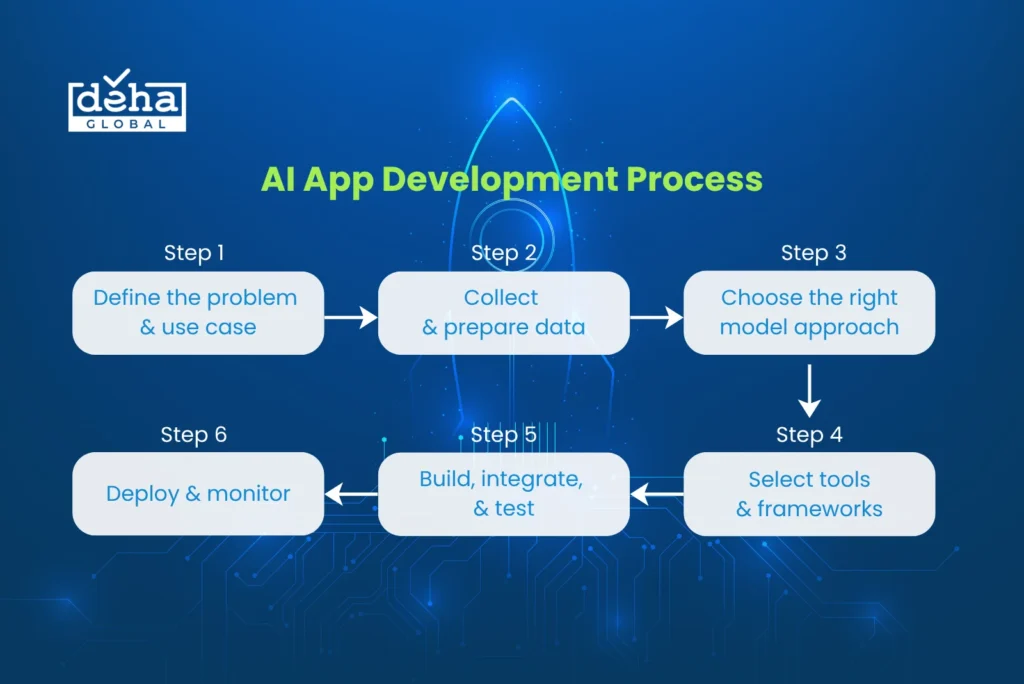
Before any technical work begins, the startup must define precisely what the AI component will solve. Having a specific goal helps select the right data, algorithms, and infrastructure. Broad goals like “make the app smarter” produce unfocused builds; a specific goal like “reduce support ticket volume by 40% through an intent-detection chatbot” produces a testable product.
AI models are only as good as the data they are trained on. Focus first on ensuring its accuracy, completeness, and relevance rather than simply collecting large volumes. For most early-stage startups, this means sourcing existing labeled datasets, using public datasets, or implementing structured data collection from day one.
Startups rarely need to train models from scratch. Using pre-trained models such as OpenAI, Salesforce Einstein, or Google Vertex AI can reduce development and training costs for startups to create AI apps quickly. Custom training becomes relevant only when domain-specific accuracy requirements exceed what off-the-shelf models can deliver.
Popular AI tools used in app development include TensorFlow for machine learning, Core ML for iOS features like face recognition, Dialogflow for conversational assistants, and Microsoft Azure AI for cloud-based intelligent apps. The right stack depends on the app’s primary AI function and the team’s existing expertise.
AI models behave differently in real-world scenarios compared to lab conditions. Continuous testing is necessary throughout the development cycle, including A/B tests to compare AI-driven versus non-AI workflows. Functional testing should happen in parallel with model performance evaluation.
Deployment is not the end of the process. Build a feedback loop into the workflow to ensure models stay up-to-date and relevant. Model drift — where accuracy degrades as real-world data patterns shift — is one of the most common and underestimated post-launch challenges for AI startups.
Estimated development timeline by scope:
| App scope | Typical timeline | Key variable |
| AI MVP (single feature) | 4 – 8 weeks | Pre-trained model vs. custom training |
| Mid-complexity AI app | 3 – 6 months | Data availability and UI complexity |
| Full-scale AI product | 6 – 12+ months | Custom model training and enterprise integrations |
In 2026, the speed of experimentation matters more than technical perfection. The companies that win are not the ones with the most advanced models — they are the ones that learn the fastest.
Cost remains one of the most underestimated factors in AI development. AI engineers and data scientists typically charge higher rates due to specialized expertise. In addition, infrastructure and API costs increase as usage grows.
Total investment includes multiple cost layers. These layers scale at different rates as the product grows. Therefore, startups must plan beyond initial development expenses.
Key cost components:
Estimated budget ranges by app type:
| App type | Estimated cost range | Notes |
| AI MVP (single feature, pre-trained model) | $15,000 – $40,000 | Fastest to market; validates core AI hypothesis |
| Mid-tier AI app (custom integrations) | $40,000 – $120,000 | Adds data pipeline and custom model tuning |
| Enterprise-grade AI product | $120,000 – $500,000+ | Custom model training, compliance, and enterprise integrations |
Cost optimization strategies:
Most AI app failures are not technical — they are strategic. The most promising AI applications for startups focus on solving specific industry problems rather than implementing AI for its own sake. The following practices distinguish products that sustain traction from those that launch and stall.

In Conclusion
The startups that succeed with AI are not the ones with the largest budgets. They are the ones who learn and adapt the fastest. These companies launch small, intelligent products early. They measure performance carefully and iterate continuously. As a result, they improve faster than competitors.
AI app development has become more accessible than ever. Therefore, execution speed now matters more than technical complexity. The next step is simple: choose the right problem and start building.