AI Development Benefits in 2026: Strategic Advantages for Enterprises
March 05, 2026





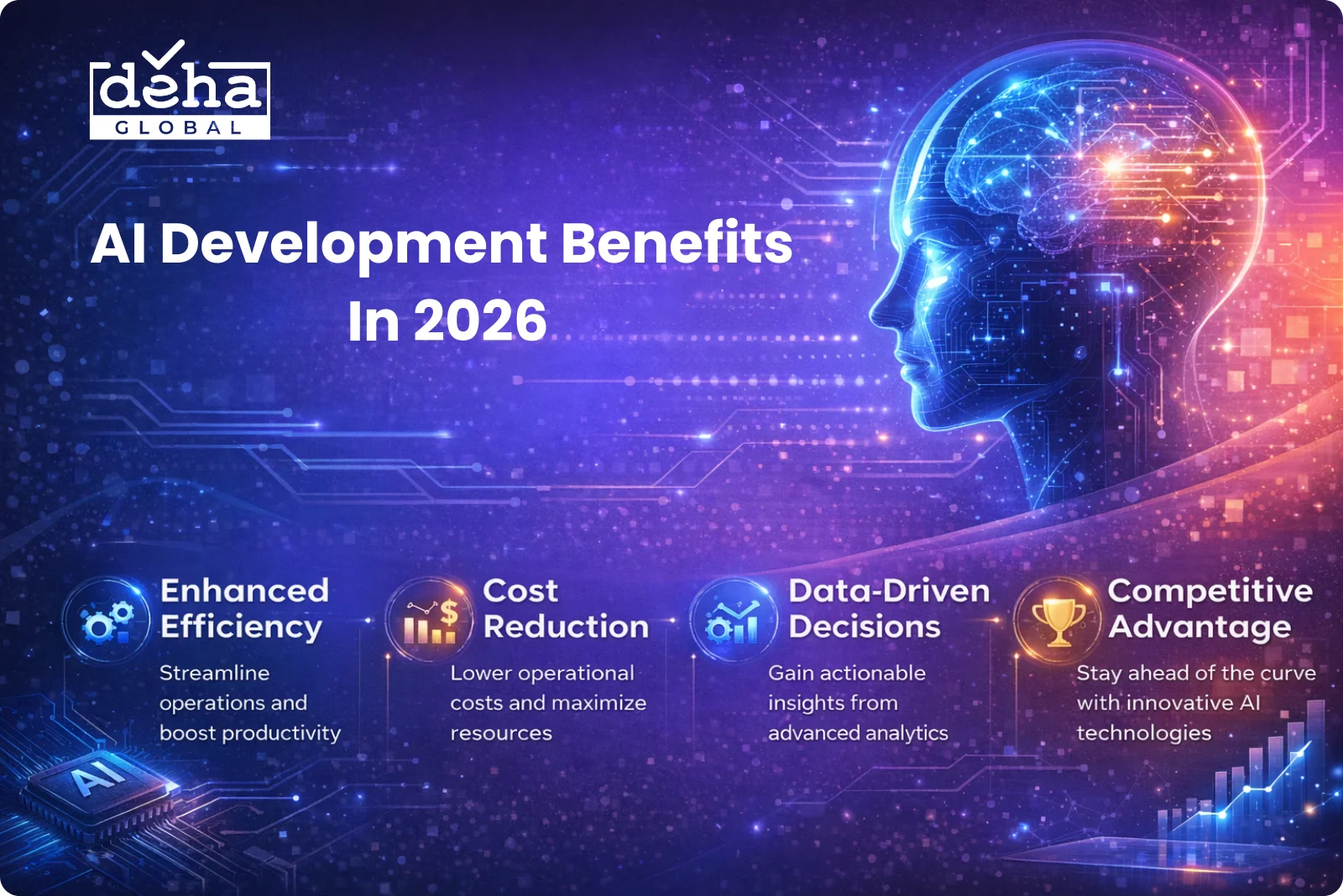
Artificial intelligence (AI) continues to evolve rapidly, and enterprises across industries are integrating AI into their core systems to optimize operations, enhance financial performance, and strengthen management efficiency. A strategic and well-planned approach to AI adoption enables your organization to unlock both immediate improvements in productivity and long term competitive advantages, which clearly demonstrate the growing importance of AI development benefits in modern business strategy.
In this article, we will explore the latest AI developments for 2026 and examine whether your enterprise should leverage these advantages early to stay ahead in an increasingly data-driven economy.
Enterprise adoption of AI has accelerated significantly between 2024 and 2026, as organizations move beyond pilot initiatives and integrate AI into core business functions. Recent industry reports indicate that more than half of large enterprises have already deployed AI in at least one operational process, and investment levels continue to rise year over year. This growth reflects a broader recognition that AI development benefits are no longer theoretical but measurable across financial and operational metrics.
Financial services, healthcare, retail, and logistics remain the leading industries in AI investment due to their strong reliance on data-driven decision-making and automation. Enterprises in these sectors are shifting from experimentation toward production-ready AI systems that support fraud detection, predictive maintenance, personalized marketing, and intelligent supply chain management. As a result, AI has transitioned from an innovation experiment to a strategic operational asset embedded within enterprise infrastructure.
Let’s explore the key advantages of AI development and examine how these benefits can help your enterprise advance further in this era of intelligent transformation.
Many businesses encounter barriers during AI implementation that prevent them from achieving their intended objectives. The following obstacles represent common challenges that your organization should anticipate and address when defining its AI development strategy.

A lack of clearly defined objectives often causes AI initiatives to operate in isolation from broader business goals. This misalignment reduces the measurable impact of AI development and creates confusion regarding success metrics. To solve this issue, enterprises should align AI projects with specific financial KPIs and long-term strategic priorities from the outset.
Poor data quality and fragmented data systems limit the effectiveness of AI models and reduce prediction accuracy. AI development relies heavily on clean, structured, and integrated datasets to deliver reliable outcomes. As a result, organizations must establish strong data governance frameworks and unify data sources before scaling AI initiatives.
The shortage of experienced AI engineers, data scientists, and machine learning specialists slows down AI implementation and increases project risks. Limited internal expertise can also lead to poorly designed models or inefficient deployment processes. In order to overcome this barrier, enterprises should invest in upskilling programs or collaborate with experienced AI development partners.
Legacy IT infrastructure often lacks compatibility with modern AI technologies, which complicates deployment and increases integration costs. This technical complexity can delay AI implementation timelines and reduce system performance. As a result, enterprises should adopt modular architectures and phased integration strategies to modernize infrastructure gradually.
Employees and management teams may resist AI adoption due to fear of job displacement or uncertainty about new workflows. This resistance can slow AI development progress and limit enterprise-wide adoption. To address this challenge, leadership should communicate clear benefits and provide structured change management programs.
Many AI models operate as opaque systems that lack explainability, which creates trust and compliance concerns. This lack of transparency can discourage stakeholders from relying on AI-driven decisions. As a result, enterprises should implement explainable AI frameworks and governance policies to increase accountability and stakeholder confidence.
AI implementation costs often extend beyond initial development expenses and include infrastructure, maintenance, data processing, and talent acquisition. Misjudging these variables can reduce ROI and create budget overruns. In order to manage this complexity, enterprises should conduct comprehensive cost assessments and develop phased investment plans aligned with measurable outcomes.
It can be difficult to visualize how AI development delivers real business success if your enterprise has never experimented with practical AI applications. The following real-world examples demonstrate how organizations have successfully developed and deployed AI systems to achieve measurable results, helping you understand how AI development unfolds in practice and what outcomes it can generate.
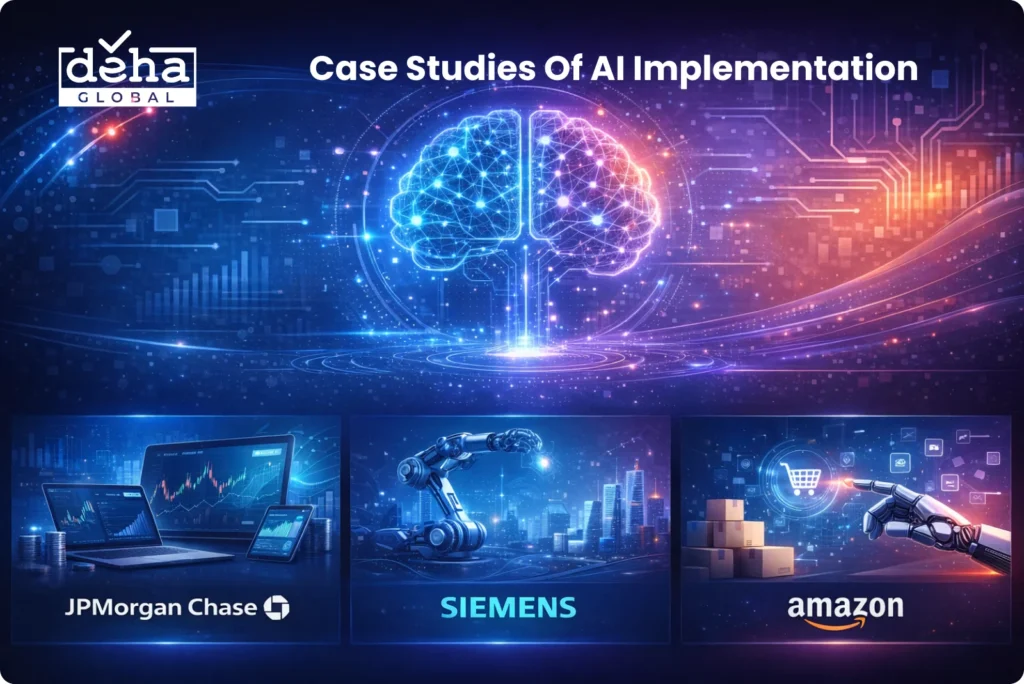
JPMorgan Chase is one of the largest financial institutions in the world, operating in investment banking, asset management, and retail banking. The organization implemented AI-powered systems to support fraud detection, contract analysis, and risk assessment through advanced machine learning models. These intelligent systems assist internal teams by processing vast volumes of financial transactions and legal documents more efficiently than manual review.
Achievements:
Siemens is a global industrial manufacturing and engineering company specializing in automation, energy systems, and digital industries. The company integrated AI into its industrial IoT platforms to monitor equipment performance and predict maintenance needs before failures occur. These AI systems analyze sensor data from machinery to optimize maintenance schedules and production efficiency.
Achievements:
Amazon is a global leader in e-commerce, cloud computing, and digital services. The company leverages AI across its ecosystem to power recommendation engines, warehouse automation, and intelligent logistics planning. These AI-driven systems support demand forecasting, personalized product suggestions, and route optimization.
Achievements:
Based on the challenges, benefits, and real-world examples discussed above, let us now explore practical approaches that can help your enterprise maximize the value generated from AI development.
Clear alignment between AI initiatives and measurable business objectives ensures that projects deliver tangible value rather than experimental outcomes. Your enterprise should define specific KPIs, such as cost reduction targets, revenue growth projections, or efficiency benchmarks, before initiating development, which allows leadership to evaluate performance objectively and prioritize high-impact use cases.
High-quality, well-structured data is essential for reliable AI performance and predictive accuracy. Organizations should implement standardized data collection processes, centralized data warehouses, and strict governance policies to maintain consistency, security, and regulatory compliance across departments.
A scalable system architecture allows AI models to expand alongside business growth without high reengineering costs. Enterprises should adopt modular development approaches and cloud-based infrastructures so that new AI components can be integrated gradually while maintaining operational stability.
AI success depends heavily on skilled professionals who understand machine learning, data engineering, and model governance. Your organization should combine internal training programs with external partnerships to ensure access to specialized expertise while fostering long-term knowledge development within the enterprise.
Continuous performance evaluation ensures that AI systems remain efficient, accurate, and aligned with strategic objectives. Enterprises should implement dashboards that track metrics such as prediction accuracy, processing speed, cost savings, and revenue impact, which enable data-driven adjustments and sustained value creation over time.
In Conclusion
AI development offers substantial advantages for enterprises that aim to optimize operations, improve decision-making, and build sustainable competitive differentiation in a rapidly evolving market. A clear understanding of AI development benefits allows your organization to invest in a strategy.