GenAI Development in Healthcare: From Pilot Experiments to Operational Impact
May 12, 2026





Healthcare organizations are no longer asking whether generative AI matters. Most hospitals, clinics, and healthcare technology providers have already tested AI in some form, from clinical documentation tools to patient-facing assistants.
The bigger challenge now is turning those experiments into systems that are safe, scalable, and operationally useful. In practice, healthcare AI adoption is rarely limited by model capability alone. Integration with existing workflows, regulatory requirements, physician trust, and data governance often become the real barriers to deployment.
This article explores practical healthcare use cases, measurable business benefits, and implementation considerations for organizations planning to scale generative AI initiatives responsibly.
Before investing in generative AI, healthcare leaders benefit from understanding which functions deliver the most immediate value.
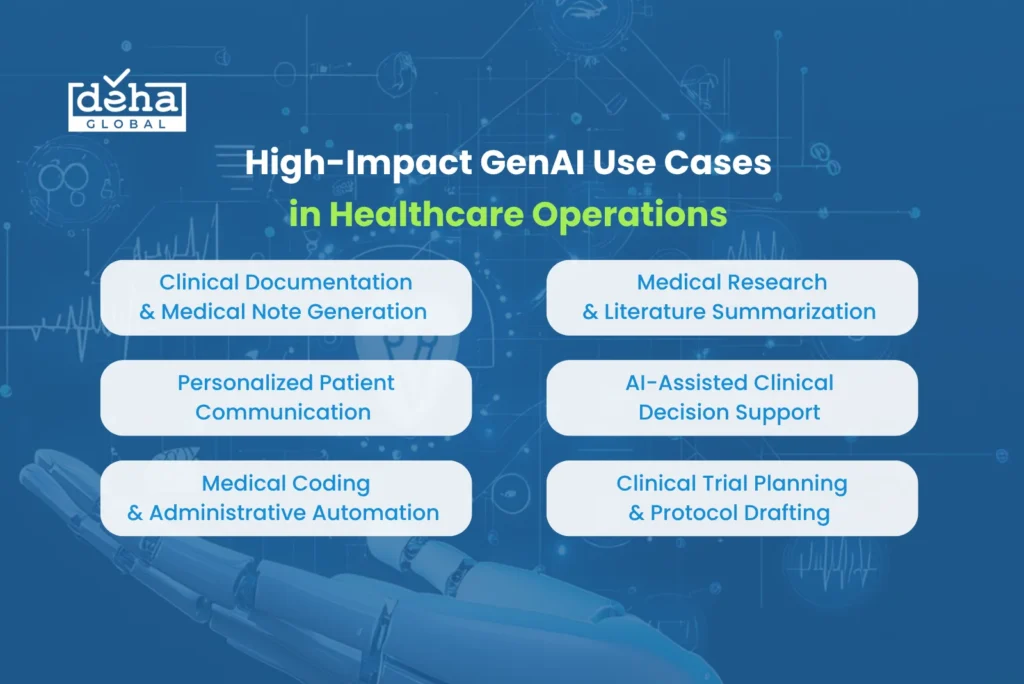
The following sections describe concrete, realistic use cases that can be turned into structured Gen AI Development projects.
| Use Case Category | Typical impact in healthcare |
| Clinical Documentation | Reduced administrative burden for clinicians. |
| Research and Literature Summarization | Faster literature review and discovery. |
| Patient Communication | Clearer, tailored explanations for patients. |
| AI-Assisted Clinical Decision Support | Structured, second‑opinion‑style support for clinicians. |
| Medical Coding and Billing | Faster, more consistent documentation for reimbursement. |
| Clinical Trial Design | Accelerated planning and protocol drafting. |
| Internal Knowledge and Training | Rapid access to guidelines and policy information. |
Documentation remains one of the largest sources of administrative burden in healthcare environments. Physicians often spend hours updating electronic health records (EHRs), preparing discharge summaries, and documenting patient encounters.
Generative AI systems can help reduce that workload by drafting:
Many healthcare organizations are also exploring ambient clinical intelligence solutions that convert physician-patient conversations into structured medical documentation.
The goal is not to replace clinicians. Human review remains essential. Instead, these systems help reduce repetitive typing and allow healthcare professionals to spend more time focused on patient care rather than administrative tasks.
For healthcare providers facing clinician burnout and staffing shortages, documentation support is often one of the most immediately valuable AI investments.
Healthcare researchers and medical teams process enormous volumes of clinical studies, journal articles, treatment guidelines, and regulatory updates.
Generative AI can significantly accelerate literature review workflows by:
This becomes particularly valuable in:
Instead of manually reviewing hundreds of documents, research teams can focus attention on the most relevant insights and high-priority findings.
In fast-moving healthcare domains, reducing research turnaround time can directly improve decision-making speed and innovation cycles.
One of the most practical applications of Generative AI Development in healthcare is improving patient communication.
Medical information is often difficult for non-clinical audiences to understand. Patients may struggle with:
Generative AI systems can help healthcare organizations create:
This improves patient engagement while reducing confusion around treatment plans and care instructions.
For hospitals and healthcare networks, clearer communication can also help reduce missed appointments, improve adherence, and support better patient satisfaction outcomes.
Generative AI is increasingly being explored as a decision-support layer for clinicians rather than an autonomous diagnostic system.
AI models can analyze:
to help surface relevant findings or suggest potential diagnostic considerations.
In practice, these tools function more like intelligent assistants that support physician workflows by organizing information and identifying patterns that may require attention.
However, healthcare organizations remain cautious in high-risk clinical scenarios.
Human oversight, explainability, validation processes, and governance controls remain essential, particularly in environments involving diagnosis, treatment recommendations, or patient safety decisions.
The most successful healthcare AI implementations usually position generative AI as a support system for clinicians, not a replacement for medical expertise.
Revenue cycle management remains a major operational challenge across healthcare systems.
Administrative teams spend significant time preparing:
Generative AI systems can help standardize portions of these workflows by generating structured drafts based on clinical records and operational data.
Potential benefits include:
For enterprise healthcare providers managing large patient volumes, even small efficiency improvements in administrative operations can produce a meaningful financial impact.
In pharmaceutical and life sciences environments, generative AI can support early-stage clinical trial preparation.
Teams can use AI systems to assist with:
These tools help research and regulatory teams move faster during planning phases while improving internal alignment across stakeholders.
Although human review remains mandatory, AI-assisted drafting can shorten preparation cycles and reduce manual coordination work in complex research environments.
Healthcare organizations manage large volumes of internal policies, treatment guidelines, operational procedures, and compliance documentation.
Finding accurate information quickly can be difficult, especially across large hospital networks or multi-location healthcare systems.
AI-powered internal knowledge systems allow healthcare staff to:
This supports:
For healthcare enterprises operating across multiple departments or facilities, internal AI knowledge systems can help standardize access to information at scale.
Beyond technical capabilities, healthcare stakeholders focus on measurable outcomes. Generative AI must deliver value for clinicians, patients, and operational leadership. Therefore, the following benefits highlight both clinical and business impact.
Medical environments face strict requirements for privacy, safety, and accountability, so Gen AI Development must be carefully structured from the beginning.
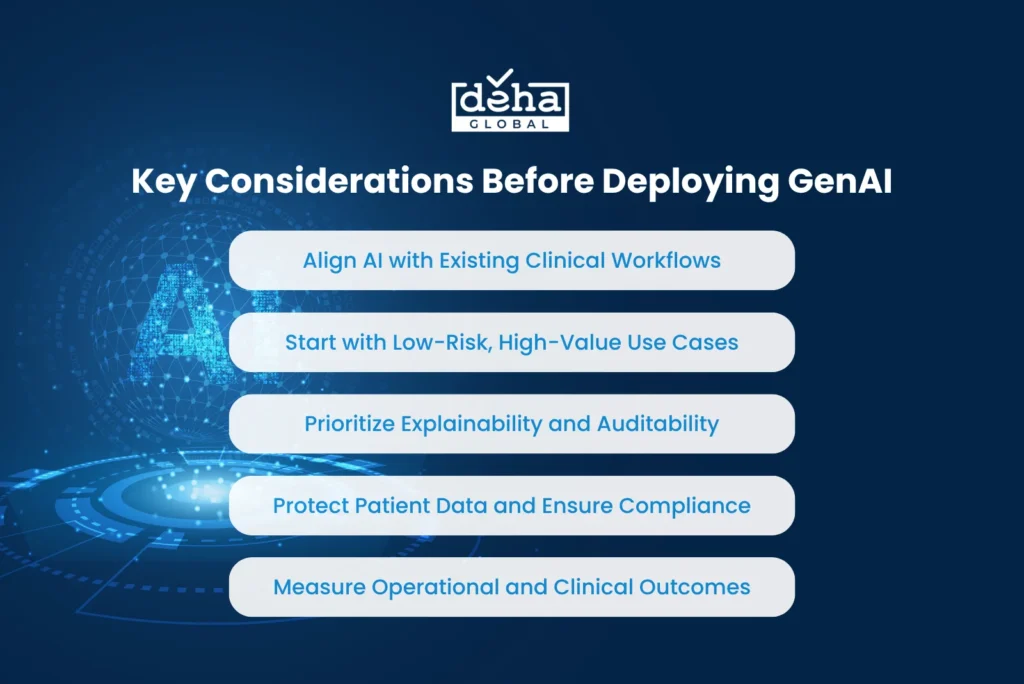
This section outlines key principles for designing, deploying, and governing generative AI projects in healthcare.
A Practical Readiness Checklist for Healthcare Organizations
In Conclusion
Generative AI development is gradually transforming healthcare services. It supports clinicians, patients, and administrative staff in more efficient and structured ways. As a result, medical systems can improve both operational performance and care quality.
By focusing on targeted use cases such as documentation, research, and patient communication, healthcare institutions can achieve measurable results. Therefore, the most effective approach is to start with controlled pilots. From there, stakeholders can scale solutions based on clinical evidence, user feedback, and regulatory requirements.