
According to Grand View Research, the global generative AI market reached $16.87 billion in 2024 and is expected to reach $109.3 billion by 2030. Growth is no longer the question – cost control is.
Yet many organizations still approach GenAI Development without a clear view of how costs evolve across each stage. The result? Budgets look reasonable on paper but quickly lose accuracy once projects move into execution.
In practice, AI Development costs vary widely based on scope and complexity. A simple application may start at around $50,000, while a full enterprise-grade solution can exceed $1.5 million. What’s often missed is the operational layer – where companies end up spending an additional $350,000 to $820,000 per year to keep systems running and improving.
This article breaks down what drives Generative AI Development cost – so you can plan investments with clarity instead of reacting when budgets are already off track.
What Actually Drives Generative AI Development Cost
The cost of building a generative AI product is never fixed. Instead, multiple variables interact and shape the total investment. Each factor can shift costs by tens or even hundreds of thousands of dollars.
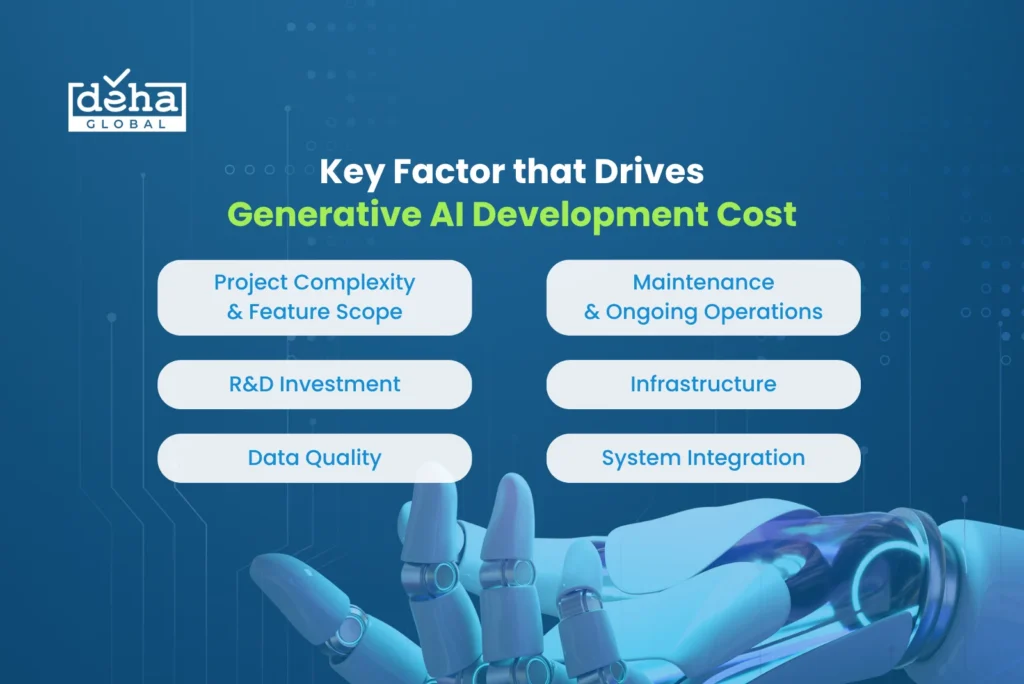
Therefore, organizations must understand these variables before defining project scope. This understanding supports more accurate budgeting and reduces financial risk. The table below provides a high-level view of how application type affects investment levels.
| Application Type | Estimated Development Cost Range |
| Basic GenAI app (simple text/image generation) | $20,000 – $150,000 |
| Feature-rich GenAI app (advanced capabilities, multi-system integration) | $100,000 – $500,000 |
| Full custom enterprise GenAI solution | $600,000 – $1,500,000 |
| Customizing an existing foundation model | ~$10,000,000 |
| Building a proprietary AI model from scratch | Up to $200,000,000 |
1. Project Complexity & Feature Scope
Application complexity directly drives generative AI development costs. The total investment increases as feature requirements expand. It also rises with the variety of content types and the number of tasks handled at scale
Why it matters: A simple customer-facing chatbot costs far less than a multimodal system. The difference becomes clear when the system must generate text, images, and code simultaneously. Content type also plays a key role in cost structure. Text-based systems remain more affordable, while image, video, or audio systems require higher computational resources.
Estimated ranges:
- Basic text generation applications: $20,000–$50,000
- Feature-rich applications with advanced NLP or multimodal capabilities: $120,000–$500,000
How to control this cost: Teams should prioritize features carefully during the scoping phase. A narrow and high-impact use case reduces initial investment. At the same time, it allows organizations to validate ROI before expanding the product roadmap.
2. R&D Investment: Talent is Still a Bottleneck
R&D investment includes the expertise required to design and refine AI models. This phase demands highly skilled talent, which remains limited and expensive. As a result, more innovative applications require higher R&D budgets.
Specific cost components:
- US-based AI engineers: Annual salaries typically range from $90,000 to $250,000, depending on experience level and location, though the market has shown some softening from 2023 peaks as talent supply increases.
- Offshore AI development partners: Firms in regions such as South Asia and Eastern Europe typically charge $50–$120 per hour, while senior ML architects in competitive markets command $150–$250+ per hour.
- Regional comparison for reference:
| Region | Typical AI Developer Hourly Rate |
| USA / Canada | $100 – $250+ |
| UK / Western Europe | $70 – $180 |
| Eastern Europe | $50 – $120 |
| India / South Asia | $25 – $60 |
| Vietnam / Southeast Asia | $20 – $50 |
How to control this cost: Geographic arbitrage offers a practical cost advantage. For the same budget, companies can hire a full offshore team instead of a small local team. This structure often includes project managers, developers, and QA specialists. At the same time, quality can remain consistent when managed properly.
3. Data: The Most Expensive Layer You Don’t See
High-quality and diverse training data are essential for any reliable generative AI model. This phase includes sourcing, labeling, cleaning, bias auditing, and compliance verification. As a result, it becomes a major cost component that many organizations underestimate.
Specific cost components:
- Dataset acquisition and labeling: A solid, well-labeled training dataset typically costs between $10,500 and $85,000, depending on the domain, data volume, and labeling complexity.
- Data cleaning and bias reduction: These processes require automated pipelines and human review. This requirement becomes critical in sensitive industries such as healthcare, legal, and finance.
- Regulatory compliance: Ensuring adherence to GDPR, HIPAA, or CCPA adds another layer of cost. Many organizations fail to include this in early planning.
Business impact: Poor data quality increases long-term costs and reduces model performance. Even a 10% error rate can lower output quality by more than 40%. As a result, weak data investment creates technical debt that becomes expensive after launching.
How to control this cost: Automated data validation reduces manual effort and improves efficiency. Teams should also focus only on the data needed for the initial use case. This approach helps control costs before expanding datasets gradually.
4. Infrastructure: Where Cost Becomes Recurring
Generative AI systems require significant computational power. High-performance GPUs and TPUs handle large-scale parallel processing for model training and inference. Therefore, infrastructure decisions strongly influence both upfront and ongoing costs.
Two common approaches:
- On-premises: This option requires a high upfront investment but offers full control over security and performance. However, it also introduces ongoing maintenance costs and limited scalability.
- Cloud computing (AWS, Google Cloud, Microsoft Azure): This option reduces upfront capital investment but introduces variable operational costs. These costs can escalate rapidly during intensive training phases. While GPU prices have decreased compared with 2022–2023, overall spending remains substantial.
Estimated operational scale: The average monthly organizational spend on AI infrastructure reached $62,964 in 2024 and is projected to rise to $85,521 in 2025 — a 36% year-over-year increase (CloudZero State of AI Costs 2025). Furthermore, 58% of companies already report that their cloud costs are too high, and this concern intensifies materially with AI adoption.
How to control this cost: A hybrid infrastructure model balances cost and performance. Companies can use cloud resources for flexible workloads and on-premises systems for stable operations. In addition, reserved instances and spot pricing can reduce compute costs significantly.
5. System Integration: The Hidden Complexity Layer
System integration remains one of the most underestimated cost drivers in AI projects. Organizations must connect AI systems with CRMs, ERPs, databases, APIs, and internal workflows. This complexity increases both development time and engineering effort.
Two scenarios carry the highest integration cost:
- Third-party platform integration: Connecting external APIs requires custom development and ongoing maintenance. Teams must also manage compatibility as platforms evolve.
- Legacy system integration: Older systems often require middleware, data transformation, and custom pipelines. These efforts are rarely included in initial planning.
Business impact: Poor integration planning leads to fragmented data and inefficient workflows. It also creates user experience issues that reduce overall ROI. In addition, integration challenges extend timelines and increase labor costs.
How to control this cost: Teams should define the integration scope early in the project. Early involvement of system architects improves planning accuracy. Well-documented internal APIs also reduce future integration costs as the system scales.
6. Maintenance & Ongoing Operations
Generative AI systems require continuous investment after launch. Teams must handle bug fixes, performance optimization, security updates, and model retraining. Therefore, maintenance becomes a recurring cost rather than a one-time expense.
Specific cost components:
- Annual maintenance and support: Ongoing maintenance for production of GenAI systems typically costs between $5,000 and $50,000 per year, averaging $15,000–$25,000 for most deployments.
- Model retraining and fine-tuning: Maintaining accuracy and relevance as business data and user needs evolve adds approximately $5,000–$12,000 per year.
- Scaling costs in years 2–3: Many organizations overlook this phase. However, scaling and optimization often cost $40,000 to $70,000 annually. In many cases, these years have become more expensive than the initial launch.
How to control this cost: Automated monitoring reduces manual maintenance effort. Teams should also implement retraining triggers within the system architecture. Finally, organizations must define a maintenance budget early instead of delaying cost planning.
Hidden Costs in Generative AI Development
Most technology leaders understand visible AI costs such as infrastructure, talent, data, and integration. However, hidden costs often create the biggest financial impact. These costs frequently push projects over budget and reduce expected ROI.
A fintech SME case clearly illustrates this issue. The company planned a $75,000 budget but ended up spending $90,000. The 20% increase came from unplanned GDPR compliance and high-performance cloud requirements. Therefore, hidden costs are not unpredictable, but they are often ignored during planning.
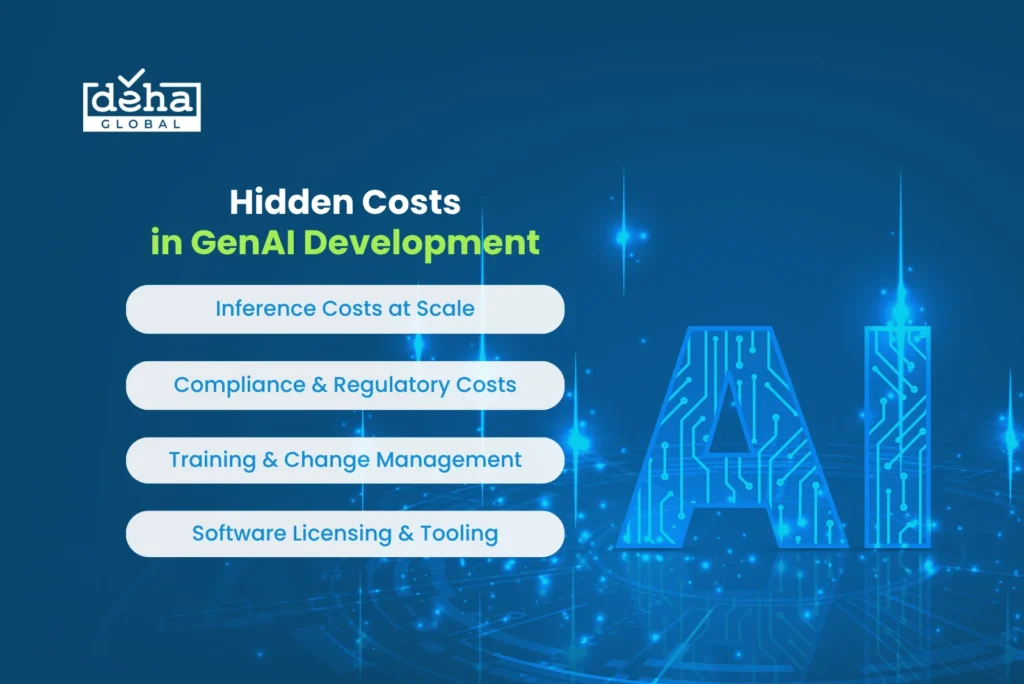
1. Inference Costs at Scale
Unlike traditional software that incurs relatively fixed operational costs, generative AI models consume computational resources for every single user interaction. This creates a variable AI cost structure that can exceed total development costs at scale if not actively managed from the architecture phase.
The scale of the problem: At one million daily requests, an unoptimized model priced at approximately $0.50 per 1,000 requests generates substantial monthly operational expenses. However, the same workload can cost as little as $0.02 per 1,000 requests — a reduction of more than 95% — through systematic optimization.
Key inference optimization methods:
- Model distillation: This method creates smaller and faster models. These models retain most performance while reducing computational cost.
- Quantization: This approach reduces numerical precision. It lowers memory usage and improves inference speed with minimal quality loss.
- Caching strategies: This method stores repeated responses. It eliminates the need to regenerate identical outputs and reduces costs.
- Edge deployment: This approach runs models directly on user devices. It removes cloud inference costs for suitable use cases.
How to control this cost: Inference optimization should be treated as a first-class engineering priority, not a post-launch refinement. Studies show that organizations implementing distillation, quantization, and caching in combination can reduce ongoing inference expenses by 80–98% – a difference that determines whether a product is operationally sustainable at scale.
2. Compliance & Regulatory Costs
Data privacy regulations — GDPR, HIPAA, CCPA, and sector-specific frameworks — impose strict, legally binding requirements on how training data is collected, stored, processed, and used. Compliance is not optional, and its cost is not marginal.
Specific cost components:
- Compliance infrastructure: Organizations must implement encryption, audit logs, and access control systems. These elements often increase costs beyond initial estimates.
- Estimated compliance budget: Compliance and AI ethics measures typically cost between $30,000 and $100,000. The exact amount depends on data sensitivity and regulatory scope.
- Remediation costs: Late compliance fixes create higher expenses. Many organizations only identify issues after deployment.
How to control this cost: Teams should adopt a “privacy by design” approach from the beginning. Early integration of compliance reduces both cost and risk. Involving legal experts during the data strategy phase also improves planning accuracy.
3. Training & Change Management
Even the most technically capable generative AI system will underperform organizationally if the people working with it are not adequately trained and supported. Training is a recurring expense, and organizational change management is a cost category that most AI project budgets omit entirely.
Specific cost components:
- Ongoing staff skill development: Training costs typically range from $3,000 to $8,000 per person each year. Teams must continuously update their skills as AI evolves.
- Change management investment: Organizations must communicate new workflows clearly. They also need resources to manage resistance and define governance frameworks.
Business impact: Many organizations struggle to measure AI ROI effectively. Only 51% strongly agree they can track ROI, despite 91% claiming confidence. This gap reflects weak investment in training and enablement.
How to control this cost: Organizations should plan change management early in the project. Internal AI champions can support adoption across teams. This approach reduces external training costs and improves efficiency.
4. Software Licensing & Tooling
AI development requires a wide range of specialized tools. These tools include training frameworks, data platforms, and monitoring systems. Many of them require recurring licensing fees.
Business impact: The AI tooling landscape evolves quickly. Tools that were effective in early 2024 may become outdated within a year. Therefore, organizations must invest continuously in upgrades and replacements.
How to control this cost: Teams should conduct annual technology audits. This process helps evaluate tools based on performance and cost. Consolidating platforms with integrated capabilities also reduces total licensing expenses.
In Conclusion
Generative AI development involves more than initial investment. While entry costs have decreased, lifecycle costs continue to grow. Therefore, organizations must evaluate both dimensions during planning.
Every cost component discussed in this article is predictable. Data preparation, scaling, and operational expenses can all be planned. However, this requires continuous cost management rather than one-time estimation.
This series will continue in Part 2. The next section will focus on cost optimization strategies and ROI measurements. It will help organizations scale AI investments more effectively and sustainably.