Artificial intelligence has moved from a buzzword to a core business infrastructure. Many companies are now actively running AI development projects. However, the selection at this stage often determines whether the initiative succeeds or fails.
The wrong vendor can create delays, technical debt, security risks, and ongoing operational costs that continue long after deployment. On the other hand, the right partner helps businesses move from experimentation to sustainable adoption with significantly lower risk.
Before committing to any AI initiative, decision-makers should evaluate vendors through both technical and business lenses. The goal is not only to find a company capable of building AI systems, but also one that can support long-term growth, governance, and operational reliability.
This guide outlines why vendor selection matters and provides a practical checklist for evaluating partners before signing any contract.
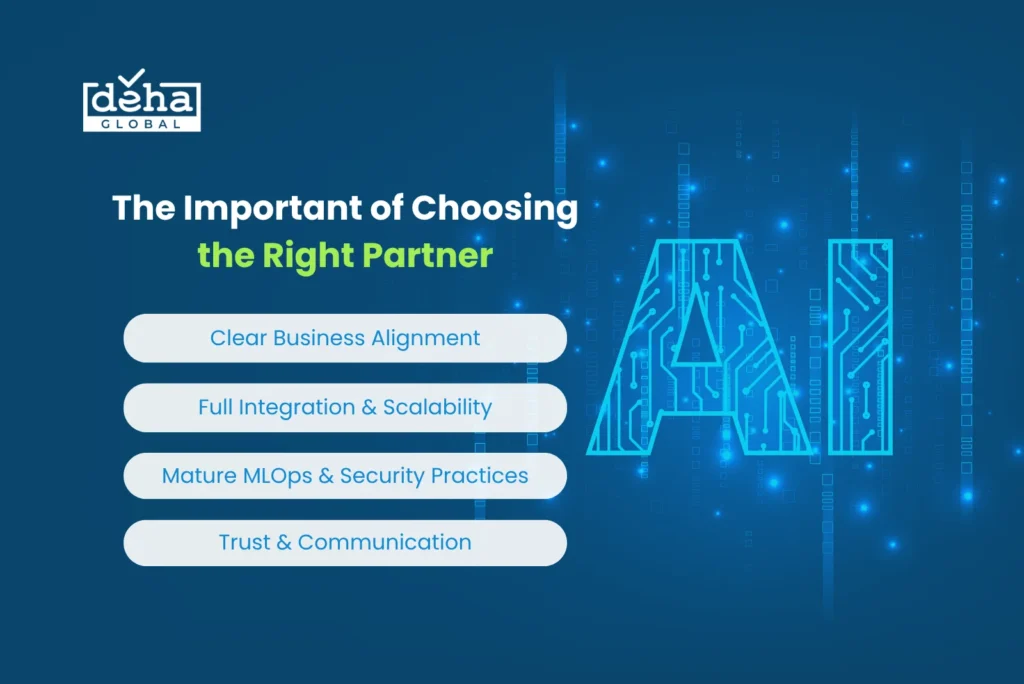
Why Vendor Selection Determines AI Project Success
Many businesses start AI initiatives with strong expectations. However, they often struggle to achieve measurable outcomes. In most cases, the root cause lies in vendor selection rather than technology limitations.
AI projects often fail because of misalignment, not technology: They rarely fail due to model limitations. Instead, failure often comes from unclear goals and unrealistic expectations. Studies indicate that nearly 80% of AI initiatives fail to deliver measurable value for this reason.
Poor vendor selection amplifies these risks: Some vendors focus heavily on model performance while overlooking infrastructure, governance, or integration challenges. This often leads to a familiar situation: the organization receives impressive proof of concept, but the solution never becomes production-ready.
The right vendor acts as a strategic enabler: A strong partner contributes more than technical expertise. The vendor should bring a structured approach to problem definition, data strategy, and measurable outcomes. As a result, the AI development effort is more likely to generate real ROIinstead of remaining a demo.
Vendor reliability reduces hidden costs: In enterprise environments, deployment is usually more difficult than development. AI systems must connect with existing workflows, interact with legacy systems, comply with security policies, and scale reliably under operational pressure. Vendors without experience in these areas tend to underestimate the complexity involved.
Trust and communication matter as much as code: The strongest AI partners contribute more than technical execution. They help organizations define practical use cases, prioritize achievable outcomes, and avoid unnecessary technical complexity early in the process. Their value comes not only from writing code, but from reducing delivery risk across the entire project lifecycle.
In practice, the success of an AI development project depends on more than algorithms. It depends on how well the vendor understands the business problem, data environment, and long-term roadmap.
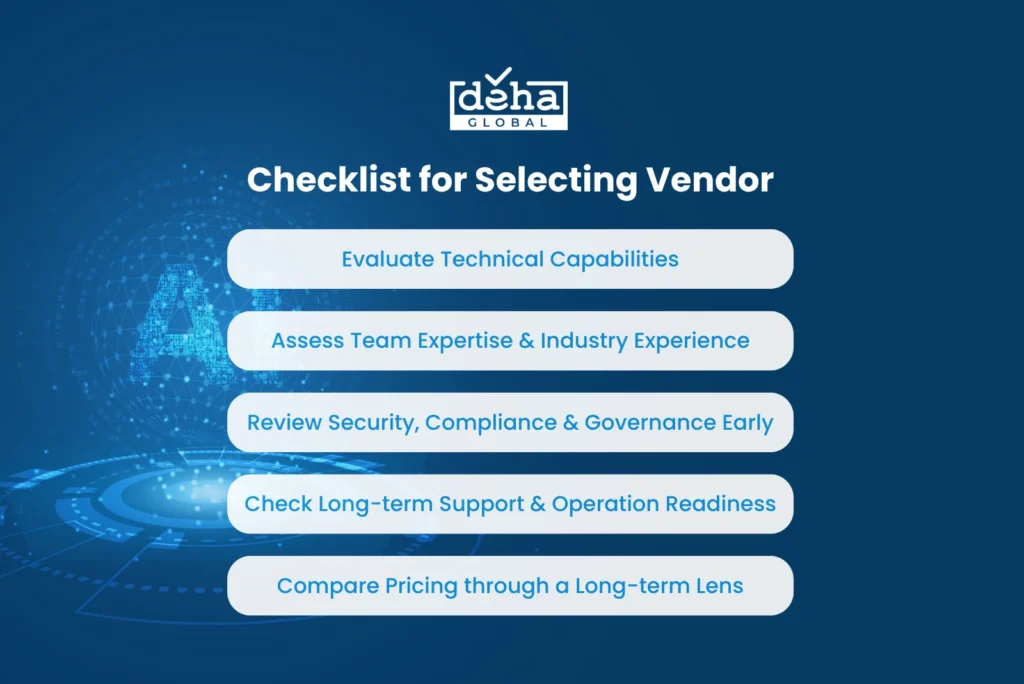
Checklist for Selecting Your AI Development Partner
Before allocating resources, decision-makers should define clear evaluation criteria. A structured checklist helps compare vendors objectively. After that, businesses can move beyond intuition and make informed decisions.
1. Evaluate Technical Capabilities
A vendor’s technical capability is the foundation of any AI Development project. Without solid architecture and deployment practices, even the smartest model remains a lab curiosity.
You should therefore evaluate the following elements:
Level of AI/ML specialization
The vendor should clearly state which frameworks, libraries, and platforms it truly masters (for example, TensorFlow, PyTorch, cloud‑native ML services).
They should be able to explain how they choose one toolkit over another, based on the project’s requirements.
Understanding of deployment patterns
Look for evidence that the vendor has built and deployed production‑grade AI systems, not just prototypes.
Ask how they handle real‑time inference, batch processing, and model versioning in production environments.
MLOps and automation practices
The right vendor should describe how they manage continuous training, model monitoring, and rollbacks.
Automation of these processes reduces manual errors and keeps the AI Development pipeline stable over time.
Cloud and scalability orientation
The vendor should be comfortable with cloud‑native designs, auto‑scaling, and containerization (for example, Kubernetes).
This approach helps the AI system grow with the business without sudden infrastructure overhauls.
You can summarize this evaluation in a simple table to compare vendors:
Criterion
Example Question to Ask
AI/ML Expertise
Which frameworks do you use, and how do you choose between them?
Deployment Experience
Can you share examples of AI systems you have deployed in production?
MLOps & Monitoring
How do you retrain models and monitor performance in production?
Cloud & Scalability
Is your architecture cloud‑native, and how do you handle scaling under load?
By completing this section, you filter out vendors who rely solely on hype and short‑list those who can genuinely deliver a robust AI Development solution.
2. Assess Team Expertise and Industry Experience
The people behind the technology often matter more than the technology itself. A strong AI Development partner should combine diverse skills instead of relying on a single “genius” data scientist.
When reviewing the team, consider the following points:
Team composition
The vendor should have a mix of data scientists, machine‑learning engineers, software engineers, and DevOps specialists.
Domain‑specific experts (for example, finance or healthcare) can help translate business questions into technical requirements.
Industry‑specific experience
Ask how often the vendor has worked in your sector and what constraints (regulatory, security, latency) they have faced.
This experience helps them foresee pitfalls that a generalist AI shop might miss.
Track record and references
Request case studies or anonymized examples of previous AI Development projects.
Speaking directly with past clients reveals how the vendor behaves under pressure, misses, and changes requirements.
To make this evaluation more concrete, you can create a short scoring grid:
High score (strong fit): the team has worked in your industry, can explain complex concepts simply, and provides active references.
Medium score (needs caution): limited domain experience but strong technical skills and willingness to learn.
Low score (high risk): no clear references, no defined roles, or vague answers about their process.
By focusing on team expertise, you increase the chances that the AI Development project will be built by people who stay engaged, adapt quickly, and communicate clearly.
3. Review Security, Compliance, and Governance Early
Data is the fuel of any AI Development effort, and how a vendor handles it can make or break trust and legality. Poor data or security approach can lead to breaches, fines, or project cancellation.
Consider the following aspects when evaluating a vendor:
Data privacy and regulatory alignment
The vendor should be familiar with relevant regulations such as GDPR, HIPAA, or industry‑specific standards.
They should explain how they anonymize, store, and process data in a way that respects these rules.
Security practices
Look for certifications or internal policies around encryption, access control, and incident response.
A vendor that treats security as a by‑product instead of a core requirement introduces unnecessary risk.
Bias, fairness, and transparency
Ask how the vendor evaluates model fairness and whether they can detect or mitigate harmful bias.
Transparency in model behavior builds trust with stakeholders and regulators.
To help you compare vendors, you can list a few “must‑have” checks:
Does the vendor perform regular data‑quality and bias audits?
Are data transfers and storage encrypted by default?
Can they provide documentation showing compliance with key regulations in your market?
Answering these questions honestly will steer your AI Development project away from compliance disasters and toward responsible, sustainable AI use.
4. Check Long-term Support and Operation Readiness
Once the MVP is built, the real test begins: how well the AI system is maintained, updated, and supported over time. A strong vendor should think beyond the first release and plan for long‑term governance.
Key areas to explore include:
Model governance and documentation
The vendor should maintain clear documentation for each model, including assumptions, limitations, and performance metrics.
Version control and audit trails help track changes and explain results when something goes wrong.
Support and service‑level agreements
Ask about uptime guarantees, response times for incidents, and retraining schedules.
A well‑defined SLA protects the business from unexpected downtime or degraded performance.
Long‑term viability and partnership potential
Investigate the vendor’s financial stability, growth trajectory, and strategic focus.
A partner who plans to stay in the market for years is more likely to support your AI Development roadmap than a short‑term contractor.
To visualize this, you can use a simple checklist:
Clear governance and documentation
Defined SLAs and support channels
Evidence of long‑term commitment (clients, roadmap, team size)
By treating governance and support as core criteria, you ensure that the AI Development project does not become a fragile, unmaintained black box.
5. Compare Pricing through a Long-term Lens
Cost is rarely the deciding factor in successful AI Development, but transparency and alignment are. A cheap vendor can become expensive if hidden costs accumulate over time, while a fair‑priced partner can add long‑term value.
When discussing pricing and alignment, pay attention to the following:
Pricing models and TCO
The vendor should be able to break down costs into development, infrastructure, maintenance, and training.
Hidden costs often appear in ongoing model retraining, support, and unexpected scope changes.
Transparency in deliverables and communication
Clear milestones, regular updates, and open communication channels help avoid misunderstandings.
A vendor who avoids concrete deliverables or timelines may be hiding uncertainty.
The right partner should understand your long‑term goals and how this AI Development project fits into them.
Alignment reduces friction and makes it easier to scale the solution across multiple use cases in the future.
By comparing these elements across vendors, you can choose a partner that is not only technically capable but also financially and strategically aligned with your long‑term vision.
In Conclusion
An AI development project can transform business operations when executed correctly. However, success depends heavily on choosing the right partner from the beginning. Relying on hype or superficial evaluation increases the risk of failure and wasted investment. In contrast, a structured checklist helps decision-makers evaluate vendors more objectively.
By focusing on technical capability, team expertise, governance, and long-term alignment, businesses can turn AI into a strategic asset. The right partner not only delivers the system but also supports long-term growth and capability building.