How Generative AI Is Accelerating Product Development
May 15, 2026





Many companies are experimenting with generative AI, but very few successfully move beyond prototypes. In many cases, the issue is not the model itself. The real challenge is managing GenAI Development as a structured product and engineering initiative rather than a standalone experiment.
In this article, we’ll break down a practical, step-by-step process for managing Generative AI projects, including team structure, workflow design, deployment considerations, and common implementation challenges that enterprises should prepare for early on.
For many organizations, the biggest opportunity lies in accelerating workflows, improving decision-making speed, and enabling teams to operate more efficiently at scale. Below are some of the key business drivers behind enterprise GenAI adoption.
Generative AI can significantly reduce the time required to move from concept validation to product delivery.
Product and engineering teams use AI systems to: draft feature specifications, generate UX copy, summarize customer feedback, create prototypes, and accelerate experimentation. This allows organizations to test ideas faster before committing larger engineering resources.
For startups and enterprise innovation teams alike, faster iteration cycles can create a meaningful competitive advantage in rapidly changing markets.
Many enterprise workflows involve repetitive tasks that consume significant engineering and operational time. Generative AI tools can help automate portions of documentation, testing, content generation, support workflows, and internal knowledge management.
Developers may use AI-assisted coding tools to generate boilerplate logic or test cases, while operational teams use AI to summarize reports or organize information more efficiently.
Traditional applications often rely on static workflows and predefined responses. Generative AI enables applications to deliver more contextual and dynamic experiences through conversational interfaces, personalized recommendations, AI assistants, intelligent search, and real-time content generation.
For customer-facing products, these capabilities can improve engagement and create more responsive user experiences. However, personalization must still be balanced with governance, consistency, and operational control.
Most organizations already possess large volumes of unstructured information, like customer conversations, support tickets, documentation, internal knowledge, reports, and operational logs.
Generative AI systems help transform this information into usable insights through summarization, classification, retrieval, and contextual analysis. This improves information accessibility while helping organizations make faster, data-informed decisions.
Managing Generative AI Development projects requires more than traditional software planning alone.
Teams must balance experimentation with governance while continuously evaluating model behavior, usability, operational performance, and business outcomes.
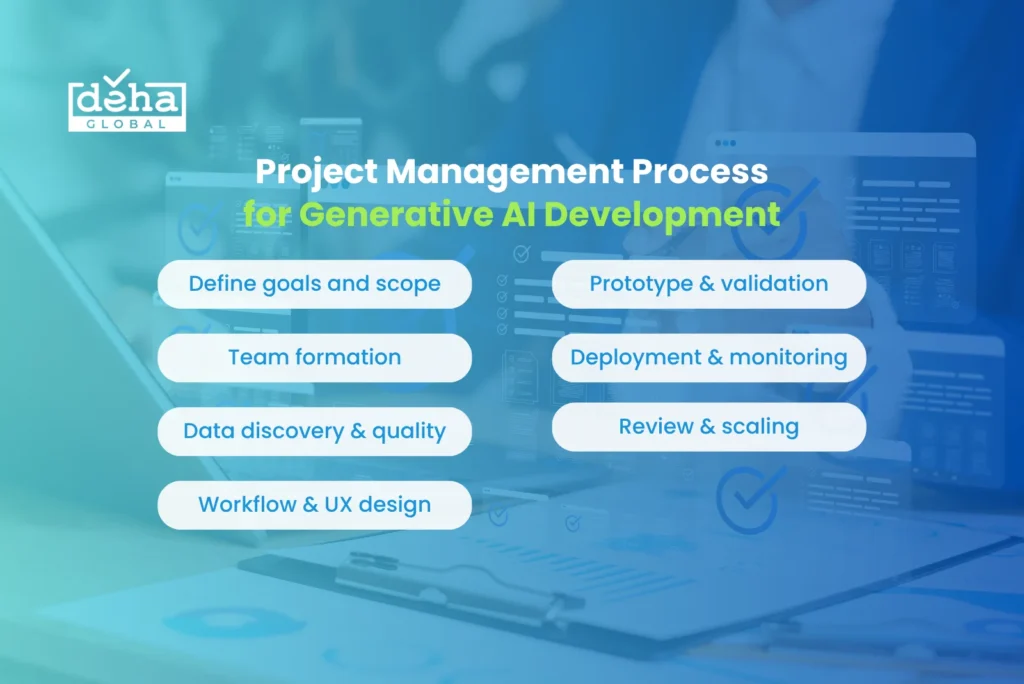
The framework below reflects how many successful enterprise AI initiatives are structured in practice.
| Phase | Main focus in Gen AI Development Projects |
| Define goals and scope | Align AI with business objectives and define KPIs. |
| Team formation | Assemble cross‑functional roles and clarify responsibilities. |
| Data discovery and quality | Identify data sources and set quality standards. |
| Workflow and UX design | Integrate AI into user or operational flows. |
| Prototype and validation | Build and test small, measurable pilots. |
| Deployment and monitoring | Roll out models safely and track performance. |
| Review and scaling | Improve processes and expand AI use where value is proven. |
Many GenAI projects fail because teams begin with technology exploration before defining measurable business objectives. Strong AI initiatives usually start with a clear understanding of workflow needs improvement, operational pain points that exist, and how success will be measured.
Instead of asking “How can we use AI?”, high-performing teams typically ask: “Which workflow creates enough operational friction that AI could improve it meaningfully?”
Success metrics should measure both technical performance and business impact. Important indicators include accuracy, workflow speed, customer satisfaction, operational efficiency, and user engagement.
Clear KPIs help prevent AI projects from drifting into endless experimentation.
Successful AI initiatives require collaboration across multiple roles. These roles include product managers, data scientists, engineers, and UX designers. Early role definition reduces confusion and improves coordination. As a result, execution becomes more efficient.
Generative AI projects rarely succeed when ownership is isolated within engineering teams. AI delivery impacts multiple stakeholders simultaneously, including product management, engineering, security, compliance, operations, customer support, and UX teams.
Without alignment, projects often slow down due to:
Strong enterprise AI initiatives usually establish cross-functional collaboration early so operational, technical, and business requirements evolve together.
Teams must identify where data will come from, how it will be stored, and what level of quality is needed. Poor or biased data can derail even the most sophisticated models, so robust data assessment and cleaning are critical early steps.
Data quality has a direct impact on GenAI performance. Even highly capable models produce weak outputs when connected to incomplete, outdated, or inconsistent information sources.
Teams should evaluate:
For RAG-based systems and enterprise AI assistants, retrieval quality often matters more than model sophistication alone. Organizations should also assess data privacy requirements, access permissions, compliance considerations, and bias risks before deployment begins.
One of the most common GenAI implementation mistakes is treating AI as a standalone feature instead of embedding it naturally into operational workflows. AI systems should support how users already work.
This includes defining:
Even technically capable AI systems can fail adoption if users feel uncertain about output reliability or workflow consistency.
Early-stage GenAI prototypes work best when focused on small, high-frequency workflows rather than broad transformation initiatives. At this stage, teams should measure more than output quality alone.
Evaluation should also include:
The real objective is to determine whether the workflow creates sustainable operational value under real-world usage conditions.
Production-ready AI systems require continuous monitoring. Unlike traditional software, GenAI behavior can shift over time due to prompt changes, model updates, data drift, retrieval inconsistency, or evolving user behavior.
Organizations should implement:
Monitoring should cover both technical and business metrics, including latency, accuracy, user satisfaction, operational cost, and workflow adoption. Without observability, organizations struggle to identify where AI performance degrades in production environments.
Many organizations attempt to scale GenAI initiatives too aggressively after successful pilots. However, enterprise AI adoption works best incrementally.
Teams should expand only after validating:
Over time, organizations can standardize successful workflows, improve orchestration layers, and integrate AI more deeply into products and operational systems.
Concrete examples help teams see how the project management process above translates into real-world applications.
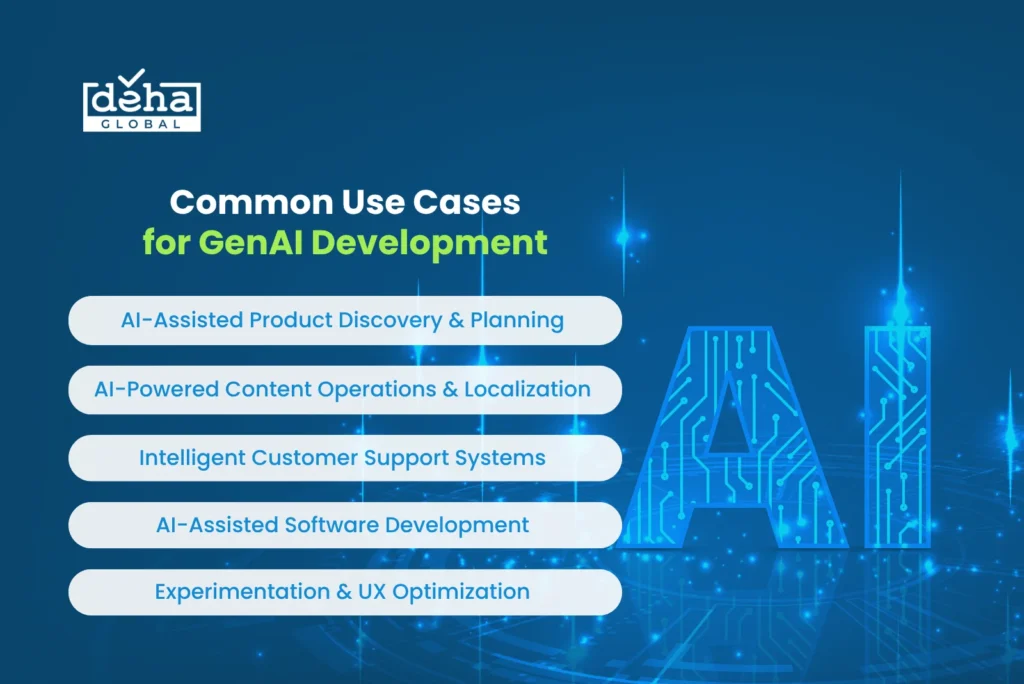
The following sections highlight a few typical Gen AI Development use cases that fit naturally into product or service projects.
| Use Case Category | Typical Project Impact in Gen AI Development |
| AI-Assisted Product Discovery and Planning | Faster ideation and clearer feature specifications. |
| AI-Powered Content Operations and Localization | Faster launches and easier support for multiple languages. |
| Intelligent Customer Support Systems | Lower support load and better user experience. |
| AI-Assisted Software Development | Higher developer productivity and better‑maintained code. |
| Experimentation and UX Optimization | More data‑driven, optimized user experiences. |
Product teams use generative AI to:
This helps teams move from concept exploration to validation faster while improving alignment between stakeholders.
Many digital products rely on large volumes of text, from help articles to in‑app microcopy and marketing messages. Generative AI helps organizations scale content production and localization workflows while reducing manual effort and time-to-market.
Support systems can integrate generative AI to handle routine inquiries. AI-powered support assistants can help answer routine questions, summarize tickets, classify requests, and recommend next actions for support teams.
This reduces operational load while allowing human agents to focus on higher-complexity interactions. For many organizations, customer support becomes one of the fastest areas to demonstrate measurable AI value.
Engineering teams use AI tool for:
While human review remains essential, these workflows can improve development velocity and reduce repetitive engineering work.
Generative AI can accelerate experimentation by producing:
This helps product teams iterate faster while improving data-driven decision-making.
After defining processes and use cases, practical execution becomes the next challenge. Clear guidelines help maintain alignment across stakeholders. Therefore, these tips focus on balancing innovation with governance.
In Conclusion
Generative AI projects deliver strong value when managed with structured discipline. Successful implementations balance experimentation with governance and data quality. As a result, organizations can move from prototypes to scalable systems.
By following a clear project management framework and focusing on measurable outcomes, businesses can turn generative AI into a repeatable capability. Therefore, the best next step is to start with a small, well-defined pilot. From there, stakeholders can expand based on real-world results and continuous feedback.