You’ve got a breakthrough idea, but will the market embrace it—and pay for it? Too many startups and enterprises devote significant time and resources to product development only to discover their efforts have fallen short. Therefore, the ultimate goal is to achieve Product-Market Fit (PMF). But in today’s AI-driven world, can you launch a fast, successful experiment without an AI MVP? The answer is clear: You can’t.
What is Product-Market Fit (PMF)? Key Metrics for PMF
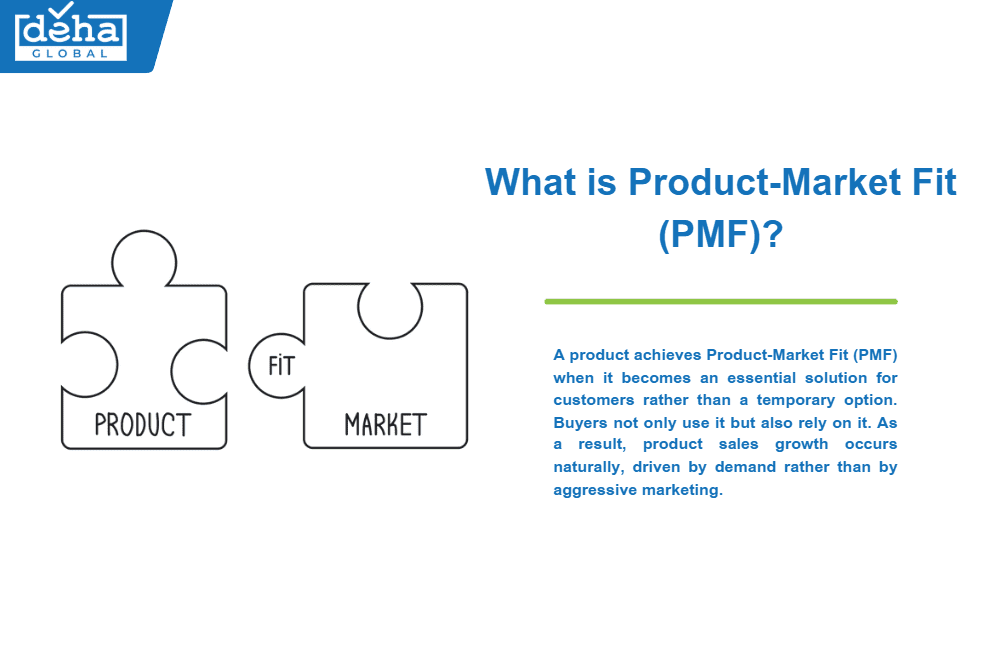
A product achieves Product-Market Fit (PMF) when it becomes an essential solution for customers rather than a temporary option. Buyers use it and rely on it. As a result, product sales growth occurs naturally, driven by demand rather than by aggressive marketing.
When a product successfully reaches and achieves PMF, it pulls the market toward it. Users instinctively adopt it and effortlessly incorporate it into their daily activities without hesitation. As dependence increases, businesses expand usage based on outsized growth, increasing supply and pushing demand to promote sustainable revenue growth and long-term viability.
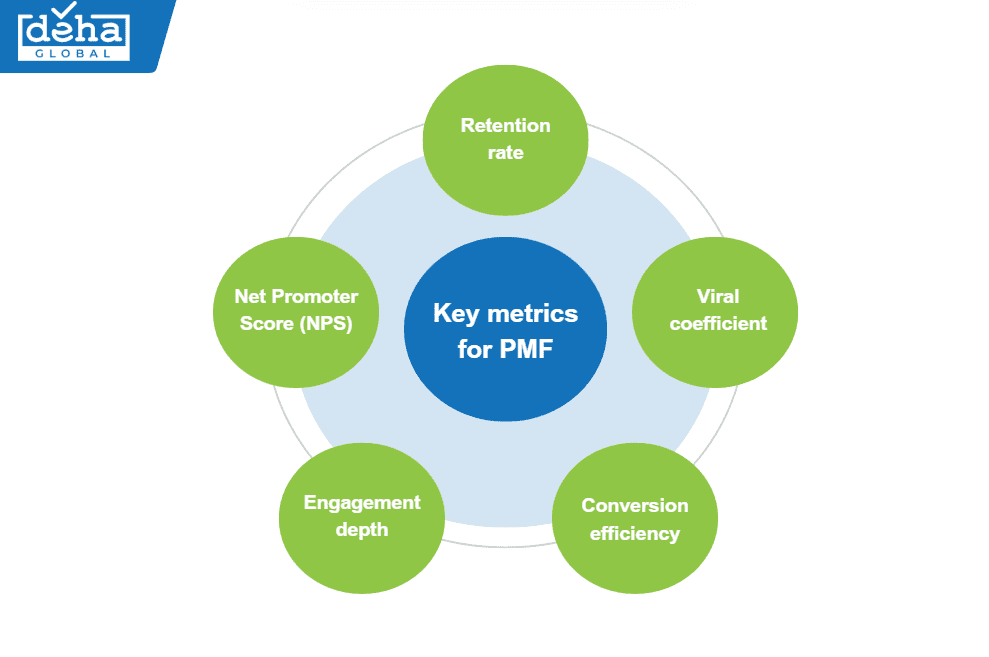
Some key metrics for PMF:
Retention rate: A product with PMF keeps users engaged long after onboarding. They see the product as essential and consistent in their lives.
Net Promoter Score (NPS): This metric reflects how deeply satisfied people find the product valuable enough to recommend it by word of mouth without incentives. For example, the insurance industry boasts an average NPS of 71, reflecting exceptional customer approval (according to QuestionPro).
Engagement depth: A well-adopted product integrates into daily workflows, with users relying on multiple features. Sporadic logins or reliance on only basic functions signal weak engagement and uncertain long-term value.
Conversion efficiency: A strong PMF product converts trial users into paying customers without additional persuasion. It all relies on superior features and addressing the right customer pain points.
Viral coefficient: The viral coefficient measures the number of new users each existing user brings to your product. A coefficient greater than 1 indicates viral growth, while less than one suggests additional acquisition channels are needed.
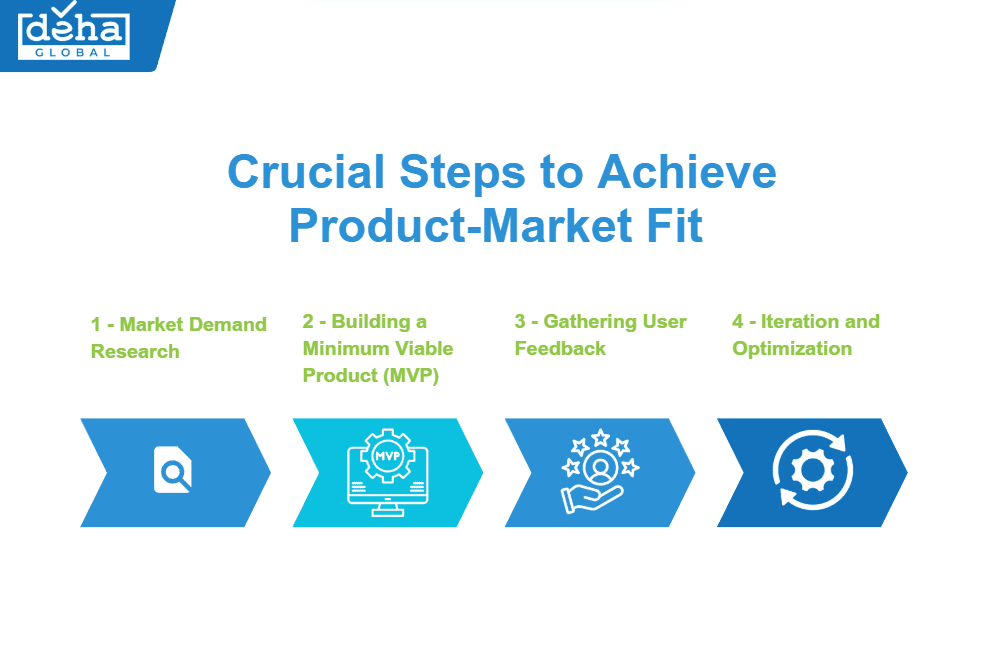
Crucial Steps to Achieve Product-Market Fit
A product doesn’t achieve PMF by accident. It follows a structured roadmap and strategy, where precision, adaptability, and data-driven insights dictate success. AI MVP accelerates validating and refining the fit with market needs in this journey.
Market Demand Research
Market demand is the foundation of PMF. No matter how advanced the technology, a product that misreads market demand will fail. Understanding demand fundamentally is the first step toward success.
The core steps in this journey include:
Identify customer pain points: Every market has inefficiencies that cost businesses and customers time and money. Compliance risks, operational bottlenecks, and outdated workflows create daily struggles. A product that removes these barriers becomes essential.
Track customer behavior for insights: What customers do is more important than what they say. Usage patterns, churn rates, and repeat interactions must be understood before any product is developed to understand customers’ needs and make them a natural part of business operations.
Understand gaps in existing solutions: What problems are your current products facing? Do they fall short on usability, scalability, or pricing flexibility? A solution that fills these gaps has the potential to win customers without needing excessive persuasion.
Measure market size and viability: A niche market with a high willingness to pay will beat out a large audience with low retention. Sustainable demand drives long-term business growth, not just initial hype. And thorough market research will help you get a holistic view before selecting and developing a distribution product.
Building a Minimum Viable Product (MVP)
Building an MVP is critical in product development, allowing businesses to test market demand, gather user feedback, and minimize risks before scaling. However, the traditional MVP approach is no longer enough in today’s hyper-competitive and fast-moving digital landscape.
An AI MVP transforms how businesses develop, launch, and refine their products. By leveraging artificial intelligence, companies can accelerate development. Eliminate inefficiencies and optimize PMF with real-time data. AI MVPs don’t just reduce time and effort; they create dynamic, self-improving products that continuously adapt to market needs.
AI-driven rapid development: AI-powered tools automate code generation, suggest improvements, and handle repetitive tasks. The method significantly reduces manual workload, accelerates development timelines, and allows teams to focus on innovation rather than debugging. AI minimizes human errors, ensuring a smoother MVP evolution.
Autonomous bug detection & self-healing systems: Machine learning models scan codebases in real-time, detecting and resolving bugs before they impact users. This approach reduces downtime, ensures a more stable launch, and speeds up iteration cycles. AI-driven debugging creates a self-healing system that keeps the MVP functional without constant manual intervention.
Real-time user adaptation & scalable A/B testing: AI continuously monitors user interactions, running scalable A/B tests to refine features based on live engagement data. Unlike traditional methods, AI MVPs adapt dynamically—ensuring that product improvements are instant, data-backed, and aligned with user behavior.
Predictive feature prioritization for PMF: AI analyzes behavioral data, past user trends, and market shifts to determine which features drive engagement, retention, and revenue. The process eliminates guesswork, allowing businesses to focus only on high-impact functionalities. AI MVPs ensure that the product is designed for maximum relevance and market fit from day one.
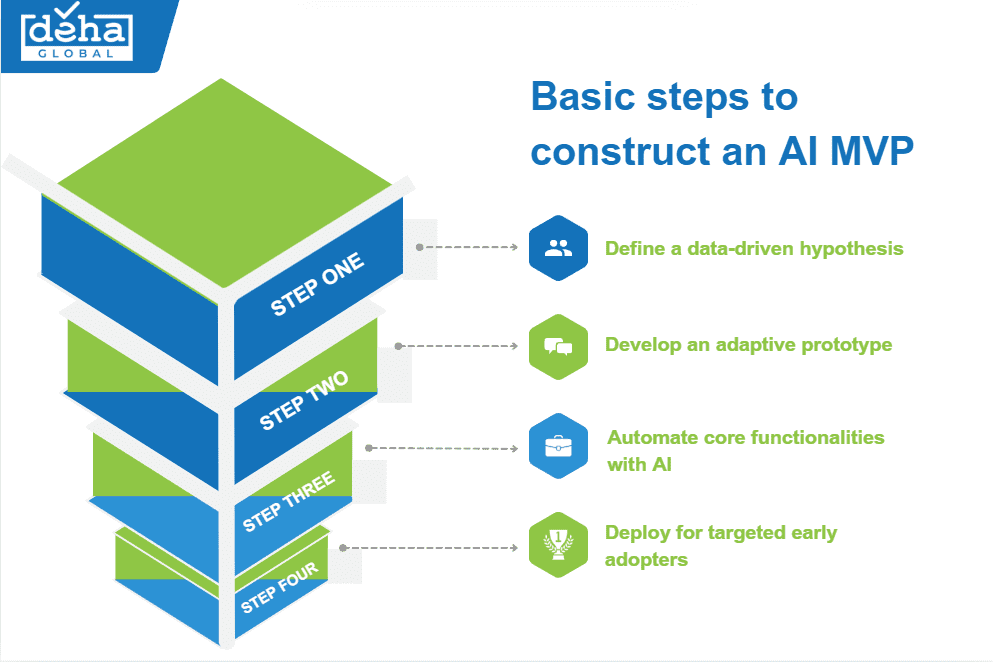
Basic steps to construct an AI MVP:
Step 1: Define a data-driven hypothesis: Identify a specific problem your AI MVP will solve. Use AI-driven market analysis to uncover trends, gaps, and demand. Define success metrics based on measurable AI insights (e.g., engagement rates, predictive accuracy, cost reduction).
Step 2: Develop an adaptive prototype: Use AI-powered design tools to generate wireframes and UI layouts dynamically. Implement AI-driven automation to adjust features based on real-time interactions. Train AI models to analyze early user behavior and refine the product iteratively.
Step 3: Automate core functionalities with AI: Implement AI-driven automation in user authentication, data analysis, or personalization processes. Leverage machine learning algorithms for predictive analytics, recommendation engines, or fraud detection. Use AI-powered tools to generate, test, and optimize codes, reducing manual effort.
Step 4: Deploy for targeted early adopters: Identify a high-value test audience that fits your ideal customer profile. Use AI-driven segmentation to personalize user experiences based on initial interactions. Implement AI-powered monitoring tools to detect pain points and optimize features instantly.
Gathering User Feedback For AI MVP
Feedback fuels iteration. Collecting feedback from direct users when using MVP is crucial for understanding strengths, weaknesses, and emerging issues, allowing businesses to refine their products before officially launching and scaling.
An AI MVP makes this process faster, more structured, and more data-driven. AI enhances feedback collection by organizing large volumes of user interactions, recognizing patterns, and uncovering insights that traditional methods might miss.
Several key AI-driven capabilities streamline the process:
Automated data structuring: AI organizes user feedback into meaningful categories, making analysis more efficient.
Unstructured data processing: AI can extract insights from open-ended responses, reviews, and social interactions, revealing hidden trends.
Pattern recognition in behavioral data: AI links different user actions in MVP, identifying correlations that impact product adoption.
Engagement heatmaps: AI visualizes high-impact touchpoints, helping businesses optimize user experience.
By leveraging AI to analyze customer data from an MVP, businesses can improve product quality, predictability, and adaptability—delivering more refined solutions to the market.
Iteration and Optimization For AI MVP
This phase is the final step toward market success. Once the AI MVP has been built, the refinement process will determine whether the product will grow or die. We must carefully make and calculate every adjustment to ensure purposeful changes, as we cannot follow all feedback. AI assistance continues to maximize its effectiveness in this strategic part.
Data guides this process. User behavior, interaction patterns, and direct feedback highlight what works and what doesn’t. The metrics collected with the AI MVP or input given by AI support in the previous steps point out weaknesses, while the structure testing validates improvements.
Realistic interactions support every decision, and the product is also transformed based on real-world needs.
DEHA Global’s AI MVP Solution: Your Fastest Path to Product-Market Fit
Reaching product-market fit is challenging, mainly when you utilize AI MVP to enhance the process compared to your competitors. Without a structured approach, scaling becomes a high-risk gamble.
DEHA Global transforms uncertainty into strategic growth. With deep expertise in AI MVP Development, the team maps market needs, solves technical barriers, and aligns resource allocation with business goals. Every step follows a structured framework, minimizing risk and maximizing product potential.
Partnering with DEHA Global means gaining a competitive edge in AI innovation. Businesses benefit from:
Specialized AI knowledge: Deep technical proficiency in developing and refining AI MVPs.
Adaptive cost structure: Scalable solutions tailored to evolving business needs.
Holistic guidance: Structured support covering strategy, performance analysis, and AI refinement.
Advanced AI frameworks: Seamless deployment with Microsoft Azure AI, machine learning, and OpenAI technologies.
Connect with DEHA Global today to explore your business’s most effective AI MVP strategy.