

In Part 1, we covered the investment required for GenAI, from infrastructure and talent to data and hidden costs. However, the financial journey of AI development does not end at launch. Instead, the most expensive phase starts after deployment.
Once the Generative AI system goes live, the cost dynamic changes quickly. It includes inference optimization, model retraining, system integration, and compliance overhead. While some of these factors appear during development, many teams underestimate their long-term impact. As a result, these costs often determine whether a project delivers sustainable ROI or becomes a financial burden.
This article represents Part 2 of the series and focuses on the full cost structure of operating generative AI at scale. It explains how costs evolve from model selection to real-world deployment paths. More importantly, it helps technology and business leaders plan with the financial clarity required for production-scale AI systems.
The Cost Structure Behind the Generative AI Development
Enterprise AI Development typically follows five interconnected cost structures. This structure includes five interconnected phases, each with its own trade-offs and budget impact. Although these phases seem sequential, they influence each other throughout the project’s lifecycle. Therefore, decisions made early will directly affect long-term cost efficiency.
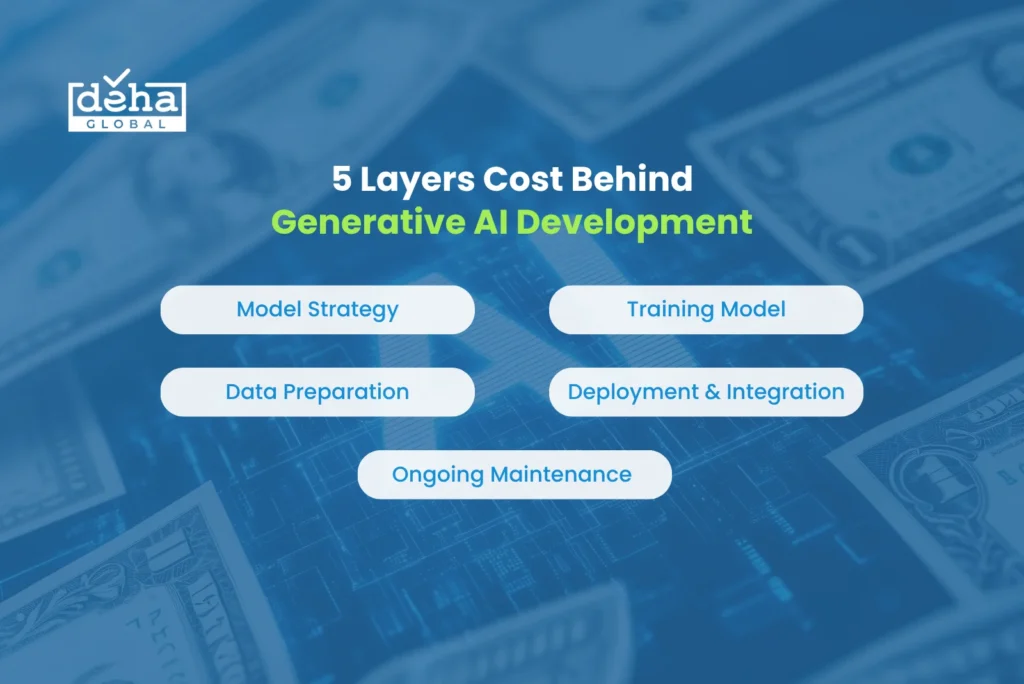
Model Strategy: Choosing or Developing
The model selection decision directly shapes the total cost of a generative AI project. As a result, it has become the most critical cost driver in the entire lifecycle.
1.1 Sub-section A: Off-the-Shelf or Custom?
What this decision covers: This decision defines whether the organization uses a pre-built model or builds a custom solution. Each option creates a different cost structure and long-term investment path. Therefore, selecting the wrong model type often leads to budget overruns.
Model type cost comparison:
| Model Type | Cost Profile | Best for |
| GANs (Generative Adversarial Networks) | High — dual-component training requires large, high-quality datasets and significant GPU compute. | Image generation, data augmentation. |
| VAEs (Variational Autoencoders) | Moderate – less compute-intensive than GANs; lower output quality ceiling at scale. | Image synthesis, anomaly detection. |
| Transformer Models (GPT, BERT, T5) | High – resource-intensive training requires high-performance GPUs or TPUs throughout. | Text generation, code generation, translation. |
| Autoregressive Models | Moderate – manageable compute for standard tasks; more expensive for long-form generation. | Speech synthesis, music composition. |
| Diffusion Models | High – multi-step refinement process is both compute-heavy and time-intensive. | Image and video generation. |
| RNNs (Recurrent Neural Networks) | Low-Moderate – lower per-run compute, but slow to train and data-hungry for quality output. | Text generation, time-series forecasting. |
Key decision insight: This decision defines whether the organization uses a pre-built model or builds a custom solution. Each option creates a different cost structure and long-term investment path. Therefore, selecting the wrong model type often leads to budget overruns.
1.2. Sub-section B: Closed-Source vs. Open-Source Models
What this decision covers: Beyond architecture, organizations must also decide how to access and control the model. This choice affects data privacy, customization ability, and long-term ownership cost. Therefore, it becomes a strategic decision rather than a purely technical one.
| Closed-Source Models | Open-Source Models | |
| Examples | OpenAI GPT-4, Google Gemini, Anthropic Claude. | LLaMA 2, Mistral, Falcon, GPT-J, BLOOM. |
| Access method | API or SDK – no infrastructure setup | Self-hosted on cloud or on-premises. |
| Maintenance | Vendor-managed | Self-managed by internal or partner team. |
| Integration speed | Fast | Slower – requires internal DevOps support |
| Pricing model | Usage-based (per token or character) | Infrastructure + tuning + operational labor. |
| Customization | Limited to prompt engineering | Full model architecture flexibility |
| Data privacy/ Compliance | Vendor-dependent – data leaves your environment | Full in-house control |
| Vendor lock-in risk | High | None |
Our recommendation: Most organizations benefit from closed-source models during early stages. These models offer faster deployment and lower initial complexity. However, enterprises in regulated industries often prefer open-source models to better control data. In addition, small language models provide a practical middle-ground for cost-efficient deployment.
2. Data Preparation: The Most Underestimated Cost Driver
What this phase covers: Data preparation forms the foundation of any generative AI system. This phase includes sourcing, cleaning, labeling, bias auditing, and compliance validation. Although it appears early in the process, many organizations underestimate its cost and impact.
Specific cost components:
- Third-party pre-built datasets: Licensing costs typically range from $10,000 to $100,000, depending on complexity and volume.
- Data annotation and labeling: Outsourced labeling costs range from $5 to $50 per hour. Large datasets can significantly increase this expense.
- Internal data collection: Organizations must invest in tools, engineering, and consent management. These requirements add hidden costs to the overall budget.
Business impact: Poor data quality directly reduces model performance. Even a small error rate can create major output issues at scale. Therefore, weak data investment leads to technical debt that becomes more expensive later.
How to control this cost:
- Prioritize free public datasets (Kaggle, Hugging Face) for initial model experimentation before committing external procurement budgets.
- Leverage automated data-cleaning tools such as Open Refine and crowdsourced labeling platforms such as Amazon Mechanical Turk to reduce the manual annotation cost burden.
- Scope data requirements for the initial use case only — expanding data coverage iteratively as the product proves its value is consistently more cost-efficient than attempting to build a universal dataset from the outset.
3. Training Model: Where the Cost Escalates Quickly
What this phase covers: Model training converts data and architecture into real system performance. This phase requires high computational power and specialized expertise. As a result, it has become one of the most resource-intensive stages in the lifecycle.
Specific cost components:
- Cloud GPU rental: Training large generative AI models on platforms such as AWS, Google Cloud, or Microsoft Azure costs between $10,000 and $100,000+, depending on model size and total training duration.
- Engineering talent: US-based data scientists and ML engineers command annual salaries of $100,000 to $200,000. Meanwhile, offshore development teams in regions such as Vietnam, Eastern Europe, or India provide access to equivalent technical expertise at substantially lower total labor cost.
Key variables that shape training cost:
- Model parameter count: More parameters increase both training compute requirements and time-to-convergence.
- Data volume and quality: Larger, messier datasets require more training iterations to achieve target accuracy.
- Training approach: Fine-tuning a pre-existing foundation model costs dramatically less than training from scratch and delivers sufficient performance for the vast majority of enterprise use cases.
How to control this cost: Cloud spot instances and reserved capacity pricing can reduce compute costs by 40–70% compared to standard on-demand pricing. Additionally, starting with fine-tuning rather than from-scratch training eliminates the most expensive portion of the compute to spend on most business applications.
4. Deployment & Integration: Where Complexity Becomes Cost
What this phase covers: Deployment connects the trained model to real-world applications. This phase includes infrastructure hosting and system integration. Both areas often create unexpected costs when not planned properly.
Specific cost components:
- Cloud infrastructure hosting: Serving a production GenAI model on cloud infrastructure costs between $1,000 and $10,000 per month if usage is not actively optimized.
- System integration: Connecting the GenAI layer to existing CRM, ERP, or customer-facing applications via custom API development typically costs between $10,000 and $50,000 per integration project.
How to control this cost:
- Serverless architectures such as AWS Lambda charge only for actual usage, reducing idle costs.
- Pre-built integrations and no-code tools reduce custom development requirements.
- Clear integration scope definition during the design phase prevents budget overruns.
5. Maintenance & Scaling: The True Long-term Cost
What this phase covers: Post-launch maintenance represents the largest portion of long-term AI cost. Organizations must continuously update, monitor, and secure the system. Therefore, maintenance becomes a recurring and unavoidable expense.
Specific cost components:
- Model updates and retraining: Keeping the model current with new data, evolving user needs, and business context changes costs between $5,000 and $50,000 per year.
- Performance monitoring tools: Platforms such as Neptune.ai and Weights & Biases typically charge between $50 and $500 per month for production-grade monitoring capabilities.
- Years 2–3 scaling costs: Many organizations underestimate this phase. However, scaling often requires $40,000–$70,000 annually.
Business impact: Most long-term AI costs come after deployment. Research shows that maintenance and scaling account for up to 60% of total five-year costs. Therefore, poor planning at this stage creates financial pressure during growth.
How to control this cost:
- Incremental training methods reduce retraining costs significantly.
- Automated monitoring systems detect issues early and prevent expensive failures.
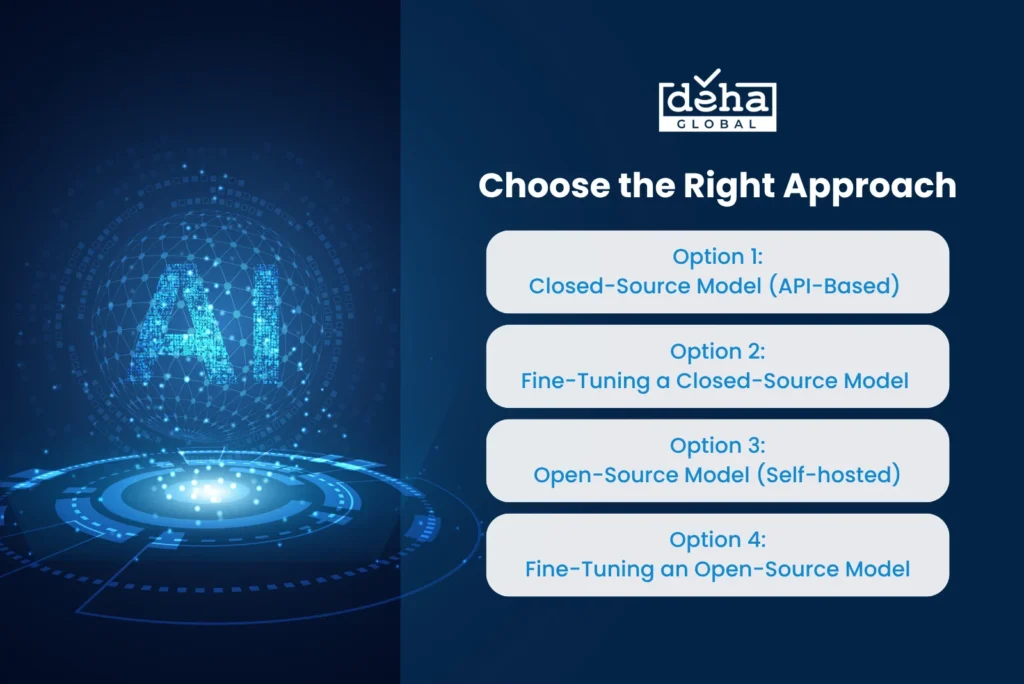
4 Practical Ways to Choose the Right GenAI Development Approach
Model type and access model define what a generative AI system can achieve. However, the implementation path determines how much it costs to realize that potential. Therefore, organizations must evaluate both technical fit and financial sustainability before planning.
Before selecting an approach, every organization should answer four key questions. These questions clarify both operational needs and long-term cost exposure.
- What types of tasks need AI enhancement – customer-facing, internal workflows, or compliance-sensitive processes?
- How critical is organizational control over model behavior and proprietary data flows?
- Does the existing team have the infrastructure and talent required for deployment and ongoing model management?
- Is this initiative an exploratory pilot or a long-term operational investment?
The answers to these questions directly shape the most suitable and cost-effective implementation path.
Closed-Source Model (API-Based)
What this approach involves: This approach allows organizations to access a pre-built model through APIs or SDKs. It removes the need for training, infrastructure setup, or model maintenance. As a result, it offers the fastest path to initial deployment.
Key characteristics:
- Integration simplicity: The technical setup is straightforward: connect via API, engineer the prompts, and the system is operational.
- Customization ceiling: Model behavior is adjustable only through prompt engineering; there is no mechanism for domain-specific training on proprietary data.
- Vendor dependency: The organization is entirely dependent on the provider for model uptime, output quality, and pricing continuity.
Example tools: OpenAI ChatGPT, Google Gemini, Anthropic Claude, Synthesia
Estimated AI cost:
- Text generation: $0.0005 per 1,000 characters (Google PaLM 2 via Vertex AI) or $0.001–$0.03 per 1,000 tokens (OpenAI GPT-3.5/GPT-4)
- Image generation: $0.04 per standard 1024×1024px image (DALL·E 3); up to $0.08–$0.12 for larger or high-definition outputs
- Turnkey video platforms: Synthesia from approximately $804/year for basic tiers
Strategic note: This option delivers fast results for pilots and simple use cases. However, costs increase rapidly as usage scales. In addition, vendor lock-in limits long-term flexibility.
Fine-Tuning a Closed-Source Model
What this approach involves: This approach improves a pre-built model using organization-specific data. It increases accuracy while keeping the infrastructure managed by the provider. Therefore, it balances performance and operational simplicity.
Key characteristics:
- Improved accuracy: Fine-tuning significantly improves performance on domain-specific tasks compared to prompt engineering alone.
- Retained vendor infrastructure: The model continues to be hosted and maintained by the provider, reducing internal operational overhead.
- ML expertise requirement: Data preparation, fine-tuning pipeline management, and ongoing model evaluation require a dedicated ML engineering capability.
Example providers: OpenAI fine-tuning API (GPT-3.5), Google Vertex AI (PaLM fine-tuning), Salesforce Einstein Copilot
Pricing mechanics:
- Fine-tuning fee: $0.008 per 1,000 tokens (OpenAI GPT-3.5 fine-tuning API)
- Production inference after fine-tuning: $0.003 input / $0.006 output per 1,000 tokens
- Data storage on provider servers: approximately $0.20 per 1 GB per day
Estimated total AI cost: $10,000–$50,000, depending on data volume, fine-tuning cycles, and production query volume
Strategic note: This approach suits organizations that need better accuracy without building infrastructure. However, recurring costs and vendor dependency remain key limitations.
Open-Source Model (Self-hosted)
What this approach involves: This approach deploys open-source models within the organization’s infrastructure. It removes licensing fees and provides full control over data. Therefore, it becomes attractive for privacy-sensitive environments.
Key characteristics:
- Zero licensing cost: No vendor fees apply; the primary costs are infrastructure, integration engineering, and internal DevOps support.
- Full data control: All data remains within the organization’s environment, making this path suitable for privacy-sensitive use cases.
- Output quality limitation: General-purpose open-source models frequently underperform specialized business content without additional fine-tuning.
Example models: GPT-2, GPT-Neo, RoBERTa, DistilGPT (available via Hugging Face)
Estimated AI cost: $20,000–$50,000 for infrastructure setup, integration work, and foundational operational overhead
Strategic note: This option works well for internal tools with moderate accuracy needs. However, customer-facing applications often require additional fine-tuning.
Fine-Tuning an Open-Source Model
What this approach involves: This approach provides the highest level of control and customization. Organizations train models on proprietary data within their own infrastructure. As a result, they achieve the best domain-specific performance.
Key characteristics:
- Maximum customization and accuracy: The model is fully shaped by proprietary data, delivering the highest domain-specific performance of any implementation path.
- Complete data sovereignty: All training data, model weights, and inference outputs remain within the organization’s environment, meeting the strictest regulatory and compliance requirements.
- Full operational ownership: Ongoing MLOps support, versioning, security patching, and retraining cycles are entirely the organization’s responsibility.
Example models: LLaMA 2, Mistral, Falcon, GPT-J, BLOOM (available via Hugging Face)
Estimated AI cost: $80,000–$190,000+, factoring in infrastructure setup, development, fine-tuning cycles, and long-term internal support overhead
Strategic note: This approach requires the highest upfront investment. However, it delivers the lowest long-term cost per query at scale. It also provides maximum flexibility and independence.
Implementation Path Summary:
| Implementation Path | Estimated Cost | Customization | Data Privacy Control | Time to market |
| Closed-source | $0.0005–$0.03 per 1K tokens (usage-based) | Low | Low | Fast |
| Fine-tuned closed-source | $10,000–$50,000 | Medium | Medium | Medium |
| Open-source | $20,000–$50,000 | Medium | High | Medium |
| Fine-tuned open-source | $80,000–$190,000+ | High | Full | Slow |
Overall recommendation: Most organizations should begin with closed-source APIs to validate use cases quickly. However, long-term AI strategies should gradually move toward fine-tuned open-source models. This transition improves cost control and reduces vendor dependency over time.
In Conclusion
Across both parts of this series, one principle remains consistent. The total cost of AI development almost always exceeds initial expectations. This gap becomes larger when organizations focus only on development and ignore long-term operations.
The implementation comparison highlights this reality clearly. A $10,000 API-based solution and a $190,000 custom deployment reflect different strategic choices. These differences arise from decisions about customization, compliance, and long-term ownership.
Therefore, organizations must treat AI cost management as an ongoing discipline. Teams should continuously optimize infrastructure, inference efficiency, and maintenance planning. By doing so, they can scale AI systems sustainably and maximize long-term ROI.