GenAI Development for Retail: Where It Actually Creates Business Value
May 07, 2026





Many retail brands face a similar challenge. They must personalize customer experiences at scale while controlling costs and content creation time. Generative AI development provides a practical solution to this problem. It helps transform large language models into tools that support catalogs, marketing, and customer journeys.
This article focuses on the most relevant use cases for retail organizations, that highlights clear business benefits that leaders can evaluate.
Before committing budget to Generative AI, retailers benefit from understanding which use cases deliver the most immediate value.
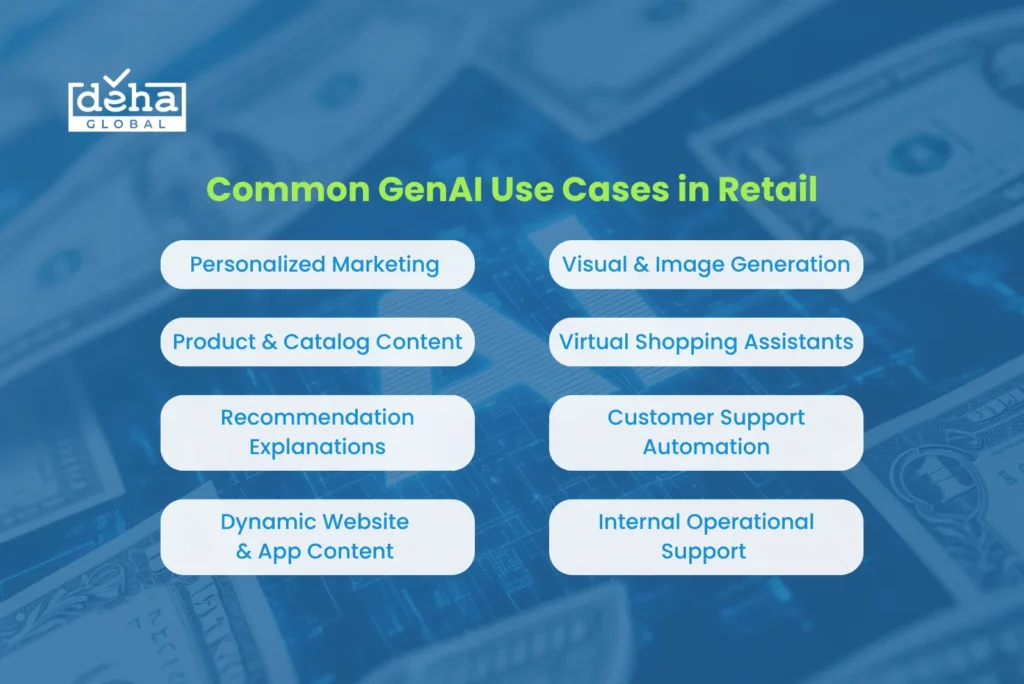
The following sections outline practical, industry-specific applications that brands can translate directly into GenAI Development projects.
| Use Case Category | Typical Impact in Retail |
| Personalized Marketing | Higher engagement and conversion through tailored messaging. |
| Recommendation Explanations | Improved trust and fewer product returns. |
| Dynamic Website & App Content | More relevant on‑site experiences without manual variants. |
| Product & Catalog Content | Faster, scalable content creation, and multilingual support. |
| Visual & Image Generation | Faster catalog updates and reduced photoshoot costs. |
| Virtual Shopping Assistants | More engaging, consultative shopping journeys. |
| Customer Support Automation | Faster resolutions and reduced support load. |
| Internal Operational Support | Streamlined vendor and internal communications. |
1.1 Personalized Marketing
Retailers use generative AI to draft promotional emails, banners, and social media posts that reflect user behavior, past purchases, and browsing history. These personalized messages tend to achieve higher open and click-through rates than generic, one-size-fits-all content.
1.2 AI‑Enhanced Recommendations
Generative AI can enhance recommendation engines by adding natural-language explanations. These explanations clarify why a product is suggested. Shoppers understand recommendations more easily. This transparency increases trust and reduces product returns.
1.3 Dynamic Website & App Content Personalization
Models can adapt homepage banners, category descriptions, and cross-sell content in real time. These adjustments reflect different user segments, improving content relevance for retailers and helping teams avoid creating thousands of manual content variations.
2.1 Product & Catalog Content Generation
Generative models can create multiple product titles, bullet points, and descriptions. These outputs can adapt to different channels, languages, and customer segments. Retailers reduce manual copywriting effort; maintain consistent content across websites, apps, and marketplaces.
2.2 Visual Content Generative Applications
Some retailers use generative AI to create product-lifestyle images, background scenes, or mockups for new collections. This approach reduces dependence on traditional photoshoots and shortens time-to-market for new catalog content.
2.3 Virtual Shopping Assistants
E‑commerce and fashion brands offer virtual stylists that suggest outfits or product combinations based on user preferences and purchase history. These assistants combine product data with generative explanations to create a more engaging, consultative shopping experience.
2.4 Customer Support Automation
Retailers deploy generative chatbots to handle common questions such as shipping, returns, and order status. These assistants respond quickly and consistently. When issues become complex, they escalate them to human agents with full context. As a result, customer service is becoming faster and more efficient.
Internal Operational Support
Retail teams use generative AI to draft purchase orders, promotional briefs, and vendor emails. These drafts reduce repetitive managerial tasks. In addition, they help align supply chains and marketing teams. As a result, internal operations have become more efficient.
After identifying use cases, retailers naturally ask: “What do we actually gain?”. The benefits of Gen AI Development in retail can be measured in revenue, cost, speed, and customer satisfaction. The sections below highlight these outcomes in simple, business‑oriented terms.
Below is a short comparison table to highlight the business‑level outcomes:
| Benefit Area | Typical Business Impact in Retail |
| Revenue & Conversion | Higher AOV, CTR, and repeat‑visit rates. |
| Customer Experience | Faster, more relevant support and product guidance. |
| Cost Reduction | Lower copywriting and support‑team costs at scale. |
| Time to Market | Faster catalog updates and campaign launches. |
| Experimentation & Personalization | More data‑informed, test‑driven personalization. |
| Employee Productivity | Reduced manual work and higher‑level strategic focus. |
Retailers that achieve real value from AI usually follow a structured approach. They start with small pilots, measure results, and scale gradually. Therefore, a clear implementation strategy becomes essential.
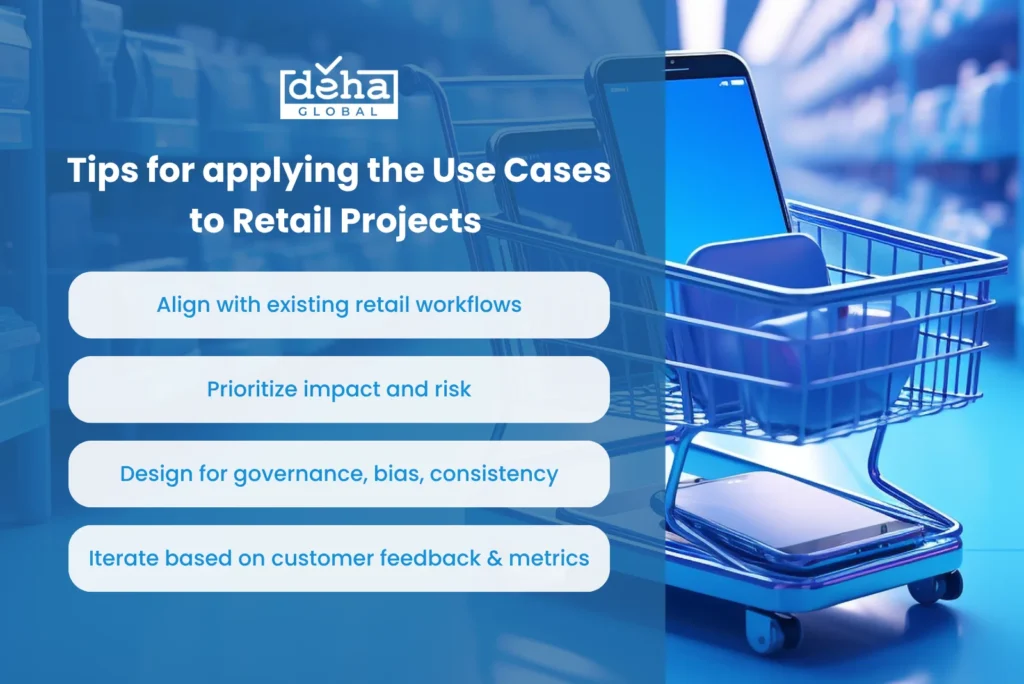
A short checklist can help teams stay focused:
In Conclusion
Generative AI development is transforming retail operations. It turns AI from a trend into a practical business tool. Retailers now use it across sales, marketing, and internal processes.
By focusing on specific use cases, organizations can achieve measurable results. These results include higher revenue, lower costs, and better customer experiences. Therefore, the best approach is to start with one or two high-impact areas. From there, retailers can scale based on real data and customer feedback.