How to Choose the Right Data Engineering Services In 2026
June 25, 2026





Data has become a critical asset for modern enterprises. Yet many organizations still struggle to turn growing volumes of data into reliable insights. Information often sits across cloud applications, operational systems, data warehouses, and real-time platforms, making it difficult to maintain consistency and trust.
As analytics, AI, and automation initiatives continue to expand, data engineering services have become a strategic investment rather than a purely technical function. A strong data foundation enables organizations to improve decision-making, accelerate innovation, and scale digital initiatives with confidence.
This guide explains what data engineering services include, the business value they deliver, and the criteria technology leaders should use when selecting a provider in 2026.
Raw data at scale creates more problems than value – without the right systems to manage it. Data engineering services provide the infrastructure and expertise organizations need to turn scattered data into a reliable, analytics-ready asset.
Data engineering services help organizations build the systems required to collect, process, store, and manage data at scale. The objective is simple: make trusted data available to the people, applications, and AI systems that depend on it.
A typical engagement begins with data strategy and architecture planning. Providers assess existing systems, identify gaps, and design an architecture that supports current and future business requirements.
From there, engineering teams build data pipelines that move information between source systems and target platforms. These pipelines automate data ingestion, transformation, validation, and delivery, ensuring business users can access accurate information without manual intervention.
Data storage is another core component. Depending on business requirements, providers may implement a data warehouse, data lake, or lakehouse architecture to support analytics, reporting, and machine learning workloads.
Modern data engineering services also include governance, DataOps, MLOps, and cloud optimization. Together, these capabilities help organizations maintain data quality, improve operational efficiency, and support long-term scalability.
Many organizations invest in analytics platforms, dashboards, and AI initiatives only to discover that poor data quality limits their results. Data engineering services address this challenge by creating a reliable foundation for decision-making.
The primary benefits include:
Choosing a provider involves more than evaluating technical expertise. The right partner should help organizations align data initiatives with broader business objectives.
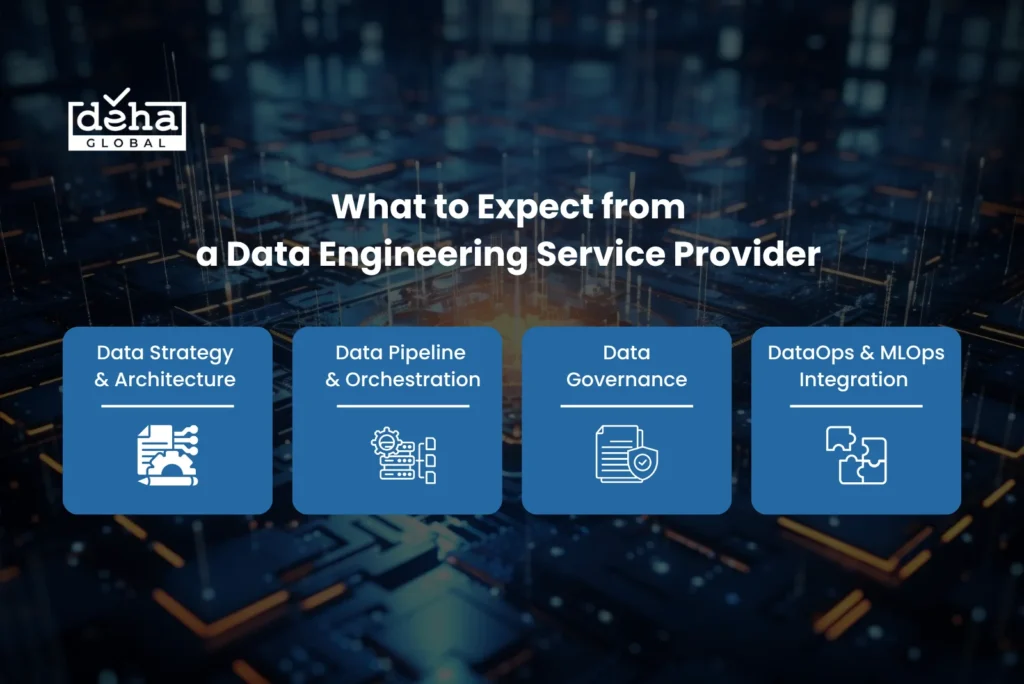
A strong engagement starts with understanding the current environment. Providers should evaluate existing systems, identify bottlenecks, and design a roadmap that supports both immediate priorities and long-term growth.
The outcome should be a practical architecture plan rather than a generic framework. Every recommendation should align with business goals, operational requirements, and compliance obligations.
Reliable data pipelines sit at the center of every modern data platform.
Providers should design, build, and maintain pipelines that support both batch processing and real-time data movement. Equally important, they should implement monitoring, testing, and orchestration capabilities that improve reliability and reduce downtime.
Clear documentation and well-defined service levels are strong indicators of delivery maturity.
Governance should not be an afterthought.
A capable provider incorporates governance directly into the architecture through lineage tracking, metadata management, access controls, and compliance monitoring. This approach reduces risk and makes future audits significantly easier.
Organizations that address governance early typically avoid the costly remediation efforts that often arise later.
As data environments become more complex, automation becomes essential.
DataOps practices improve deployment speed, increase reliability, and reduce operational overhead. Organizations with AI initiatives should also expect MLOps capabilities that support model deployment, monitoring, and lifecycle management.
Together, these practices create a more scalable and efficient operating model.
The market offers hundreds of providers, but technical capability alone does not guarantee successful delivery. Technology leaders should evaluate vendors using a combination of business, operational, and technical criteria.
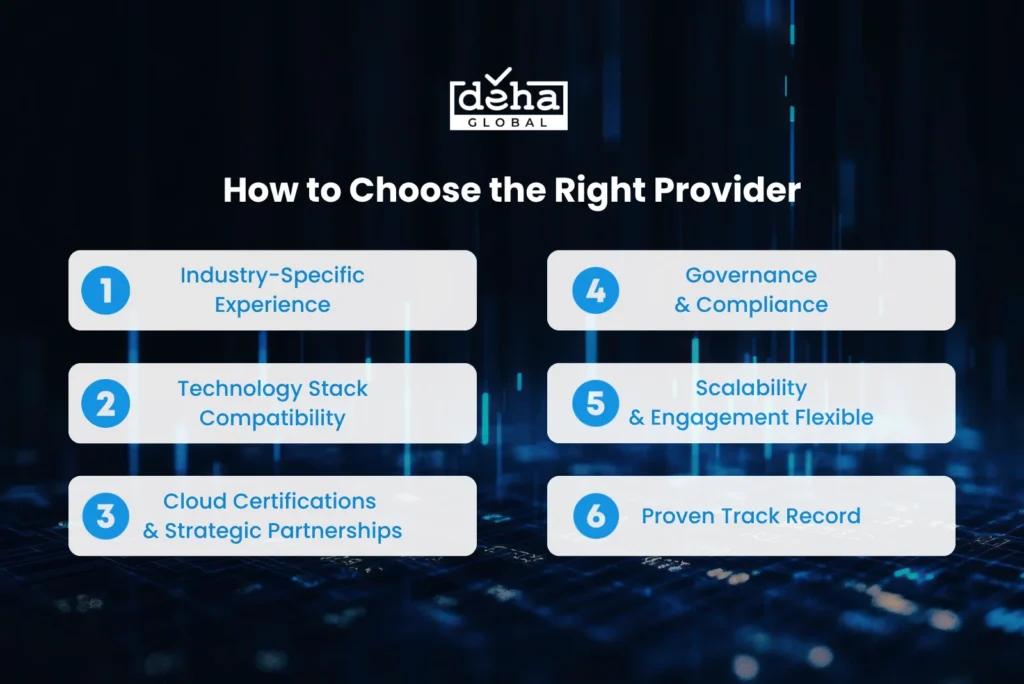
Data engineering requirements differ by sector. Financial institutions focus heavily on governance and auditability. Healthcare organizations prioritize compliance and patient privacy. Retail companies often require real-time analytics and demand forecasting capabilities.
Providers with industry-specific experience understand these requirements from the start and can significantly reduce implementation risk.
Evaluate: Sector-specific case studies, client references, and familiarity with relevant compliance frameworks.
The best provider is not necessarily the one with the largest technology portfolio. The right provider understands how to work within your existing environment.
Evaluate: Experience across the platforms your organization already uses. Strong multi-cloud expertise also reduces the risk of future vendor lock-in.
Certifications demonstrate technical investment and platform expertise. Strategic partnerships often provide providers with access to advanced training, product roadmaps, and specialized support.
While certifications alone should not drive vendor selection, they can help validate technical credibility.
| Certification | Platform | Validates |
| AWS Certified Data Engineer | Amazon Web Services | Pipeline design, storage, processing |
| Azure Data Engineer Associate | Microsoft Azure | Integration, transformation, security |
| GCP Professional Data Engineer | Google Cloud | Pipeline build and operationalization |
| Databricks Certified Associate | Databricks | Lakehouse architecture, Spark optimization |
| Snowflake SnowPro Advanced | Snowflake | Engineering, tuning, security |
Regulatory pressure continues to increase globally. Providers that embed governance into architecture from the start significantly reduce remediation costs and compliance risk later.
Evaluate: Look for providers that offer built-in lineage tracking, data quality monitoring, privacy controls, and compliance reporting. These capabilities help reduce risk and simplify regulatory requirements over time.
Data volumes grow. Business priorities shift. A strong partner offers flexible engagement that scales team capacity up or down by project phase.
Evaluate: The right provider should offer a delivery model that scales alongside business needs. Flexible staffing, clear service-level commitments, and responsive support structures often become as important as technical expertise during long-term engagements.
A vendor’s case studies reveal actual delivery performance – not just stated capability. Generic or vague project descriptions are a red flag.
Evaluate: Look beyond generic marketing claims and focus on measurable outcomes. Strong providers can demonstrate improvements in data quality, platform performance, operational efficiency, cost optimization, or delivery speed through real-world projects.
Organizations should prioritize recent case studies that reflect similar levels of complexity and scale.
In Conclusion
Choosing the right data engineering services partner has long-term consequences for data quality, system scalability, and business competitiveness. The strongest providers bring industry-specific knowledge, certified technical expertise, governance-first design, and a delivery model that grows with your needs.
DEHA Global combines AI-driven engineering, cloud architecture, and scalable data infrastructure to help enterprises across APAC move from fragmented data systems to production-ready platforms. Contact our team to discuss your data engineering requirements and explore how we can accelerate your transformation.