

Organizations generate more data than ever, yet many still struggle to turn that data into reliable business outcomes. Dashboards show conflicting numbers, analytics projects move slowly, and AI initiatives fail to deliver expected results because teams cannot access trusted data.
In most cases, the problem is not analytics or AI. The problem lies in the underlying data foundation.
Data engineering provides the systems, processes, and architecture that keep data accurate, accessible, and ready for use. It supports every reporting dashboard, machine learning model, and business decision that depends on reliable information.
This guide explains what data engineering is, how the lifecycle works, the skills and technologies that define the field, and the trends shaping enterprise data platforms in 2026.
What Is Data Engineering?
Data engineering focuses on designing, building, and maintaining the systems that collect, process, store, and distribute data across an organization. Its primary function is to make data reliable, accessible, and ensure the right data reaches the right people and applications at the right time.
Without effective data engineering, organizations struggle with inconsistent reporting, poor data quality, and limited visibility into business performance. Analysts spend time validating data instead of generating insights. Data scientists waste effort preparing datasets rather than building models.
Data engineering solves these challenges by creating a reliable foundation for analytics, business intelligence, and AI.
Data engineering covers three core areas:
- Pipeline design and development: Building automated workflows that move data from source systems to storage and analytics tools reliably and at scale.
- Data transformation: Cleaning, standardizing, and reshaping raw data into structured, analysis-ready formats through ETL (Extract, Transform, Load) or ELT processes.
- Infrastructure management: Designing and operating the storage systems, compute environments, and orchestration layers that keep data moving consistently.
The role has expanded significantly in recent years. Modern data engineers work with cloud-native architectures, real-time data streams, and AI-ready platforms that support increasingly complex business requirements.
The Modern Data Engineering Lifecycle
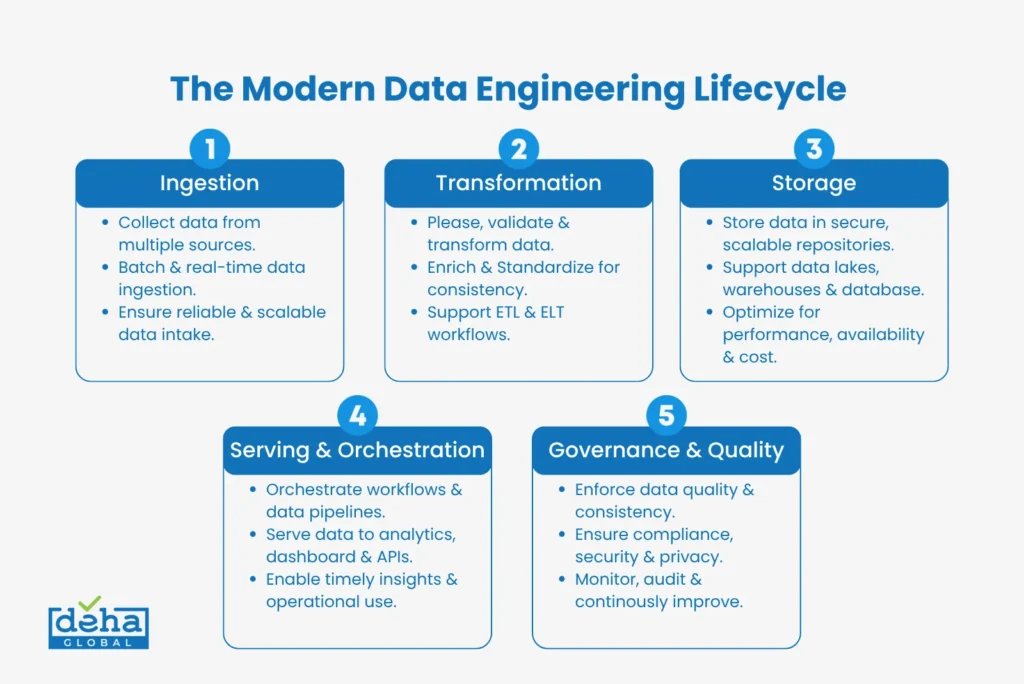
Data engineering follows a structured lifecycle. Each stage plays a critical role in ensuring data remains accurate, accessible, and valuable.
Data Ingestion
Every data initiative begins with ingestion. Organizations collect information from databases, SaaS platforms, APIs, applications, IoT devices, and event streams. Ingestion happens in two modes:
- Batch ingestion: Data is collected and moved at scheduled intervals (hourly, daily). This approach suits stable, non-time-sensitive workloads.
- Streaming ingestion: Data flows continuously in real time. Tools like Apache Kafka and Amazon Kinesis handle event-driven ingestion at high volume and low latency.
The right approach depends on business requirements. Financial transactions, fraud detection, and operational monitoring often require real-time processing. Reporting and historical analysis may function effectively with batch updates.
A well-designed ingestion layer ensures organizations can collect data consistently without creating bottlenecks downstream.
Data Transformation (ETL/ELT)
Transformation converts raw, unstructured, or inconsistent data into clean, standardized formats that analytics and AI systems can use. This stage often includes data cleansing, validation, aggregation, and business-rule implementation.
Modern organizations increasingly adopt ELT architectures because cloud platforms can process large-scale transformations efficiently. This approach improves flexibility and supports growing data volumes without creating additional infrastructure complexity.
Data Storage
Storage decisions influence both performance and scalability.
Organizations typically choose between data warehouses, data lakes, or lakehouse architectures based on workload requirements.
- Data Warehouse: Support structured, query-optimized storage for BI and reporting workloads (Snowflake, BigQuery, Redshift)
- Data Lake: Stores raw and semi-structured data at low cost for exploratory analytics and ML (AWS S3, Azure Data Lake Storage)
- Lakehouse: Combines both models; supports structured analytics and unstructured AI workloads in one platform (Databricks, Apache Iceberg)
The right storage strategy allows organizations to balance cost, performance, governance, and future scalability.
Data Serving and Orchestration
This stage focuses on making data accessible while maintaining consistency and performance. Orchestration tools coordinate workflows, monitor dependencies, and automate recovery when failures occur.
Strong orchestration reduces operational overhead and improves the reliability of data platforms.
Data Governance and Quality
Data governance defines who owns data, who can access it, how long it is retained, and how quality is maintained. Without clear ownership, access controls, and quality standards, data reliability deteriorates quickly. Teams lose confidence in reporting, compliance risks increase, and business decisions become harder to trust.
Effective governance establishes accountability across the data lifecycle. It includes lineage tracking, metadata management, security controls, retention policies, and automated quality monitoring.
Organizations that embed governance into their architecture from the beginning typically scale more successfully than those that treat it as a later initiative.
Essential Data Engineering Skills and Tools in 2026
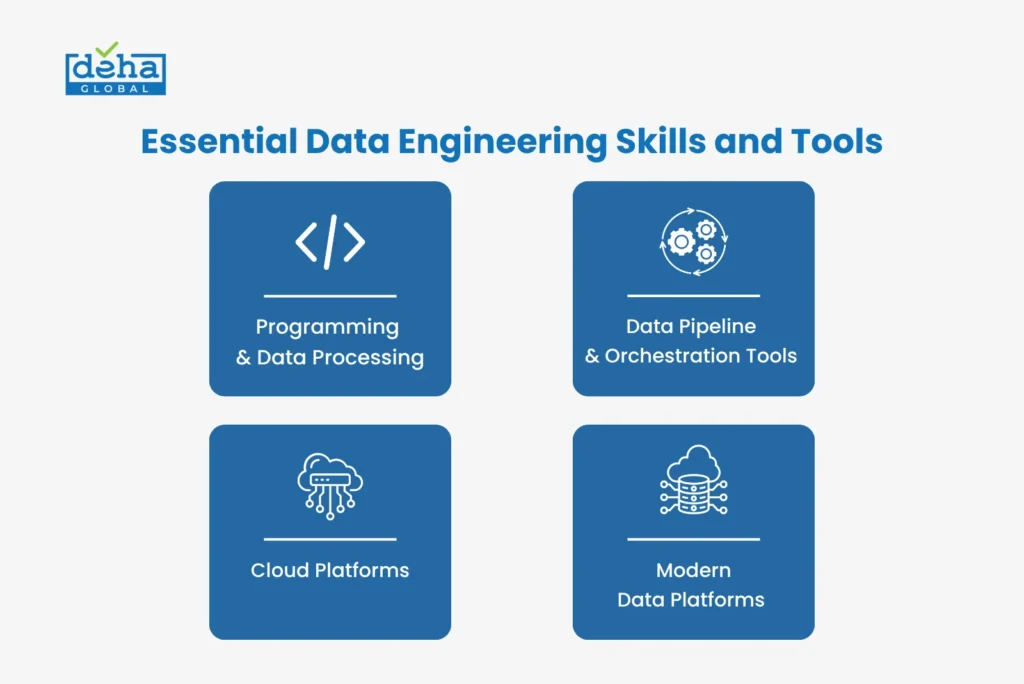
Technology continues to evolve, but several core skills remain fundamental to successful data engineering.
Programming and Data Processing
Python remains the most widely used programming language in data engineering. Teams use it to automate workflows, build pipelines, process large datasets, and support machine learning environments.
SQL remains equally important. Strong SQL skills allow engineers to model data effectively, optimize performance, and support analytics workloads at scale.
Engineers working with distributed systems often use Scala or Java alongside platforms such as Apache Spark and Apache Kafka.
Data Pipeline and Orchestration Tools
Modern data platforms depend on automation.
- Apache Airflow: help teams schedule and monitor complex workflows.
- dbt (Data Build Tool): has become a standard choice for managing data transformations within cloud environments.
- Apache Spark: supports large-scale processing
- Apache Kafka: enables real-time event streaming.
- Fivetran / Airbyte: reduce development effort and accelerate data integration projects.
Cloud Platforms
Cloud proficiency is a baseline requirement in 2026. Data engineers work across:
- AWS: Glue (ETL), Redshift (warehouse), S3 (storage), Kinesis (streaming)
- Microsoft Azure: Data Factory (ETL), Synapse Analytics (warehouse), Event Hubs (streaming)
- Google Cloud Platform: BigQuery (warehouse), Dataflow (processing), Pub/Sub (messaging)
Most enterprise environments operate across two or more of these platforms, making multi-cloud fluency a distinct advantage.
Modern Data Platforms
Data engineers also need experience with modern analytics platforms.
- Snowflake: continues to play a major role in cloud data warehousing
- Databricks: has become a leading platform for lakehouse architectures and AI workloads
- BigQuery: remains a strong choice for organizations operating within Google Cloud ecosystems.
Understanding how these platforms fit into broader data architectures has become as important as understanding the tools themselves.
Data Engineering Trends and Real-World Use Cases in 2026
AI-Driven Data Engineering
AI is changing how data teams work. Instead of spending significant time writing repetitive code, engineers increasingly use AI to generate pipeline logic, identify anomalies, optimize queries, and monitor system performance.
As automation expands, engineers spend more time on architecture, governance, and strategic design decisions. The role is shifting from implementation-focused work toward platform ownership and operational excellence.
Platform-Owned Data Infrastructure
The “best tool for every job” model is giving way to platform-owned data infrastructure – where organizations treat their data stack as a product rather than a collection of independent tools. Standardized building blocks, centralized governance, and platform-level observability replace fragmented tool sprawl.
This approach improves reliability, reduces complexity, and allows teams to scale more efficiently.
Real-World Applications of Data Engineering
Data engineering supports measurable business outcomes across industries.
- Financial services: rely on real-time data pipelines to detect fraudulent transactions before losses occur.
- E-commerce and retail: use data platforms to power recommendation engines, inventory optimization, and customer analytics.
- Healthcare: providers integrate clinical and operational data to improve decision-making and patient care.
- Manufacturing and IoT: process sensor data to predictive maintenance pipelines, process sensor data from equipment to identify failure risk before downtime occurs.
- Technology platforms: operate large-scale data platforms that enable personalization, experimentation, and real-time customer experiences.
Although use cases vary, they all depend on the same foundation: reliable and scalable data engineering.
In Conclusion
Data engineering is the foundation that determines whether your data strategy delivers real business results or stays stuck in proof-of-concept. Data leaders and engineers who master the full lifecycle, build proficiency in cloud-native tools, and stay ahead of AI-driven automation will consistently outperform those maintaining fragile legacy systems. Whether you are building a data team, evaluating tooling, or sharpening your own skills – use this instruction as your decision-making foundation for 2026.