
This is a design choice, not a limitation. A data foundation you cannot operate yourself is not a foundation. We stay on a support arrangement you scope; the delivery centre remains behind it.
Oridex is that foundation. It turns your documents – including the unstructured, scanned, and mixed-quality ones into a governed, retrievable layer inside your own infrastructure, on-premises or private cloud. Models are served inside that boundary, not called from a third-party API; a review step sits before anything goes live; and every result carries its source. Build the applications on top of it. Or let us.
1,281 extracted
3 need attention
Run report ready for review
6 metadata fields tagged
Status tracked per file, not per batch. The run report is reviewed before output is selected for retrieval. Interface shown with sample data.
When AI projects stall, it is rarely the model – the LLM itself. It is the data layer underneath, and usually in one of four places.
Years of scans and files with no consistent structure. The pilot ran on a handful of documents someone cleaned by hand; production had a document set several orders of magnitude larger that nobody had touched – so it never left the pilot.
A result with no source document behind it cannot be checked – so nobody could verify it, and the business stopped relying on it.
Extraction quality was assumed rather than checked. The first close look came when a user reported a wrong answer – and trust did not recover.
The architecture assumed documents could be pushed to an outside service for processing. For a regulated organisation, that assumption ended the project at the security review.
Oridex is not a chatbot. It is the platform a chatbot – or any other AI application – stands on. Build on top of it with your own team, with ours, or with Oriene AI, our answer application.
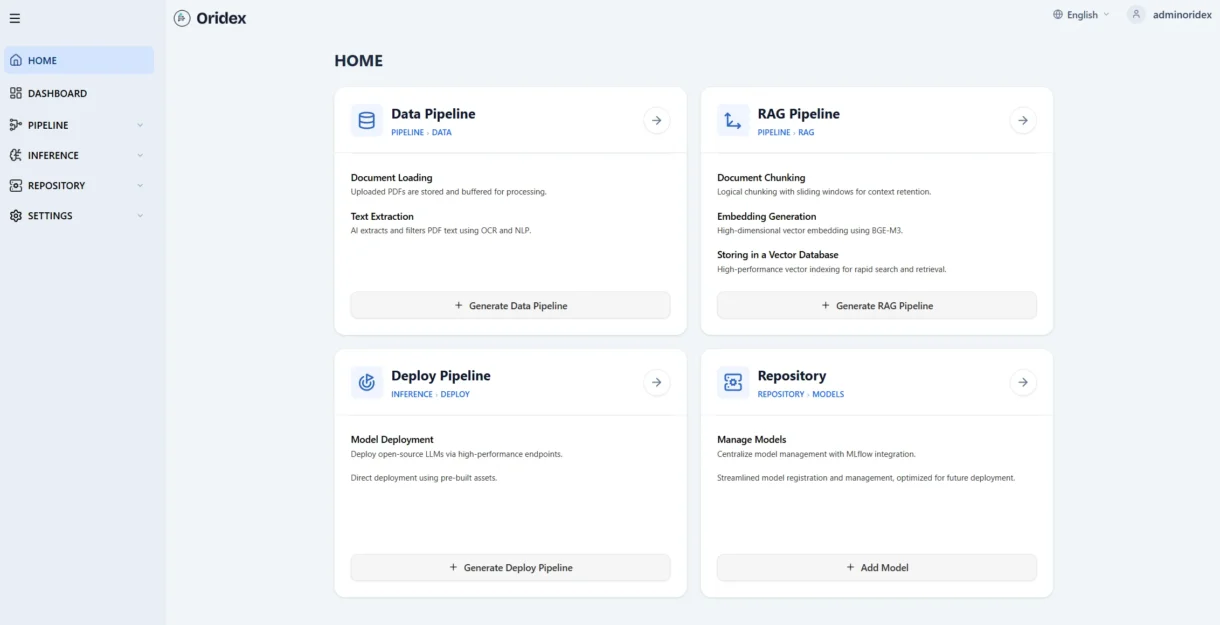
Buckets, files, document metadata and the templates that define what gets extracted.
Reads your PDFs, scans, images, Word and Excel files – including messy, mixed-quality ones – and turns them into clean, structured text, with the operational controls a large document set needs.
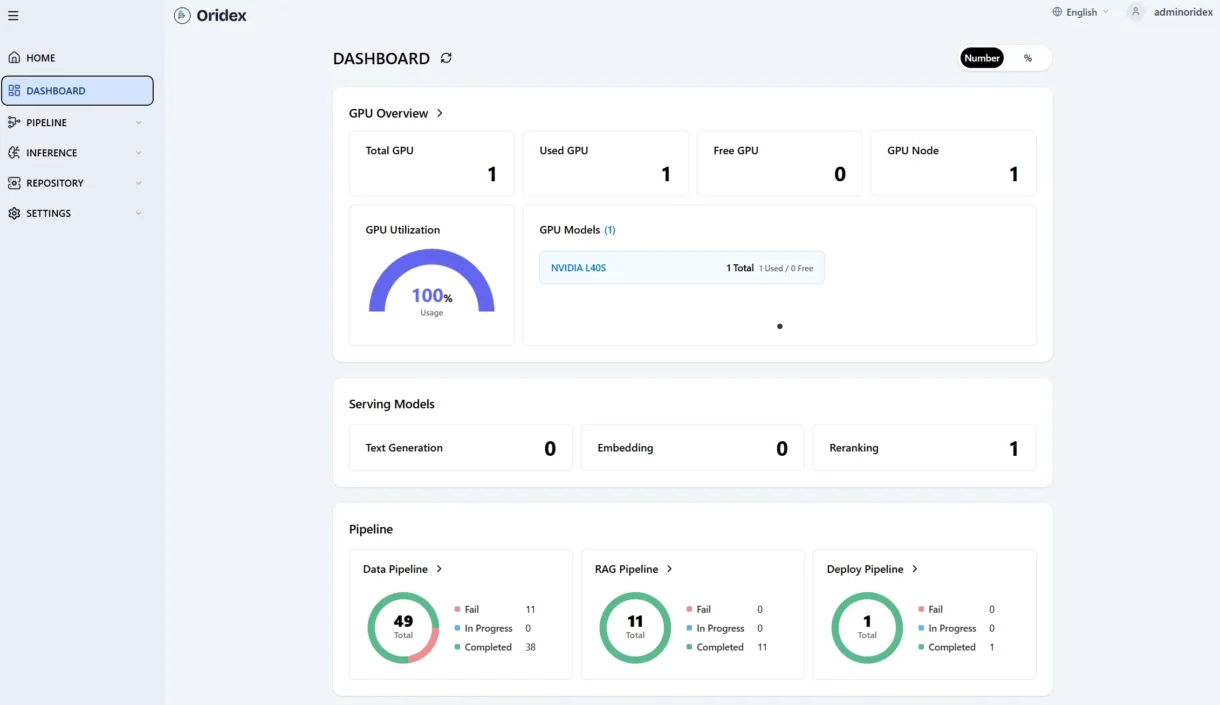
Turns reviewed content into AI-ready, retrievable data – chunked with sliding windows, embedded and indexed, validated before it goes live.
Your platform admin registers and serves a model once; pipeline owners simply select it. Open-source embedding and language models run in your cluster, not behind a third-party API.
Both pipelines include a review step: the pipeline owner checks the run report and output before selecting it for the next stage. This is what lets you answer a compliance function without promising an accuracy number.
Two things cross the boundary, stated plainly. Document extraction runs through an OCR provider configured for your deployment – a pluggable setting, changed without code – over egress you approve. And the first download of open-source models is a one-time pull, which can come from your own registry instead. Everything else – storage, embeddings, vectors, model serving and the applications querying them – stays inside your network. If your documents cannot leave, we’ll bring extraction in-cluster as scoped work on the platform, as it was for the deployment described below.
DEHA GLOBAL is the Singapore entity of DEHA Group. Oridex is built, deployed and supported by the group’s shared engineering centre — the same organisation that has shipped production systems across Vietnam, Japan and Singapore for a decade.
This is a design choice, not a limitation. A data foundation you cannot operate yourself is not a foundation. We stay on a support arrangement you scope; the delivery centre remains behind it.
An insurance group holding more than ten years of policy, claims and legal records, largely scanned and in Korean. Public cloud tools had been ruled out: the files could not leave, and the volume did not fit.
One use case, one document set, one measure of success. We scope before we quote, and we deploy once the evaluation clears your criteria and your infrastructure prerequisites are in place.
The documents, the questions that matter, the constraints. One use case, written down, with success criteria agreed before any build.
Oridex runs on a slice of your own documents – on your cluster once prerequisites are in place, or on a sample you approve in an isolated staging environment agreed during scoping. Extraction and retrieval quality measured against your criteria, with your engineers alongside ours.
You see the results on your own corpus. If it clears, we move to deployment with a scoped plan and a fixed prerequisite checklist.
Installed in your environment, smoke-tested, with manifests, run book and test suite handed to your team. Timing depends on your DNS, certificates and cluster access.
Two lines from the first contract: a platform licence, and the integration work to put it into your environment. You see what recurs and what does not.
Priced as a fraction of the first production year, and credited against it if you proceed. Scoped to one use case so the number stays small.
A Kubernetes environment (Rancher-managed or compatible), S3-compatible object storage, and a named owner on your side. GPU capacity is sized during scoping, not assumed. We share the full prerequisite checklist in week one.
Forty-five minutes with Brian Dang, CEO of DEHA GLOBAL. You describe where your AI initiative is stuck. We map it against Oridex and tell you – plainly – whether it fits, what it would take, and what it would not solve.
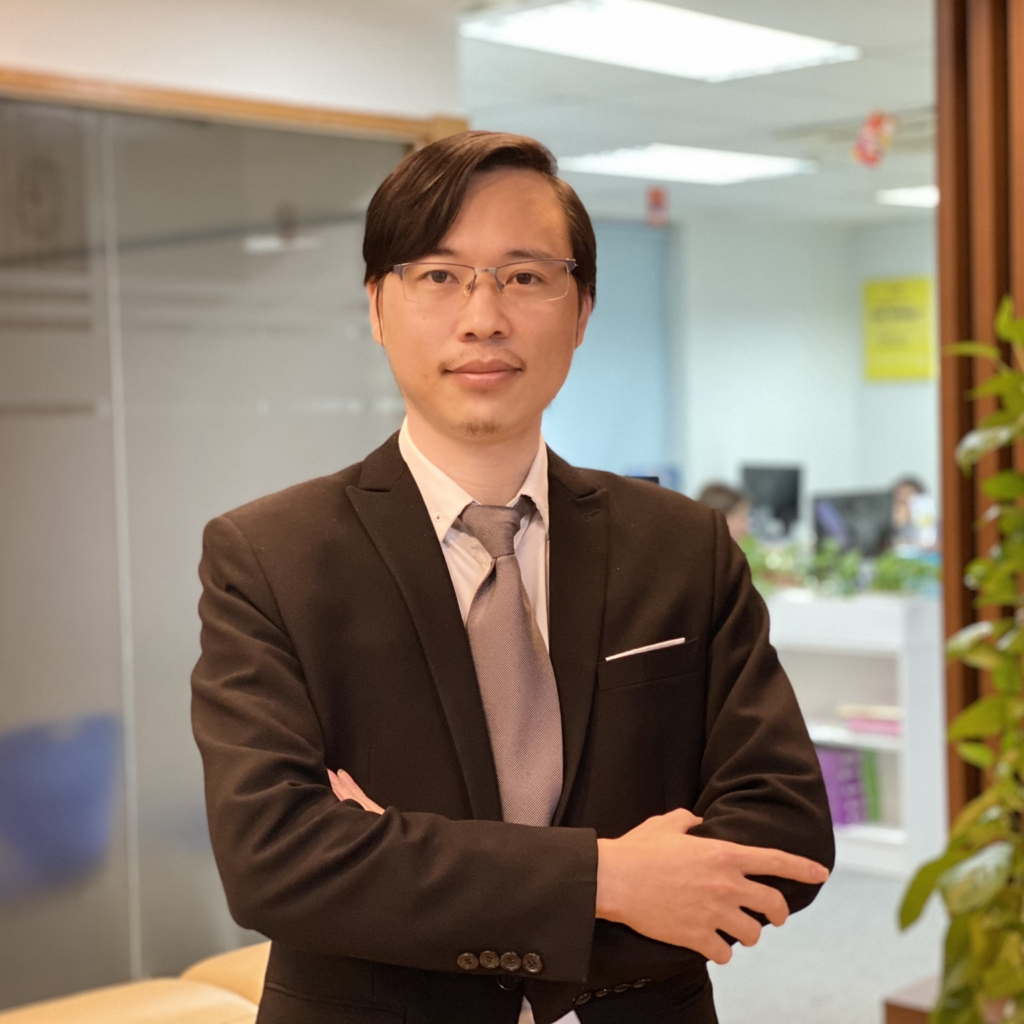
Brian Dang leads DEHA GLOBAL and works directly with CIOs and CTOs on document and data foundations for AI. When the conversation gets into cluster topology or model sizing, a solution architect from the delivery centre joins the call.
Three questions, because they decide whether the meeting is worth your time. We reply within two working days with proposed slots. By submitting you agree to our Privacy Policy (Singapore PDPA).
Not ready for a meeting? Get the technical overview by email — architecture, deployment boundary, prerequisites.
Your documents, extraction output, vectors, and served models stay inside your environment- on-premises or in your own cloud region. Document extraction runs through an OCR provider configured for your deployment, over egress you approve; which provider, and exactly what leaves in that call, is agreed during scoping and named in the Data Processing Agreement. If your documents cannot leave, we’ll bring extraction in-cluster as scoped work. A DPA, the sub-processor list, and support for your own penetration test are available under NDA.
No. Oridex is the retrieval layer underneath — structured, searchable knowledge and the endpoints to query it, with results carrying the source document and passage they came from. Build on it with your own team, or use Oriene AI, our answer application that runs on top.
A Kubernetes environment, object storage and the usual platform services. GPUs are optional and depend on whether you serve models locally and at what size. We size this with your infrastructure team during scoping and give you the prerequisite checklist up front.
You check it at a review step in both pipelines: the pipeline owner checks the run report and output before selecting it for retrieval. We measure extraction and retrieval on your own documents during evaluation, against criteria you set – rather than quoting an accuracy number that means nothing on your corpus.
Deployment and support are done by named engineers from the group’s delivery centre in Vietnam, through the remote-access path your security team approves, with sessions logged on your side. The access arrangement is agreed and documented before any work begins, so it can go through your outsourcing review up front rather than after.
Your team, with a documented handover: architecture, run book, deployment manifests, and an automated test suite. We stay on the support arrangement you scoped, and the group’s delivery centre supports it.
Scans are read with OCR rather than re-keyed, and the embedding model is selected for your language. Rather than claim a quality level, we measure it on your documents during evaluation – before anything is committed.
Book a working session with Brian Dang, or get the technical overview – architecture, deployment boundary and prerequisites.