Legal, Document intelligence

Your firm has already answered this question.
In 2011. In a matter nobody remembers.

A firm’s real asset is the advice it has already given, and most of it is unreachable, scattered across a document management system, a decommissioned archive and boxes of scans.

Oridex makes that body of work answerable inside your own infrastructure: every answer carries the document, version, clause and page it came from, nothing leaves your network, and retrieval respects the access rules your matters already run under.

oridex
Illustrative, sample data
On-premise · Private cloud · Fully offline · Access-controlled retrieval · ISO/IEC 27001:2022
/ The moment

Thursday, 21:15

A senior associate is drafting something the firm already owns.

She is certain the firm has taken a position on this before, a similar clause, a similar structure, five or six years ago. She cannot remember the client, and the matter number means nothing to the search box. So she drafts it again from first principles, a partner reviews it again – and the firm bills a second time for a view it already holds.

The cost is not her evening. It is that the firm’s accumulated judgement stops compounding. It depreciates as people leave, matters close and systems are replaced. This is not a research problem. It is what happens when institutional knowledge sits in documents no system can answer questions about.

Knowledge the firm can't find is knowledge it pays for twice.

Every merger, every migration, every retirement

/ What firms hold

The work product is the asset. The archive is the obstacle.

Not the model. Not the interface. Decades of advice, drafting and correspondence that every useful answer has to come from.

Search that matches words, not reasoning

A DMS finds the term you typed. It does not find the matter that turned on the same point under a differently drafted definition.

Three systems and a cupboard

iManage or NetDocuments today, whatever preceded it, email, and scans of files that were never migrated. Each move left something behind, and the oldest of it is where the firm’s longest memory lives.

Precedent without provenance

A clause found in an old document tells you nothing about whether it survived negotiation, was later amended, or was the position the firm lost on.

Knowledge that leaves when people do

The partner who knows which matter to look at is the constraint. When they retire, so does the index.

/ Why the pilot stopped

Most firms have already tried this once.

It stops in the same four places, and none of them are about the quality of the model.

01

Privilege does not travel

Uploading privileged material to a third-party service is a question your general counsel and your professional indemnity insurer answer before your IT team does.

02

Information barriers are not a setting

An assistant that can reach every matter is a confidentiality breach wearing a chat interface. The exposure happens at retrieval, not at the screen: if the system reaches behind an ethical wall to compose an answer, the breach has already occurred. Retrieval has to respect the walls the firm already operates.

03

The volume does not fit

Twenty years of matter files is not a context window. An assistant that reads what you paste cannot read what you hold.

04

No citation, no use

A lawyer cannot act on an answer they cannot point to. Without the document, the version and the page, the output is a suggestion, not research.

/ What we do

Three things, in this order.

01

Answers a lawyer can cite.

Every answer is generated only from the documents you registered and shows the document, version, clause and page it came from. The associate opens the source and forms their own view. The system shortens the search, it does not give legal advice, and the documents it opened are recorded.

02

Nothing leaves your infrastructure.

Deployed on-premise or in your own cloud region, including fully offline, with the language models running inside your infrastructure. Privileged material is processed where it already sits. We build and own the platform, which is why running all of it inside your perimeter is a deployment option rather than a special project.

03

In production in four weeks.

One practice group, one document set, the questions it should answer, agreed in writing before the build. Not a proof of concept that ends as a slide.

/ Which layer you need

Is your difficulty in the documents, or in the questions?

Two products, and the honest answer is that one usually has to come before the other. Worth settling before anyone builds anything.

Difficulty with the questions?

Start on this layer.

Difficulty with the documents?

Start on this layer.

Your fee earners and knowledge team

Your clients

INSIDE YOUR INFRASTRUCTURE

ORIENE AI: THE ASSISTANTS PEOPLE TALK TO

Internal knowledge assistant

Client-facing assistant

One AI-ready document base

cleaned, structured, versioned, access-mapped
Your other systems DMS / PMS

produces

ORIDEX: THE PLATFORM THAT MAKES THE ARCHIVE ANSWERABLE

Extract from PDF, scan, image, Word, Excel

Structure and version

Link what governs what

ingest as it is

YOUR ARCHIVE: AS IT IS TODAY

scanned matter files, advice memos, executed agreements, precedents, know-how: PDF, scan, image, Word, Excel

Two entry points, one stack, inside your infrastructure.

Illustrative architecture. Integrations scoped per firm.

The difficulty is in the documents

You need Oridex. Decades of matter files, much of it scanned, spread across a current DMS and everything that came before it. The work is turning that into something that can be queried at all.

This is the part firms tend not to want to start.

The difficulty is in the questions

You need Oriene AI. A defined, reasonably clean body of material, a precedent bank, a know-how library, a set of standard forms, and fee earners who need cited answers from it. When the material is already in good shape, Oriene runs on its own.

Smaller footprint, faster to stand up, and a sensible way to prove the approach on one practice group.

Both, eventually

Oridex prepares the archive for Oriene. When the archive is messy, Oridex gets the documents into a state Oriene can answer from; Oriene is the layer your lawyers actually use. Both can sit within the same deployment and access-control model.

Start with whichever half is blocking you. The other attaches later without rebuilding.
/ The platform underneath

What actually happens to a scanned matter file.

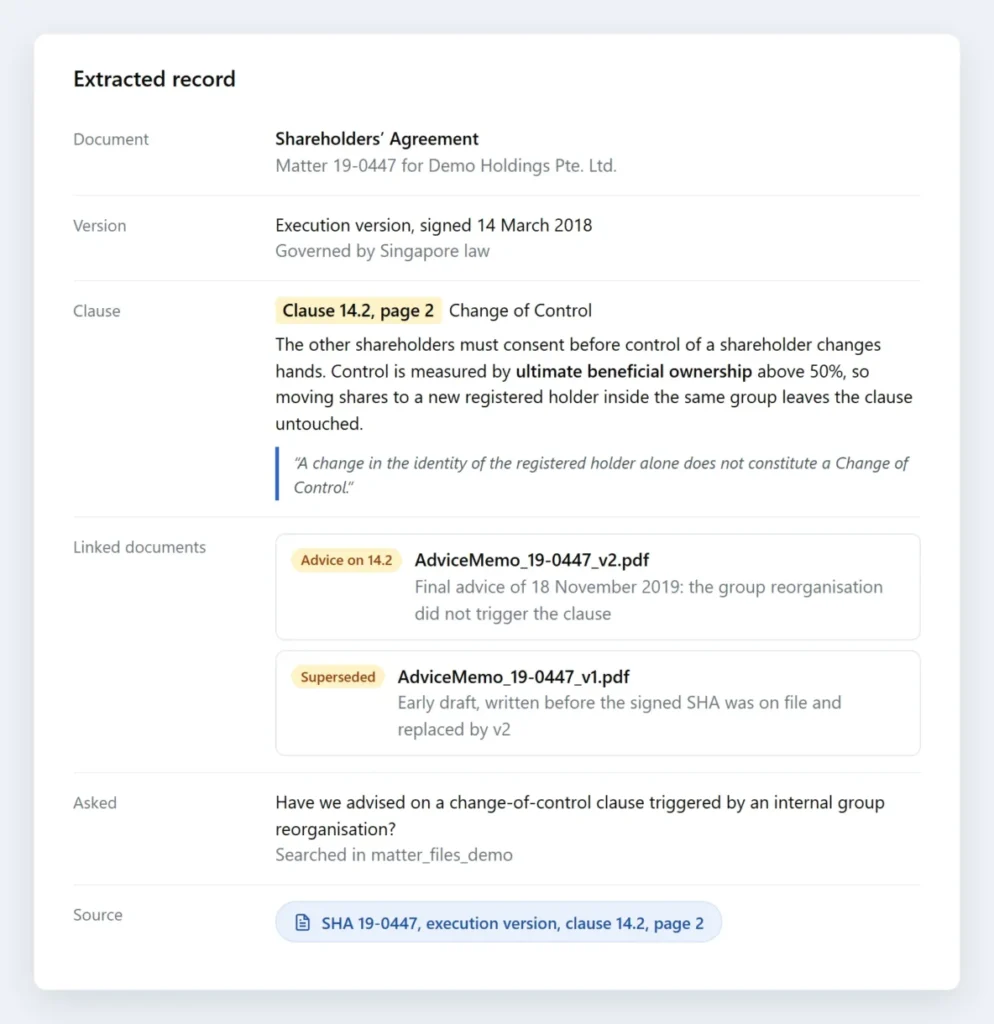
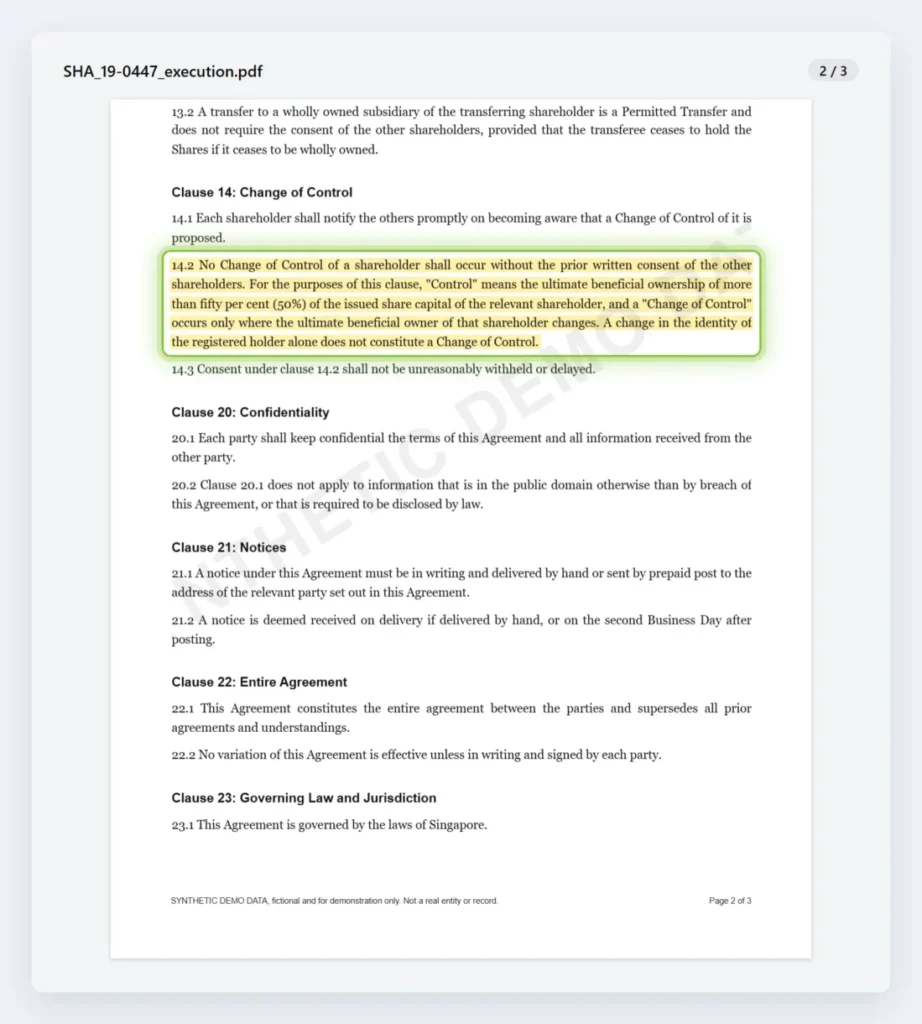
The associate’s 2018 agreement, and what comes back once the archive has been ingested. Nothing is re-keyed, and the file never leaves your network.

What is in the matter file

What Oridex hands back

The scan stays where it is. What comes back is the clause, version, page
and linked source information your team can verify.

Illustrative, constructed example

Three things the diagram does not show.

The shape is simple. These are the parts that decide whether it survives contact with a real firm archive.

One model does not read every document

An executed agreement, a scanned attendance note and a 60-page opinion do not yield to the same extraction. Document types are routed to the approach that handles them, and that routing is configured per archive.

Version is the whole point in legal

Draft, execution version, deed of amendment, restated version. Documents are versioned as they change, so an answer can say which text was in force and what came after it.

Retrieval is built to respect your permissions

Oridex is built to map access from the systems you already run, such as your matter-permissions source and conflicts platform. The source systems, mapping scope and barrier-propagation behaviour are agreed and validated per deployment.

/ In the work

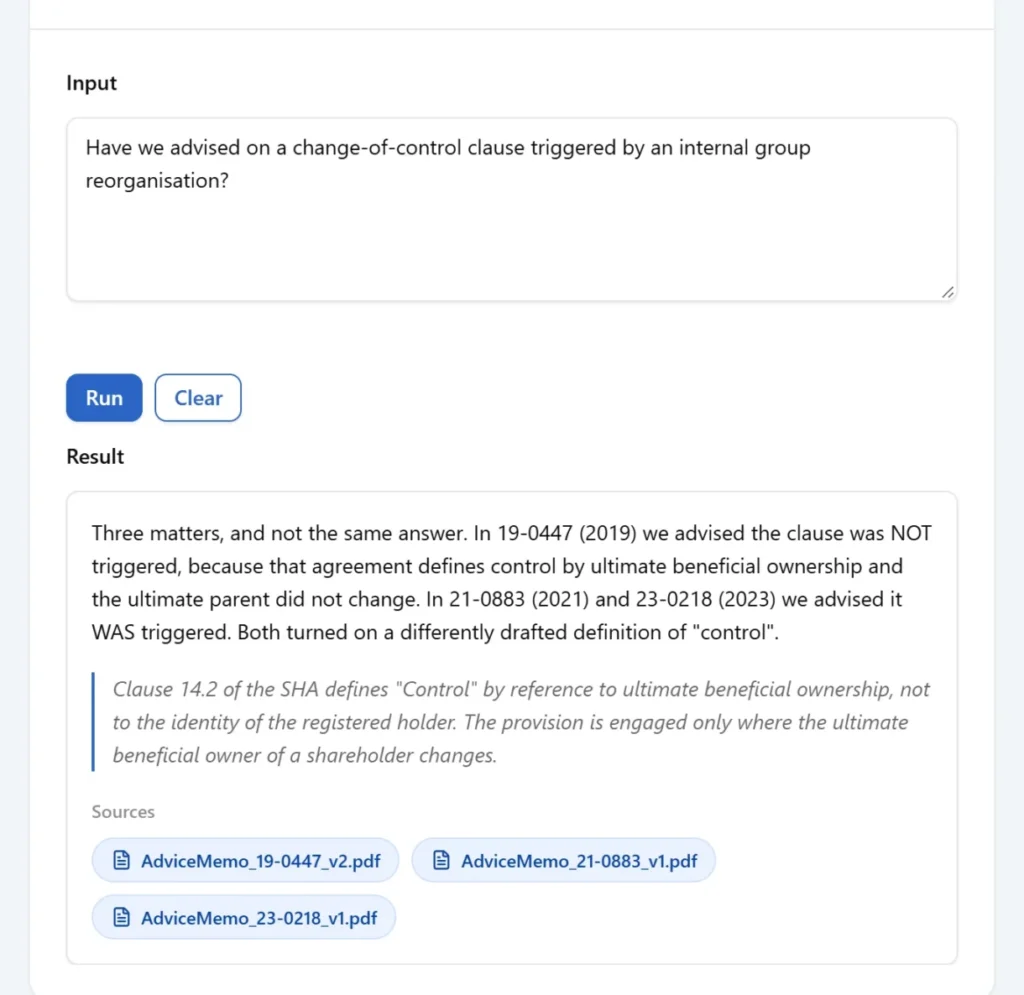
The questions fee earners actually ask.

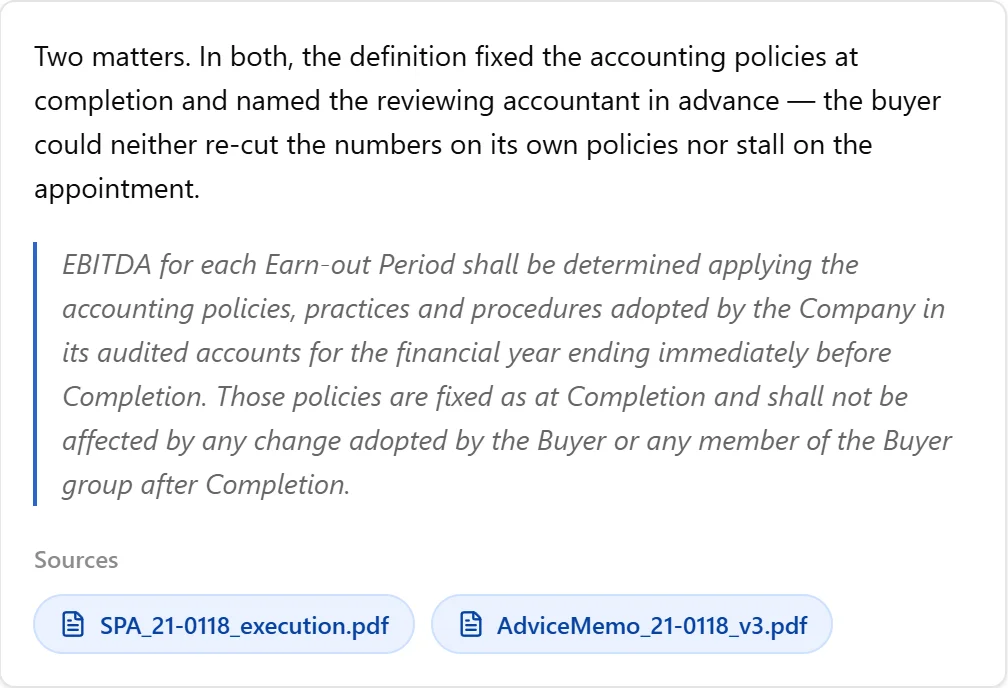
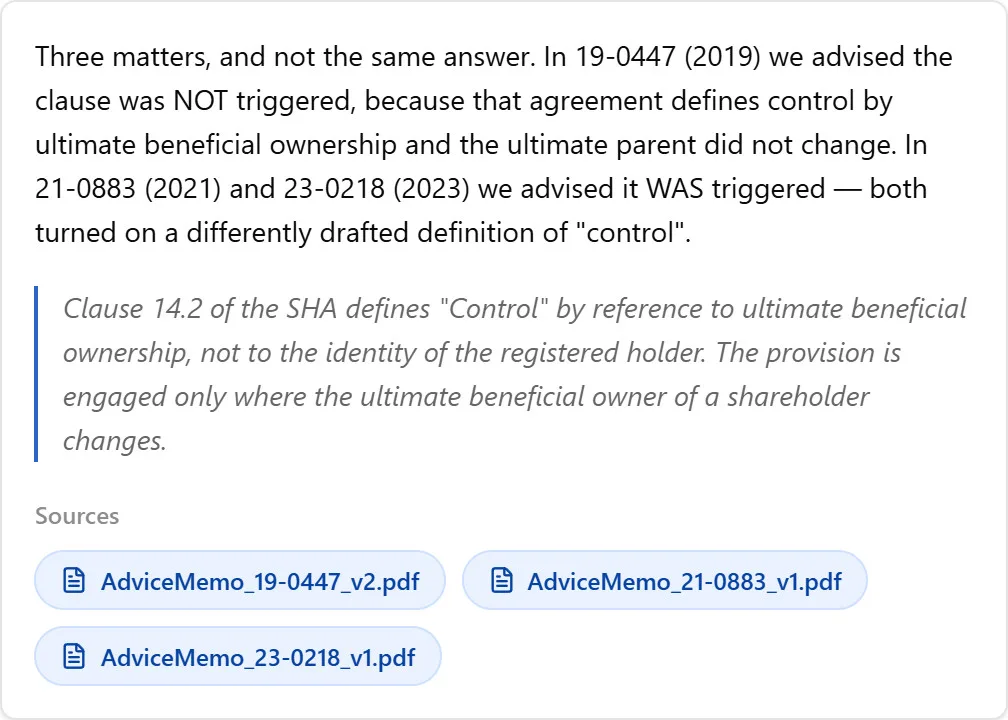
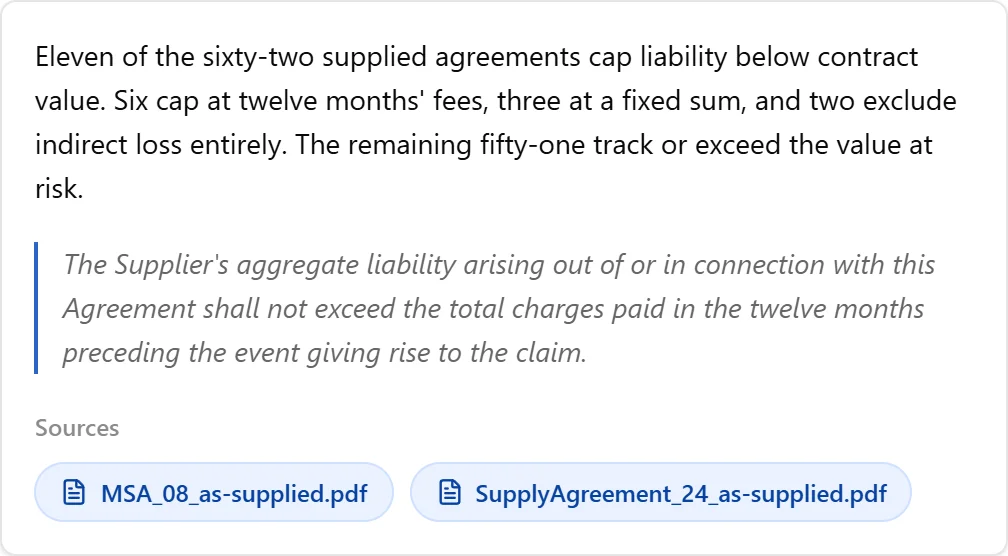
Illustrative examples using sample data.

Know-how

Have we drafted an earn-out that survived a dispute over EBITDA definitions?

Matter history

Have we advised on a change-of-control clause triggered by an internal group reorganisation?

Due diligence

Across this data room, which agreements cap the supplier's liability below the deal value?

/ Where it runs

Run it where privileged material has to stay.

Your cloud

On-premise

Fully offline

Where it runs

Your AWS or Azure region

Your data centre

Your network, no internet

Your files leave

No

No

No

Models run

In your region

Inside your infrastructure

Inside your infrastructure

Suits

Cloud-first firms

Strict residency or client mandates

Government and defence work

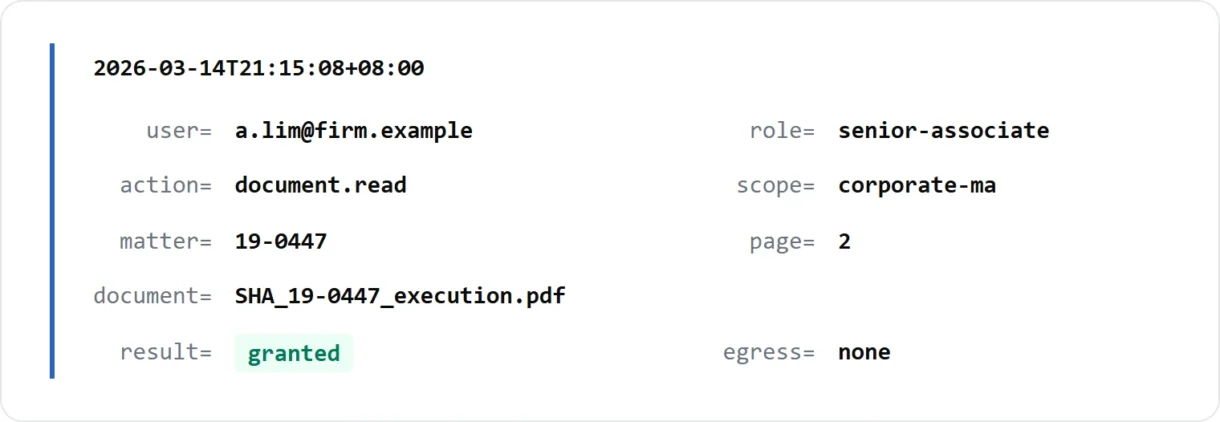
Role-based access control. Access mapping agreed per deployment. Document read and write actions are logged-encryption in transit and at rest.

audit log: one record
Illustrative format

Further retention, key-custody and support details are in the technical overview.

/ Where it earns its keep

Where a firm's own documents are the answer.

Much of the legal AI market focuses on published law. Oridex works on the documents inside your own network: matter files, internal know-how, and material supplied by clients or counterparties.

Panel reviews and client audits

We answer the questionnaires that determine whether the firm stays on a panel using the firm’s own documents with the source attached, rather than assembling them by an associate over a weekend. This one has a revenue line.

Precedent and know-how across matters

The position the firm has already taken, found by the point it turned on rather than the words that happened to be used. This is the one that compounds: every matter closed makes the next one faster.

Due diligence on documents sent to you

Sixty counterparty agreements, one deadline. They carry change-of-control consents, where the liability caps sit, which terms are unusual against your own precedents, each with the clause and page behind it. The set is indexed inside your network, not uploaded anywhere.

Matter context at intake

Before a new instruction is accepted: what related work has the firm done, for whom, and what did it conclude. Your conflicts system decides whether you can act. This tells the partner what the firm already knows.

Switching off the DMS you cannot switch off

The system you migrated away from is still running because of the archive inside it. Making the archive independently searchable can reduce the reasons that the legacy system still has to stay up. This is the one that pays for itself out of an IT budget rather than a knowledge one.

Where we do not compete

Research into published law, and drafting assistants embedded in the word processor. Both are good, both are someone else’s product, and neither answers a question about your own matter files.

/ The document your risk review wants

The technical overview, as a PDF. No meeting attached.

The technical detail your risk and IT teams will ask for before anyone discusses fees. It arrives in your inbox, not your calendar.

One email with the PDF. One follow-up. No newsletter.

What is inside

Deployment topologies: on-premise, private cloud, fully offline, and what changes between them.

How access rules are mapped from your existing systems, and where the boundary of that mapping sits.

Audit logging, retention, tamper-evidence, key custody, sub-processors and deployment access.

Integration of surface and AI-provider coverage, including models run entirely inside your network.

Support response times, and the four-week scoping template.

/ Your alternatives

What you are comparing this against.

You are not choosing between us and nothing. Four other options are on the table, and each is right for someone. Here is where each wins, and where we do not.

Your DMS vendor's own AI

A legal-research vendor's AI

A hyperscaler's document AI

Doing nothing yet

Oridex

What it answers from

Your matter files, within the permissions it holds

Published law, and increasingly your documents via their cloud

Components you assemble in your own tenant

The partner who remembers

Your own matter files, versioned, inside your network

Where it wins

No integration risk, your barriers work, already on your invoice

Case law and legislation, better than anything you would build

You run that cloud and your team can assemble the pieces

The archive is not yet the constraint on anything costly

The firm's own work product is the asset you want back

What it costs you

The decommissioned archive is not in it, and you get their roadmap rather than your archive

Privileged material processed under their terms, not yours

Your engineers own the versioning logic and maintenance

Advice re-derived, and knowledge that walks out

A platform decision, and a vendor with no law-firm deployment to point at

Where we are the wrong choice: if you need better research into published law, use a Legal-research product. If your precedent bank is already clean, curated and in one system, Oriene AI on its own may be the simpler option.

/ For in-house legal teams

If you sit inside the business, the archive is a different shape.

A general counsel’s problem is rarely precedent. It is the contract portfolio: what the company has agreed to, where those obligations sit, and which changes could breach them.

Obligations, not precedents

Executed contracts across suppliers, customers and landlords, each with notice periods, liability caps, indemnities and assignment restrictions that nobody has read together.

Documents you did not draft

Counterparty paper, external counsel advice, and whatever came in with the last acquisition. Mixed formats, mixed quality, no house style to rely on.

The same platform, a different archive

Answers you can cite, material that stays inside your infrastructure, and one scoped workflow in production in four weeks. The archive differs; the platform does not.

/ For systems integrators

If your legal clients are asking for this, you can deliver it.

Some readers are systems integrators and legal-technology consultancies whose clients want document AI on their own material, without building the platform from scratch.

You hold the client relationship

You remain the prime contractor and client lead; we supply the platform and the engineering behind it. Delivery scope and commercial terms are agreed before the engagement starts.

The platform is ours, so it can be shaped

Because Oridex is our own platform, not a resold API, its extraction, data model and deployment approach can be adapted to the client’s environment.
Including running entirely inside their network, which in legal is often the condition a client’s risk review turns on.

Capacity under your badge

Integration is where your margin lives, and we are not looking to take it. A delivery centre of around 200 engineers, appraised at CMMI Level 3 and certified to ISO/IEC 27001:2022, can support delivery under your contract and brand. You choose which parts to hand over.

Partner contact

Brian Dang

CEO, DEHA Global
/ How it starts

From scoped practice group to production, in four weeks.

One practice group, one document set, in production.

A whole firm archive made answerable: every practice group, every legacy system.

phased and scoped, not quoted from a website

start

week 4

month 3

month 6

We will tell you which of these two you are buying in the first conversation, not the third.

One practice group, one document set, in production. 4 weeks A whole firm archive made answerable: every practice group, every legacy system. phased and scoped, not quoted from a website start week 4 month 3 month 6

We will tell you which of these two you are buying in the first conversation, not the third.

Week 1

Scope one practice group

One group, one document set, and the twenty questions it should answer, written down before the build, so the pass mark is yours.

Weeks 2–3

Ground it

Your sources connected, indexed and permission-mapped against your existing matter access. The evaluation set built from those twenty questions.

Week 4

In production

Live for one group, inside your network, monitored, with a retraining cadence and a support response commitment from day one.

After Week 4

Then it extends

More practice groups, more document sets, more assistants, on the same foundation, without a second platform decision.

And what we need from you.

Four weeks is four weeks of someone’s time, and some of it is yours.

A partner or knowledge lead to approve the question set and judge the answers.

A few days from the DMS administrator to provide the document set and current access structure, in whatever state it is in. It shapes the build.

An early decision on any client-consent or engagement-letter constraints before indexing.

We would rather lose a meeting over that last list than discover it in week three of a build.

/ FAQ

The questions that decide
whether this gets approved.

Does privileged material leave the firm at any point?

No. Models, embeddings, database and processing can all run inside your own network with no external dependency. Documents are processed where they already sit. If you connect an external model provider instead, that is a configuration choice you make, and the boundary of what it receives is agreed during design.

Retrieval is built to respect the access rules Oridex maps from your existing systems: the matter and group permissions your DMS holds, and the barriers your conflicts system maintains alongside them. Which systems it maps from, and the scope of that mapping, are agreed and validated per deployment, not assumed, and it is the first thing we would work through with you, because a firm-wide index that ignores your walls is not a smaller version of this product. It is a different and unacceptable one.

No. That is what the platform is for. Scans and images are ingested as they are, with OCR and layout analysis, and different document types are routed to the extraction approach that suits them.

You check it. Every answer shows the document, version, clause and page it came from, and is generated only from the material you registered. The system shortens the search; the lawyer forms the view. We do not publish an accuracy percentage, because a number without a stated measurement method is worth nothing to your risk committee.

No. Your documents are used only within your own deployment, never to train models shared with other clients.

Read and write actions on documents are recorded against a named user and retained to your policy. Logging of AI interactions and of calls made through the integration surface is on the roadmap, not in the current release – we would rather tell you that now.

There is no list price, because the archive determines the work. We scope against your sources, your practice groups and your deployment model, and quote against that.

Read the detail first.
Talk to us second.

The technical overview answers most of what a risk review asks, and it arrives without a conversation attached. When you want the conversation, it is with Brian Dang, CEO of DEHA Global, and the engineer who would run the deployment – bring one practice area and the questions your fee earners actually ask.

In-house legal team, or an integrator? Say so when you write – there is a version of the overview for each, and the partner conversation is a separate one.