

Enterprises across industries are adopting AI-powered applications to automate processes, enhance customer experiences, and improve decision-making. Despite this growing adoption, many companies still find it difficult to predict the true AI app development cost due to the technical complexity of AI infrastructure and model training.
This article introduces the first part of the AI Cost series, focusing on the right timing for AI app development and the methods used to measure AI cost in 2026.
When Should You Invest in AI App Development?
Many companies want to adopt artificial intelligence but are unsure when the investment will deliver the highest value. Identifying the right timing for AI app development helps businesses maximize return on investment while minimizing unnecessary development costs.
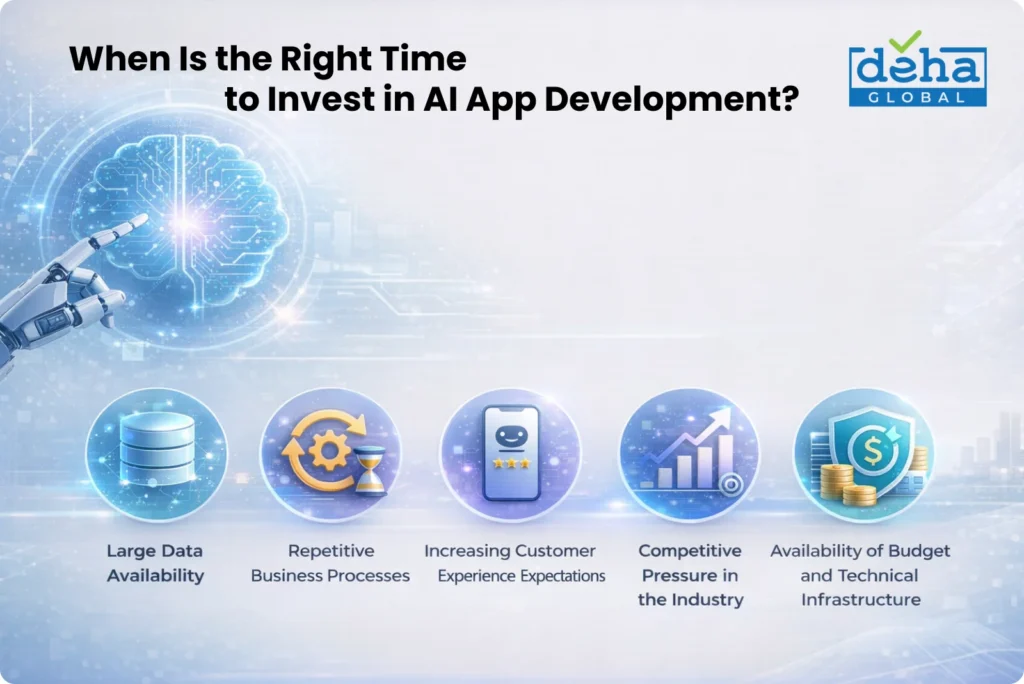
1. Large Data Availability
Organizations that already collect large volumes of structured or unstructured data are well-positioned to invest in AI applications. These datasets provide the foundation required to train machine learning models and generate meaningful insights that support business decisions.
2. Repetitive Business Processes
Businesses that operate repetitive workflows often gain immediate value from AI-powered automation. AI applications can automate routine tasks, reduce human errors, and significantly increase operational efficiency.
3. Increasing Customer Experience Expectations
Companies facing rising expectations for personalized digital experiences should consider AI app development sooner rather than later. AI-driven recommendation systems and intelligent chatbots can enhance customer engagement and improve satisfaction levels.
4. Competitive Pressure in the Industry
Organizations operating in highly competitive markets may need AI solutions to maintain their market position. Competitors that successfully deploy AI-driven platforms often gain advantages in efficiency, innovation, and customer insight.
5. Digital Transformation Initiatives
Many enterprises begin AI app development as part of a broader digital transformation strategy. Integrating artificial intelligence into existing systems can accelerate innovation and enable data-driven decision-making across the organization.
6. Availability of Budget and Technical Infrastructure
Companies that already have cloud infrastructure, data platforms, and digital development teams can adopt AI more efficiently. These resources reduce initial setup costs and enable businesses to scale AI applications more quickly.
How to Estimate AI App Development Cost
Accurately estimating AI app development expenses requires a structured and systematic approach. A step-by-step cost measurement framework helps organizations define project scope, allocate resources, and avoid unexpected financial risks.
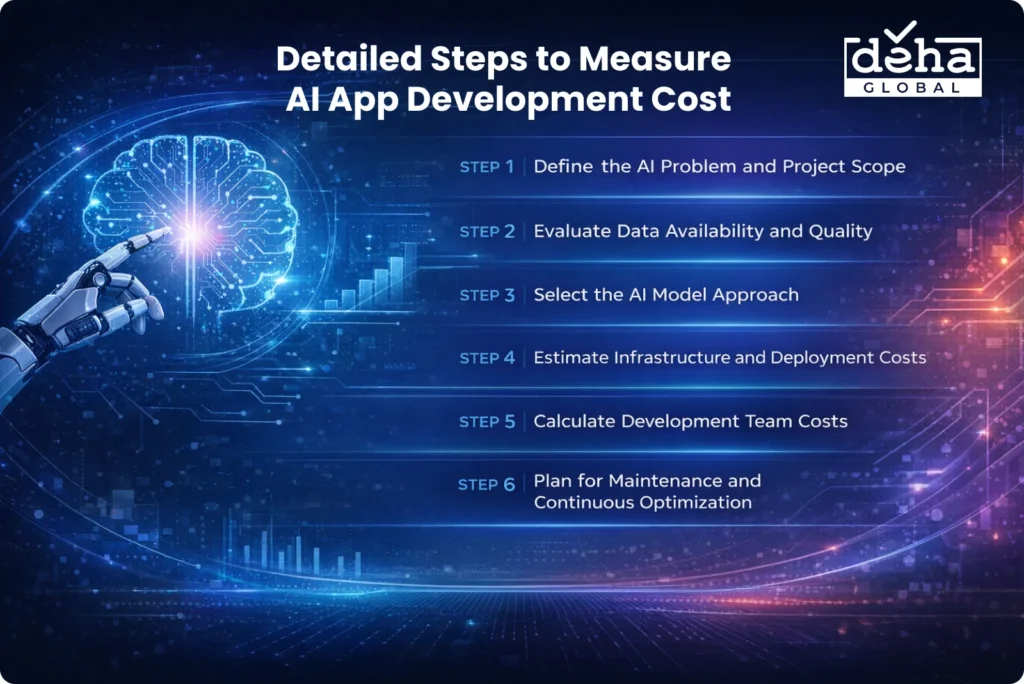
Step 1: Define the AI Problem and Project Scope
Organizations should begin by clearly defining the business problem the AI application will solve. A well-defined scope helps development teams estimate the level of complexity and required resources.
Businesses should focus on identifying specific use cases such as predictive analytics, intelligent chatbots, fraud detection systems, or recommendation engines.
Key considerations include:
- Business objectives and measurable outcomes
- Expected system features and functionalities
- Target users and operational requirements
Step 2: Evaluate Data Availability and Quality
Data is the core component of every AI system, and its quality directly impacts development cost. Companies must evaluate whether existing datasets are sufficient for training machine learning models.
Important tasks in this step include:
- Collecting relevant datasets
- Cleaning and preprocessing data
- Labeling datasets for machine learning models
Organizations should note that data preparation can represent a significant portion of the overall AI app development cost.
Step 3: Select the AI Model Approach
Choosing the right AI model strategy strongly influences the total development budget. Businesses must determine whether they will use pre-trained models, fine-tuned models, or fully customized machine learning systems.
Common AI model approaches include:
- Pre-trained models from providers such as OpenAI or Google
- Fine-tuning existing models with proprietary data
- Developing custom AI algorithms from scratch
Each option offers different trade-offs in cost, accuracy, and development time.
Step 4: Estimate Infrastructure and Deployment Costs
AI systems require computing resources for training, testing, and deployment. Organizations must estimate infrastructure costs related to cloud services, GPU usage, data storage, and AI model hosting.
Key infrastructure components include:
- Cloud computing platforms
- GPU or high-performance computing resources
- Data storage and data pipeline infrastructure
Infrastructure planning ensures the AI system can scale efficiently as data volume increases.
Step 5: Calculate Development Team Costs
AI application development requires a multidisciplinary team with specialized skills. Businesses should estimate labor costs based on the expertise required for the project.
Typical roles in AI development include:
- Data scientists
- Machine learning engineers
- Software developers
- AI solution architects
- DevOps or MLOps specialists
Accurately estimating team resources helps organizations create a realistic development budget.
Step 6: Plan for Maintenance and Continuous Optimization
AI applications require ongoing monitoring, retraining, and optimization after deployment. Companies should include long-term operational costs when calculating the overall AI app development cost.
Important maintenance activities include:
- Model performance monitoring
- Data updates and retraining
- System upgrades and security maintenance
Continuous improvement ensures that AI models remain accurate and relevant as business conditions evolve.
Benefits of Measuring AI App Development Cost Early
Calculating development costs early in the planning phase offers several strategic advantages for businesses. Early cost measurement enables organizations to align AI investments with long-term business objectives.
- Clearer budget allocation: Early cost estimation allows organizations to distribute budgets more effectively across infrastructure, talent, and technology. Businesses can prioritize high-impact AI initiatives without exceeding financial constraints.
- Reduced project risks: Cost forecasting helps identify potential financial risks before development begins. This preparation reduces the chances of unexpected expenses during later stages of the AI project.
- Improved project planning: Companies that measure AI development costs early can establish more realistic timelines and resource plans. Development teams gain a clearer understanding of technical requirements and operational constraints.
- Stronger stakeholder alignment: Cost transparency helps executives, investors, and technical teams align on project expectations. Clear financial planning improves communication and decision-making across departments.
- Higher return on investment: Accurate cost planning enables businesses to focus on AI initiatives that deliver measurable business value. Organizations can prioritize projects with the strongest potential for operational efficiency and revenue growth.
Strategic Factors That Influence AI Development Cost
Successful AI projects require more than technical expertise and development resources. Enterprises must also evaluate strategic, operational, and organizational factors before launching AI app development initiatives.
- Importance of selecting the right AI development approach: Enterprises must choose an AI development approach that aligns with their business goals and technical capabilities. Selecting the right strategy helps control costs while ensuring the AI application delivers practical business value.
- Building an internal AI team vs outsourcing to AI development partners: Some organizations build in-house AI teams to maintain full control over development processes. However, many enterprises choose to collaborate with outsourcing partners to access specialized expertise and reduce development time.
- The role of experienced AI development companies: Experienced AI development companies bring technical knowledge, proven frameworks, and best practices to complex projects. Their experience helps businesses avoid common development pitfalls and accelerate product deployment.
- Need for scalable infrastructure and MLOps pipelines: AI applications require scalable infrastructure capable of handling large datasets and complex model training processes. MLOps pipelines also ensure that AI models can be deployed, monitored, and updated efficiently.
- Security, compliance, and data governance considerations: AI applications often process sensitive business or customer data. Enterprises must implement strong security frameworks, regulatory compliance policies, and effective data governance strategies to protect information assets.
In Conclusion
Estimating the AI app development cost early allows businesses to approach AI investment with greater confidence. Organizations that evaluate the right development timing and measure costs systematically can avoid unnecessary risks. All in all, strategic budgeting ultimately enables enterprises to capture the full value of AI-driven innovation.