


AI app development is no longer an experimental investment. For most enterprises, the real question is not whether to adopt AI, but how to ensure it delivers measurable ROI.
With rising costs across data, infrastructure, and talent, poorly planned AI initiatives can quickly become expensive experiments. This makes ROI a critical metric – not just for evaluation, but for decision-making from day one.
This article explores how businesses can effectively optimize the ROI of an AI Project, providing a roadmap for calculating real returns and understanding how these investments differ from standard applications.
What Is the ROI for AI App Development?
ROI in AI initiatives evaluates the relationship between total project spending and the measurable value generated by the system. Organizations typically analyze ROI to determine whether AI adoption produces sustainable financial or operational benefits over time.
In many enterprise environments, ROI for AI projects do not rely solely on direct revenue generation. Instead, businesses evaluate a broader set of value indicators, including productivity improvements, cost reductions, and enhanced decision accuracy.
Core value dimensions that influence AI ROI:
| ROI Dimension | Business Impact |
| Financial Impact | AI systems can increase revenue streams, reduce operational expenses, and improve overall profit margins. |
| Operational Efficiency | AI automation accelerates workflows, reduces repetitive manual tasks, and minimizes human errors. |
| Customer Experience | AI-driven personalization improves customer engagement, satisfaction, and retention rates. |
| Strategic Advantage | AI enhances predictive analytics, enabling better forecasting and more informed strategic decisions. |
Why ROI from AI evolves over time
Artificial intelligence systems continuously learn from new data inputs. Therefore, the value generated by AI applications typically increases over time as models become more accurate and efficient.
Consequently, organizations often observe gradual ROI improvements rather than immediate financial returns during the early deployment phases.
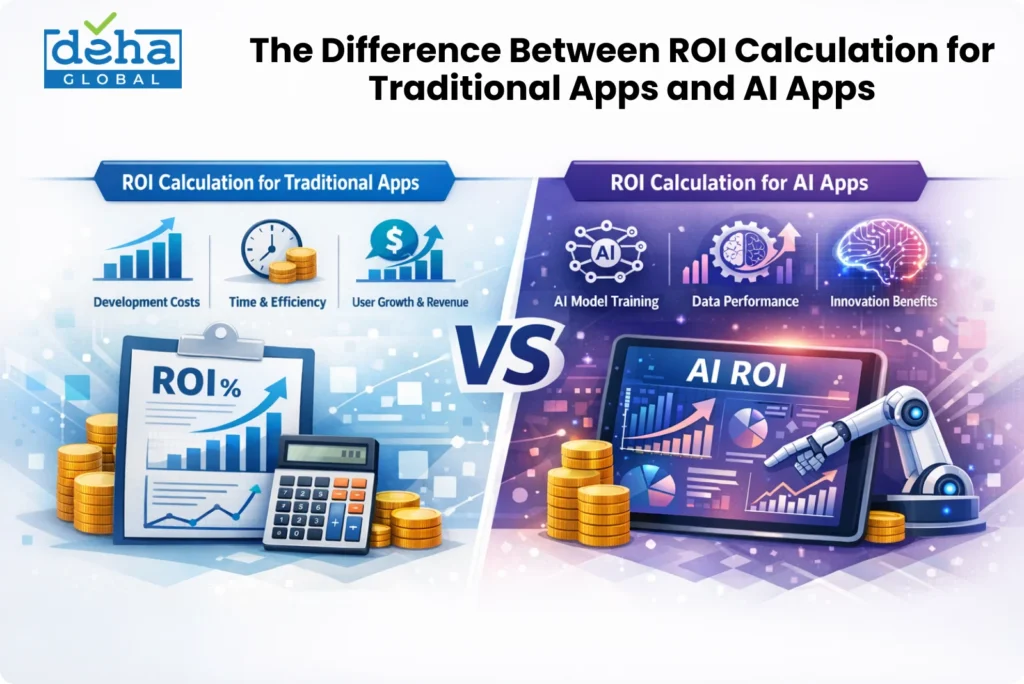
The Difference Between ROI Calculation for Traditional Apps and AI Apps
Traditional software applications and AI-powered systems generate business value through fundamentally different mechanisms. Therefore, the method used to evaluate ROI must adapt to account for the dynamic nature of AI systems.
ROI calculation for traditional software applications
Traditional application ROI calculations usually rely on predictable cost structures and direct monetization models. Businesses typically evaluate the following elements:
- Infrastructure cost
- Revenue generated from the application
- Operational maintenance expenses
The common ROI formula used in traditional software investments is shown below:
| ROI = (Gain from Investment – Cost of Investment) / Cost of Investment |
Traditional software applications generally provide stable and predictable ROI outcomes because their functionality remains relatively fixed after deployment.
ROI calculation for AI-driven applications
AI applications introduce a broader set of value drivers beyond direct revenue generation. Organizations must therefore evaluate both financial and operational outcomes when measuring ROI.
Key ROI contributors in AI systems include:
- Productivity improvements from automation
- Cost reductions in operational processes
- Improved decision-making through predictive analytics
- Enhanced personalization and customer engagement
- Reduced error rates in complex workflows
Because AI systems continuously evolve as new data becomes available, the ROI of AI applications often grows progressively as the models improve.
How to Measure AI App Development ROI: From Theory to Practice
Many organizations struggle to translate theoretical ROI formulas into practical business evaluations. A structured calculation approach helps enterprises estimate potential returns before committing to AI implementation.
Step-by-step framework for estimating AI ROI
Organizations commonly follow several stages when estimating potential ROI from an AI solution:
1. Define clear business objectives and measurable KPIs
2. Establish baseline performance metrics before AI implementation
3. Estimate expected improvements, such as cost reduction or revenue growth
4. Calculate total investment, including development and operational expenses
5. Compare projected gains with total investment
Example scenario of AI ROI calculation
| Metric | Before AI | After AI | Impact |
| Customer Support Cost | $200,000 per year | $120,000 per year | 40% reduction |
| Average Response Time | 12 minutes | 2 minutes | Faster customer service |
| Customer Satisfaction | 70% | 88% | Higher retention |
In this example, AI automation reduces operational costs while improving service quality. These measurable improvements allow businesses to estimate the financial return generated by the AI system.
AI ROI calculation example
| Investment Component | Value |
| AI Development Investment | $150,000 |
| Annual Operational Savings | $90,000 |
| Estimated ROI after two years | Approximately 60% |
The calculation above demonstrates how organizations can translate operational improvements into measurable financial outcomes.
Overview of ROI Calculation Frameworks and Their Limitations
Although ROI frameworks provide valuable insights into AI investment performance, organizations must recognize that AI projects often involve uncertainty and long-term value creation that cannot always be captured through simple financial formulas.
Core components in an AI ROI evaluation model
A comprehensive ROI evaluation model typically considers the following factors:
- Initial development investment
- Infrastructure and cloud expenses
- Data preparation and model training costs
- Revenue growth or operational savings
- Productivity improvements across business processes
These elements help organizations estimate the overall financial impact of AI adoption.
Limitations of AI ROI calculations
Despite structured frameworks, measuring the true ROI of AI initiatives remains challenging for several reasons.
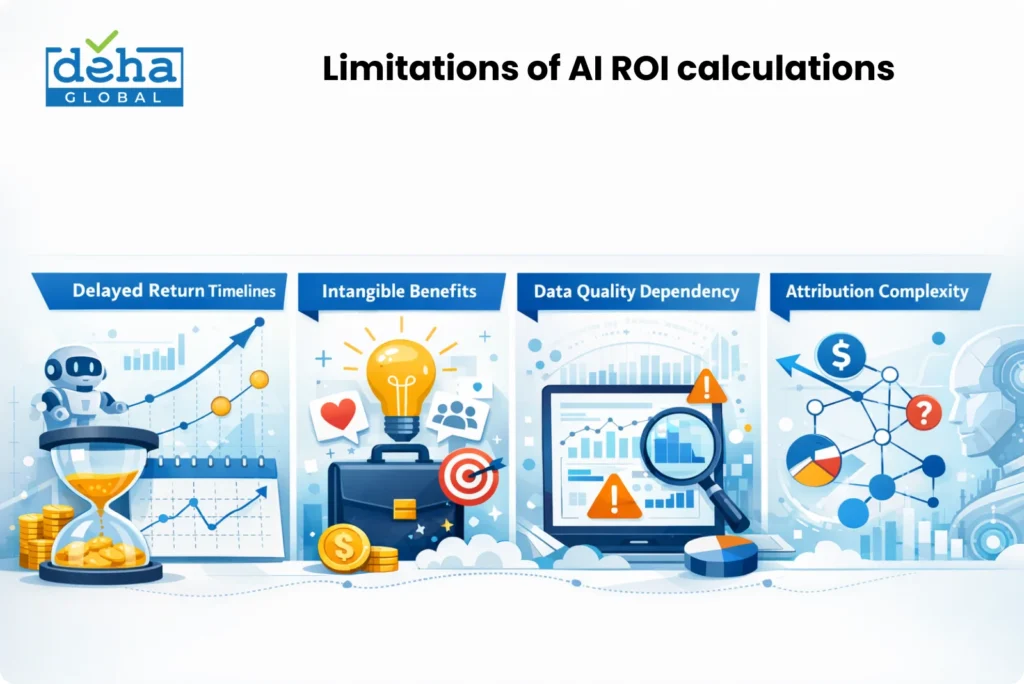
- Delayed return timelines: AI systems often require months of model training, integration, and optimization before generating measurable business impact.
- Intangible business benefits: Some advantages of AI, such as improved decision-making or employee productivity, are difficult to quantify using traditional financial metrics.
- Data quality dependency: The performance of AI systems depends heavily on the quality of available data. Poor or incomplete data can significantly reduce expected ROI outcomes.
- Attribution complexity: In many enterprise environments, human employees and AI systems collaborate to perform tasks. As a result, isolating the exact value generated solely by AI technology can be difficult.
Best practices to improve ROI evaluation
Organizations can improve ROI assessment by applying several strategic practices:
- Defining clear KPIs before AI implementation begins
- Establishing baseline performance metrics
- Tracking operational improvements after deployment
- Evaluating ROI across multiple AI projects rather than a single system
In Conclusion
To achieve significant financial gains, businesses must align their AI initiatives with specific business objectives through a rigorous evaluation of all operational outcomes. Furthermore, the implementation of a structured ROI framework allows leaders to move beyond experimentation and toward a more mature, data-driven investment strategy.
As the market continues to shift, companies that prioritize ROI optimization will be better equipped to handle the rising costs of AI talent and infrastructure. Consequently, by learning how to optimize ROI for AI App Development, your organization can ensure that every technological advancement contributes directly to your long-term success and market resilience.