
AI Development: Four Strategic Pillars That Help CFOs Balance AI Investment Costs
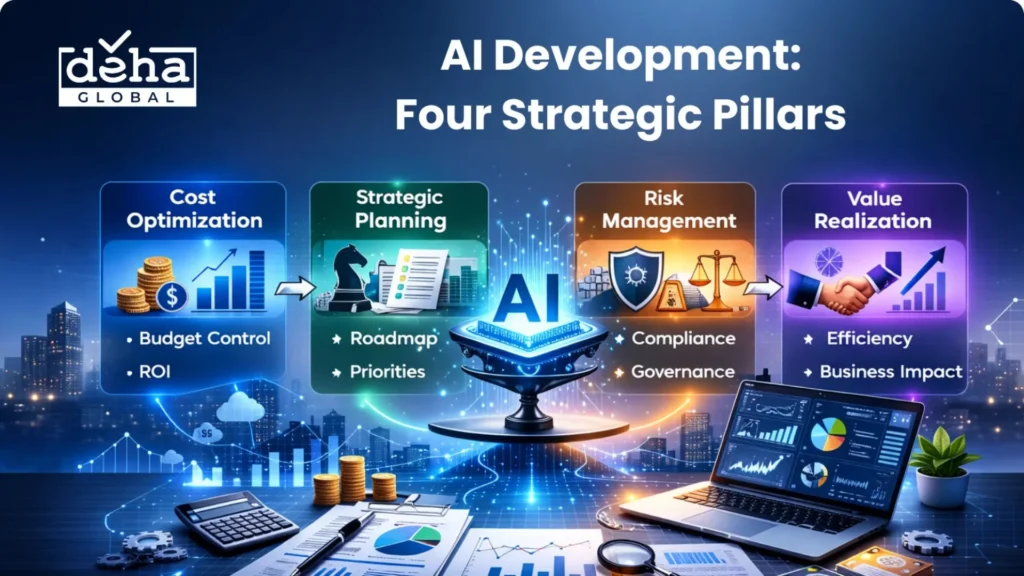
AI continues to accelerate across global enterprises as organizations pursue automation, innovation, and competitive differentiation through AI development. At the same time, rising AI cost has become a primary concern for CFOs as technology budgets expand and financial pressures grow, creating an imbalance between innovation potential and fiscal discipline. In this article, we outline four […]
AI Development Benefits in 2026: Strategic Advantages for Enterprises
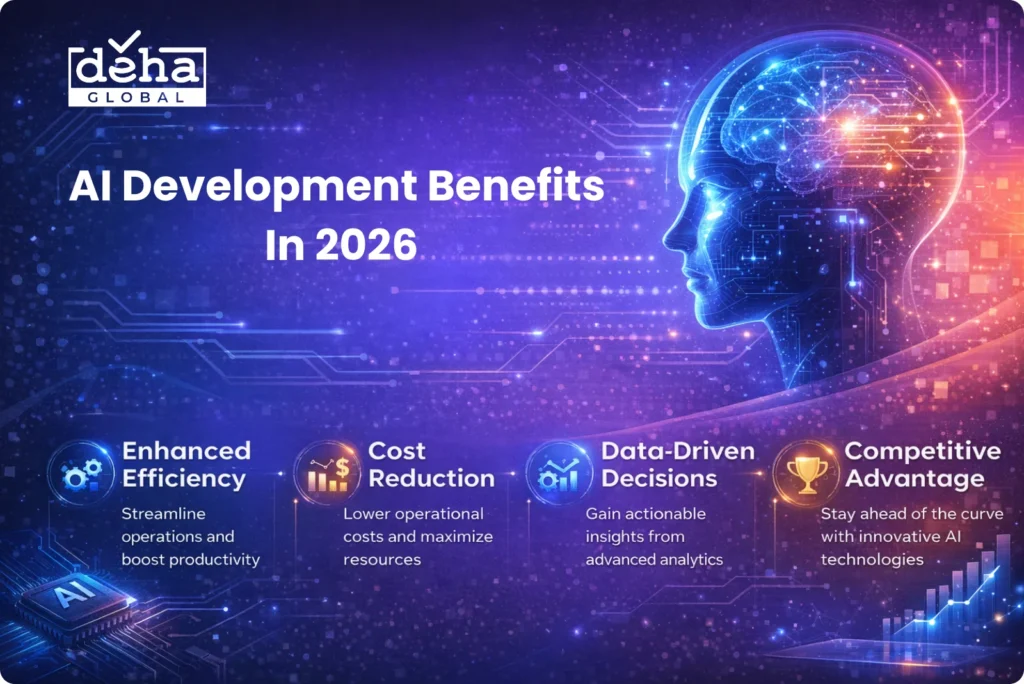
Artificial intelligence (AI) continues to evolve rapidly, and enterprises across industries are integrating AI into their core systems to optimize operations, enhance financial performance, and strengthen management efficiency. A strategic and well-planned approach to AI adoption enables your organization to unlock both immediate improvements in productivity and long term competitive advantages, which clearly demonstrate the growing importance of AI development benefits in modern business strategy. […]
DEHA’s 3-Layer QA Framework: Engineering Quality as a System
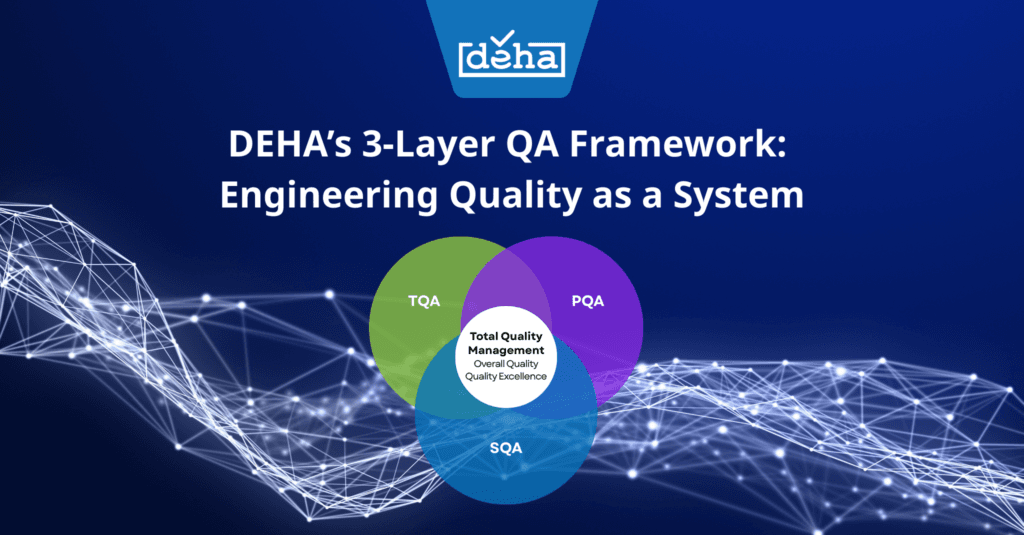
In global IT outsourcing, quality cannot rely on individual expertise or end-of-cycle testing alone. True quality is not an activity — it is a system. At DEHA, we design quality assurance as an operational foundation. Our 3-layer QA framework — TQA, PQA, and SQA — governs technology, process, and delivery outcomes across the entire project […]
A Chatbot Must Go Through 6 Steps to “Understand” Human Language
As global enterprises accelerate their shift toward AI chatbot solutions to streamline operations, many still assume that a chatbot is nothing more than an “automated responder.” The truth is far more complex. A well-designed enterprise AI chatbot must pass through six distinct NLP (Natural Language Processing) stages before it can produce an accurate response. This is […]
The Rise of Emotional AI: Why People Are Starting to “Talk” to Chatbots
In the early days of artificial intelligence, chatbots were seen as mechanical tools — designed to answer questions, automate workflows, and cut customer service costs. But in just a few years, something remarkable has changed. People are no longer using chatbots only for efficiency. They are turning to them for connection — to talk, to share, and even to be understood. Welcome to the Era of Emotional AI — where technology is not only intelligent, but also empathetic. 1. From Interaction […]
The Key Differences Between Traditional Chatbots and GenAI-Powered Chatbots
In today’s digital era, chatbots have become a familiar tool for many businesses. However, the rise of Generative AI (GenAI) marks a major transformation — turning chatbots from simple, rule-based responders into intelligent assistants that can truly understand and communicate like humans. So, what truly differentiates traditional chatbots from the new generation of GenAI-powered chatbots? 1. Traditional Chatbots – Scripted Responders Earlier generations of chatbots were rule-based or keyword-driven, designed to recognize specific inputs and return predefined responses. While this approach automated basic customer support, it came with clear limitations: According to Gartner (2023), more than 70% of traditional chatbots failed to meet user expectations due to their lack of contextual understanding and natural communication. Simply put, old-generation chatbots were machines that answered — not assistants that understood. 2. GenAI Chatbots – Intelligent Assistants Empowered by Understanding The integration of Generative AI and Large Language Models (LLMs) such as GPT, Claude, or Gemini has completely redefined what chatbots can do. These new-generation chatbots can: According to McKinsey (2024), companies adopting GenAI chatbots achieved: GenAI chatbots don’t just reply — they learn, understand, and act on behalf of users. 3. From “Responding” to “Understanding” 4. Real-World Applications These examples demonstrate how GenAI chatbots have evolved from tools to strategic assets — improving efficiency, experience, and brand value. 5. The Global Outlook According to Gartner (2025): “By 2027, 80% of global enterprises will deploy at least one Generative AI application — primarily in customer service and marketing automation.” Meanwhile, IDC (2025) projects the GenAI chatbot market to reach USD 42.3 billion by 2030, growing at a CAGR of 36%. 6. Conclusion: The New Era of Intelligent Dialogue If traditional chatbots were simply machines that reply, GenAI-powered chatbots have become intelligent companions that understand. They move beyond recognizing the question — to recognizing the person behind it. Traditional chatbots answer. GenAI chatbots understand. From “responding correctly” to “understanding deeply” — that’s the true evolution of AI […]
AI Is No Longer Just for Big Corporations — It’s Time for SMEs to Lead
The myth that “AI is only for large enterprises” is outdated For years, many business owners believed that Artificial Intelligence (AI) was a privilege reserved for tech giants — organizations with massive datasets, million-dollar budgets, and teams of data scientists. But in 2025, this belief is no longer true. AI has become a great equalizer […]
How AI Is Revolutionizing E-Commerce Logistics Efficiency
In 2025, the logistics industry is under growing pressure: higher consumer expectations, complex supply chains, and unpredictable global disruptions. According to McKinsey, companies adopting AI-powered logistics have achieved up to 15% cost reduction, 35% lower inventory, and 65% improvement in service levels. This article explores how AI is transforming logistics management—from forecasting and route optimization […]
ChatGPT “Buy” Button & Agentic Commerce: When AI Becomes a Transaction Platform
OpenAI has announced two significant innovations: Instant Checkout – a “Buy” button embedded directly in ChatGPT, and the Agentic Commerce Protocol (ACP) – an open standard that allows AI agents to execute transactions seamlessly without leaving the chat interface (VentureBeat, 2025). This is more than just a feature update—it represents a strategic inflection point. AI […]
AI Development Explained – How Enterprises Can Turn Ideas into Scalable AI Solutions
Artificial Intelligence (AI) is no longer just a futuristic concept—it has become the foundation of modern digital transformation. Enterprises across industries are adopting AI to streamline operations, improve decision-making, and create new business models. Yet, while adoption is accelerating, many organizations still lack a clear understanding of what AI development truly entails and how to […]