
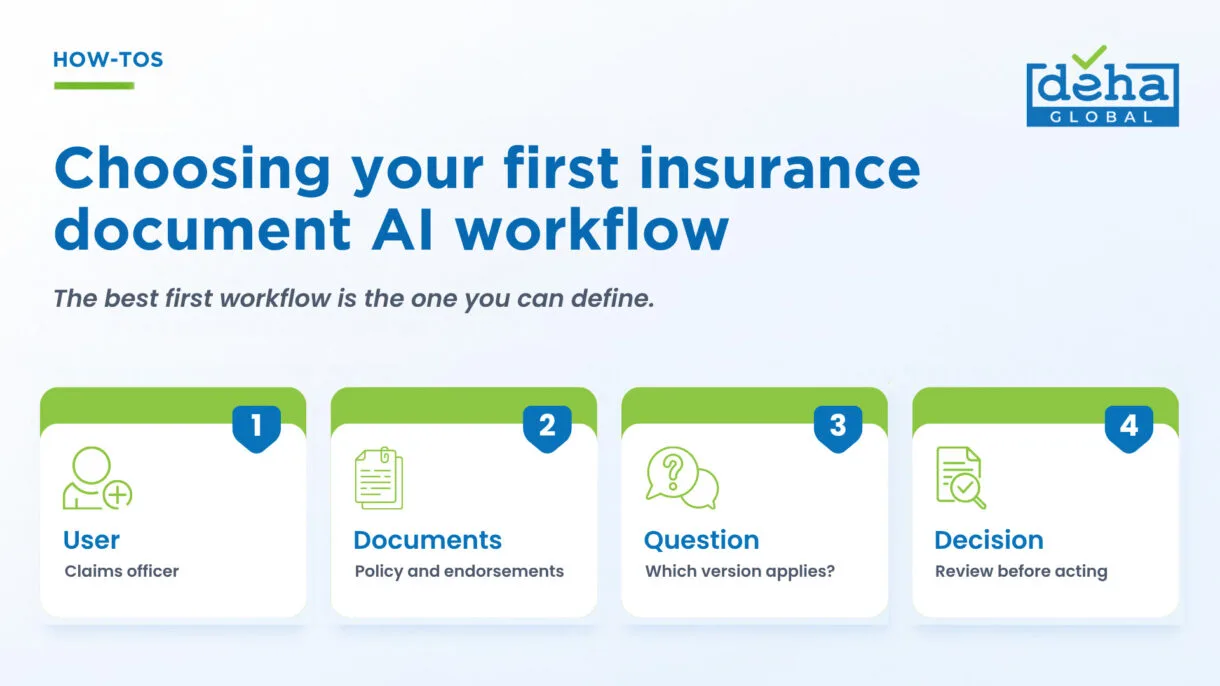
Most insurers start from the biggest pain point. The better first workflow is the one you can define.
Don’t start with “AI transformation”
An insurer runs on documents: policy wording, endorsements, claim files, correspondence, underwriting notes, SOPs, regulatory filings.
Insurance documents are rarely independent. A policy may be amended by endorsements, interpreted against a date of loss, and reviewed alongside claim evidence and internal procedure. That makes version, relationship, and evidence scope part of the workflow itself.
The question is not what AI could do with all of them. The useful question is narrower: which single workflow is small enough to test, important enough to matter, and clear enough to evaluate. One gives the team a defined test. “AI transformation” does not, until it is broken into workflows.
The best first workflow is not the biggest pain point. It is the one you can define.
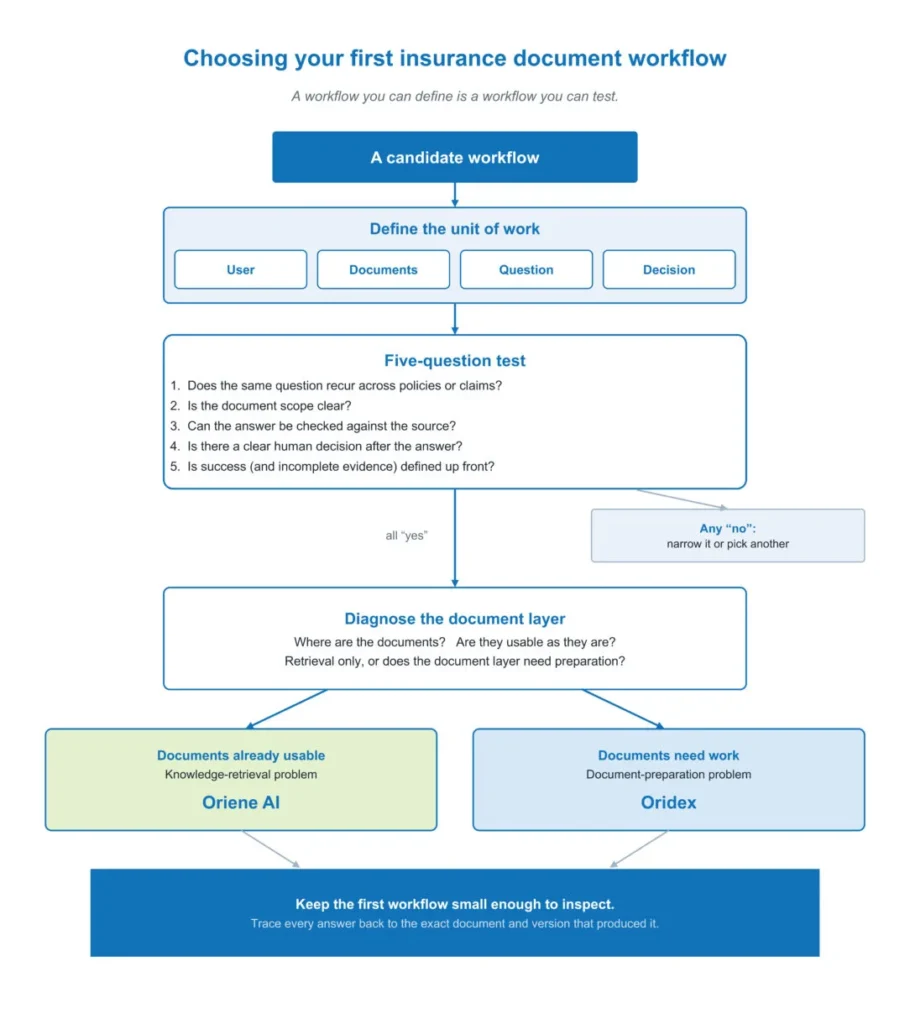
Define the unit of work
Do not start from a chatbot, an LLM, RAG, or OCR. Start from a task:
| Someone needs to find or verify something from a defined set of documents in order to complete a recurring job. |
A workflow you can test has four parts: the user, the documents, the question, and the decision that follows. If you can name all four, you can evaluate it. If you cannot, it is still too broad.
A concrete version:
| A claims officer needs to confirm which policy wording and endorsements were in force on the date of loss. |
Five questions for choosing the first workflow
Run a candidate workflow through five questions. A strong first choice clears all five.
1. Does the same document question recur across policies or claims? A good first workflow has one kind of question that returns again and again. Which clause applies? Which version was in force? Which endorsement changed the base wording? Which supporting document is still missing?
2. Is the document scope clear? You should be able to name what the AI is allowed to search: policy wording, endorsements, claim documents, internal procedures. If the scope is “everything in the company,” it is too wide to start with.
3. Can the answer be checked against the source? A citation does not make an answer correct. It makes the answer inspectable. That is what lets a claims officer decide whether to trust it. For the first workflow, choose a question where a wrong answer can be caught by checking the source.
4. Is there a clear human decision after the answer? The AI supports one defined step. It does not replace the process. The AI retrieves, the officer reviews, the officer decides.
5. Can you define what success looks like before you build it? Success here is operational, not a number. The workflow retrieves the right documents, identifies the relevant version, links the answer back to evidence, and fits the officer’s existing review. A usable workflow should also know when the evidence is incomplete, rather than treating a partial document set as complete. If the team cannot say in advance what “good enough to use” means, the workflow is still too vague.
A practical first-workflow example
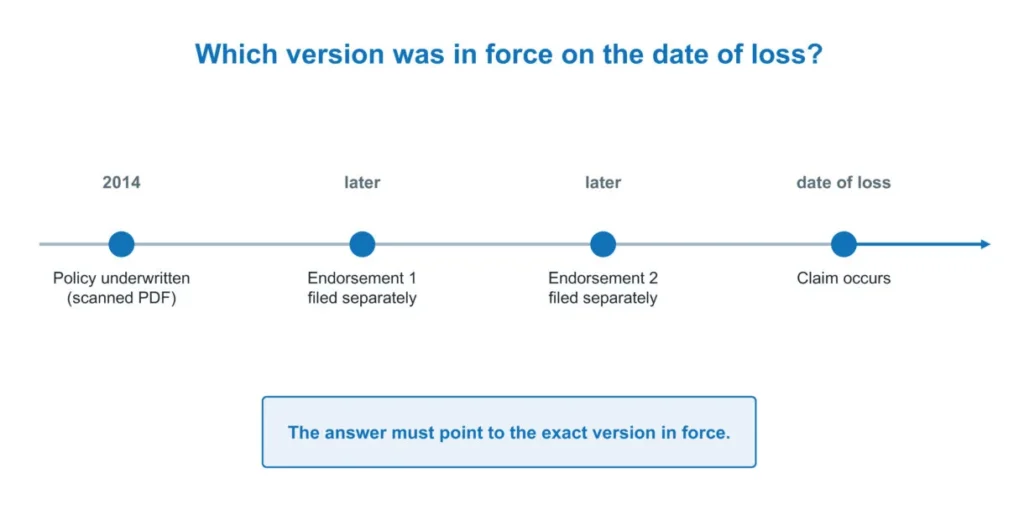
Policy and endorsement retrieval for a claim.
- The policy was originally underwritten in 2014.
- The base policy is stored as a scanned PDF.
- Two endorsements were filed separately over the years.
- A claim occurs later.
- The claims officer needs the version in force on the date of loss.
Mapped against the five questions:
| Question | Why this workflow works |
| Repeated task? | The same retrieval question recurs across claims |
| Defined documents? | Policy wording, endorsements, and the relevant claim documents |
| Verifiable? | The answer can point back to the actual policy and endorsement |
| Human decision? | The claims officer reviews before acting |
| Clear success? | The correct document and version is surfaced, with traceable evidence |
A narrow scope also makes the test easier to evaluate.
What not to choose first
Avoid a first workflow that requires:
- every document source across the insurer;
- multiple departments and systems at once;
- the AI to make the final business decision;
- automated coverage determination;
- automated claim approval or rejection;
- undefined access or security requirements;
- a success test such as “make operations smarter.”
These may become valid later workflows, but they carry more decision risk than a first retrieval-oriented test.
If you cannot describe the workflow in a single sentence, it is probably still too broad to start with.
Diagnose the document layer
Once the workflow is chosen, three questions follow. Answer them in order: location first, then usability, then how much preparation the documents need.
- Where are the documents?
- Are they searchable and extractable in their current form?
- Does the workflow need retrieval only, or does the document layer need preparation first?
These questions separate two different problems. One is a knowledge-retrieval problem. The other is a document-preparation problem.
A scanned base policy with separately filed endorsements may already turn a retrieval problem into a document-preparation problem.
Oriene AI supports the first case: the documents are already usable, and you want a grounded assistant that answers with source references for a specific workflow.
Oridex supports the second: the work sits in the ingestion, extraction, structuring, or indexing of the document layer.
| Which one do you need? Start with the workflow. If the documents are already usable, the knowledge layer may be enough. If they are not, prepare the document layer first. |
Make the first workflow small enough to learn from
A useful first workflow is small enough to inspect. Before you choose one, ask: can the user trace the answer back to the exact document and version that produced it? If not, narrow the workflow again.